An antidote for antifreeze and methanol poisoning
Fomepizole
A hospital antidote that blocks the harmful breakdown of antifreeze and methanol after poisoning.
What is Fomepizole?
Fomepizole is an antidote used to treat poisoning with ethylene glycol, found in antifreeze, and methanol, a type of alcohol. These substances are not very harmful by themselves, but the body turns them into toxic products that damage the kidneys, eyes and other organs. Fomepizole blocks the enzyme that makes those toxic products, buying time for the poison to leave the body safely, sometimes alongside dialysis. It is given by injection in hospital and is a specialist, hospital-only treatment.
Education and reference only. This is a plain-language guide to Fomepizole — it deliberately contains no doses. Doses depend on the person, the brand and the reason for treatment, and belong with your prescriber. Always check the BNF, the product labelling (SmPC) and follow medical advice.
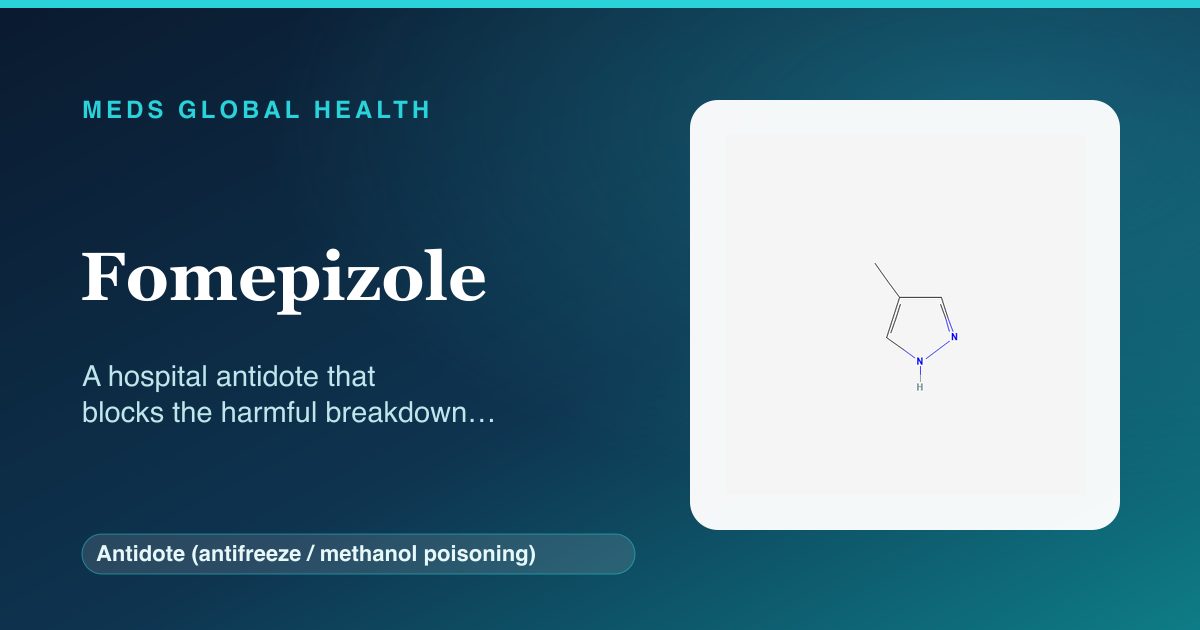
What it is
Fomepizole is an antidote for poisoning with ethylene glycol (the main ingredient of antifreeze) and methanol (a poisonous alcohol sometimes found in illicit or contaminated drinks and some industrial products). It is given by injection into a vein in hospital. Its job is to stop the body converting these substances into the harmful chemicals that cause serious organ damage, while the original poison is gradually cleared. It is a specialist emergency treatment, not a medicine for home use.
How it works
Ethylene glycol and methanol are themselves relatively harmless, but the body uses an enzyme called alcohol dehydrogenase to break them down into toxic acids that injure the kidneys, the eyes and other organs. Fomepizole blocks this enzyme, so the poison is not turned into its harmful products. This gives the body time to remove the unchanged poison through the kidneys, or with the help of dialysis in more severe cases, before serious damage is done.
Company & origin
A specialist antidote used in UK hospitals to treat poisoning with ethylene glycol (antifreeze) and methanol.
Practical use
How to take Fomepizole
General, dose-free guidance — always follow your prescriber's and the leaflet's specific instructions.
- It is given as an infusion into a vein by trained staff in hospital, not taken by mouth or at home.
- It is started as soon as ethylene glycol or methanol poisoning is suspected, because early treatment limits harm.
- It is often used alongside fluids, treatment for the blood's acidity and sometimes dialysis.
- Tell the team what was swallowed, how much and when, if known, as this guides treatment.
- Treatment continues, with regular blood tests, until the poison has been cleared from the body.
Weighing it up
Advantages & disadvantages of Fomepizole
Advantages
- Blocks the formation of the toxic products of antifreeze and methanol, protecting organs.
- Easier to use and monitor than the older approach of giving alcohol (ethanol).
- Can be combined with dialysis to clear the poison more quickly in severe cases.
Disadvantages
- Works best when started early, before much toxic product has formed.
- Is a specialist, hospital-only treatment given by infusion.
- Does not on its own remove the poison, so dialysis and other measures may still be needed.
Practical use
Good to know
Fomepizole is a hospital-only antidote used when ethylene glycol or methanol poisoning is suspected or confirmed. Early treatment matters, because the aim is to block the formation of toxic breakdown products before they have a chance to damage organs. It is often used alongside other measures, including fluids, correcting the blood's acidity, and sometimes dialysis to remove the poison and its products more quickly. Because alcohol (ethanol) competes for the same enzyme, ethanol was historically used for the same purpose, but fomepizole is easier to use and monitor. Treatment continues, with blood tests, until the poison has been cleared. It is given and monitored entirely by the hospital team.
Who should not take it / use with caution
- People with a known allergy to fomepizole or similar medicines.
- It is used under specialist guidance, with the team adjusting treatment if dialysis is also used.
- Its use is limited to hospital settings under close supervision.
Monitoring
- Regular blood tests to track the poison, the blood's acidity and kidney function.
- Monitoring the person's overall condition, including the eyes in methanol poisoning.
- Continuing treatment, sometimes with dialysis, until the poison is cleared.
Side effects
- Headache, nausea or dizziness.
- Reactions at the drip site, or a feeling of warmth during the infusion.
- Less commonly, changes in blood tests or allergic-type reactions.
Key interactions
- Alcohol (ethanol) competes for the same enzyme, so the two are not normally used together.
- Treatment is coordinated with dialysis, which can remove fomepizole and may change how it is given.
- The team considers other medicines and the person's overall condition when planning treatment.
Available as: Solution for infusion into a vein, given by healthcare professionals.
Answers
Fomepizole: frequently asked questions
What is fomepizole used for?
It is an antidote for poisoning with ethylene glycol (antifreeze) and methanol, given in hospital to block the body from turning these into harmful products.
How does it work?
It blocks the enzyme that breaks down antifreeze and methanol into toxic acids, so the poison can be cleared from the body before it damages organs.
Is it given with anything else?
Often yes. It is used alongside fluids, treatment for the blood's acidity and sometimes dialysis to remove the poison more quickly.
Can I take it at home?
No. It is a hospital-only antidote given by infusion into a vein under close supervision.
Why does early treatment matter?
The aim is to block the formation of toxic breakdown products before they damage the kidneys, eyes and other organs, so starting treatment early limits the harm.
Authoritative sources
- BNF
- NICE CKS
Building a medicines information resource?
We create evidence-led, dose-free drug and formulary references for teams.