A hormone-blocking injection for breast cancer
Fulvestrant
A hormone therapy given by injection to treat breast cancer that is driven by the hormone oestrogen.
What is Fulvestrant?
Fulvestrant is a hormone therapy used to treat hormone-receptor-positive breast cancer, the type that is fuelled by the hormone oestrogen. It works by attaching to and breaking down the oestrogen receptor inside cancer cells, so oestrogen can no longer drive the cancer to grow. It is given as an injection into the muscle of the buttock, under specialist care. Common effects include injection-site reactions, hot flushes, bone or joint pain and raised liver enzymes, so it is used and monitored by a specialist team.
Education and reference only. This is a plain-language guide to Fulvestrant — it deliberately contains no doses. Doses depend on the person, the brand and the reason for treatment, and belong with your prescriber. Always check the BNF, the product labelling (SmPC) and follow medical advice.
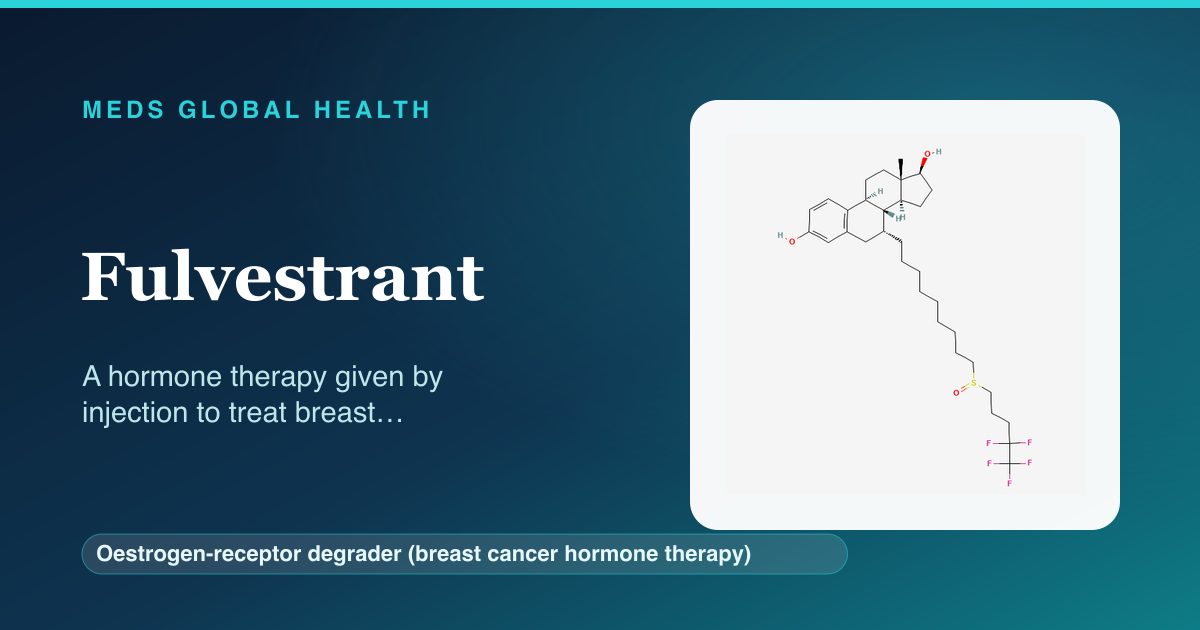
What it is
Fulvestrant is a specialist hormone therapy for breast cancer that is hormone-receptor-positive, meaning the cancer cells carry receptors that respond to the hormone oestrogen and use it to grow. Rather than just blocking these receptors, fulvestrant attaches to them and causes them to be broken down, so the cancer loses its ability to respond to oestrogen. It is given as an injection into the muscle, usually of the buttock, and is used in the treatment of breast cancer that has spread or come back. It is prescribed and supervised by a specialist cancer team, sometimes alongside other targeted treatments.
How it works
In hormone-receptor-positive breast cancer, the hormone oestrogen binds to receptors inside the cancer cells and switches on signals that make the cancer grow. Fulvestrant binds tightly to these oestrogen receptors and triggers their breakdown, reducing the number of working receptors in the cell. With fewer receptors, oestrogen can no longer drive the cancer, so its growth is slowed. Because it is a depot injection, the medicine is released steadily over time, which is why it is given on a regular schedule set by the specialist team, often together with other cancer medicines.
Company & origin
A specialist hormone therapy used in the UK to treat hormone-receptor-positive breast cancer, given by injection.
Practical use
How to take Fulvestrant
General, dose-free guidance — always follow your prescriber's and the leaflet's specific instructions.
- Have it given as an injection into the muscle of the buttock by your specialist team, on the schedule they set.
- Expect the injection site to be sore, especially as two injections are often given at one session.
- Attend for the blood tests that are arranged, as these check your liver among other things.
- Tell your team about hot flushes, bone or joint pain or tiredness, as there may be ways to help.
- Use effective contraception if there is any chance of pregnancy, as it can harm a developing baby.
Weighing it up
Advantages & disadvantages of Fulvestrant
Advantages
- An effective hormone therapy for hormone-receptor-positive breast cancer that has spread or returned.
- Works by breaking down the oestrogen receptor, a different approach from receptor-blocking tablets.
- Often combined with other targeted treatments to improve control of the cancer.
Disadvantages
- Given by injection into the muscle, which can cause soreness at the site.
- Can cause hot flushes, bone or joint pain, tiredness and nausea.
- Can raise liver enzymes, so regular blood tests are needed.
Practical use
Good to know
The key idea behind fulvestrant is that it removes the oestrogen receptor that this type of breast cancer depends on, which is a different approach from medicines that simply block the receptor. It is given by injection into the muscle of the buttock, and because two injections are often given at a session, the site can be sore afterwards. Common effects include hot flushes and other menopausal-type symptoms, bone or joint pain, tiredness and nausea, and blood tests sometimes show raised liver enzymes, which the team checks. It is often used in combination with other targeted cancer treatments, so the overall plan and side effects are managed together by the specialist team. As with other hormone therapies, it can affect a developing baby, so effective contraception is important where relevant.
Who should not take it / use with caution
- People who have had a serious allergic reaction to fulvestrant should not use it.
- It must not be used in pregnancy, as it can harm a developing baby.
- It is used with care in people with significant liver problems or bleeding tendencies, under specialist judgement.
Monitoring
- Regular blood tests, including checks on liver function.
- Reviewing how the cancer responds and how side effects are tolerated.
- Watching for injection-site problems and menopausal-type symptoms.
Side effects
- Pain, redness or a lump at the injection site.
- Hot flushes and other menopausal-type symptoms.
- Bone or joint pain, tiredness, nausea or headache.
- Raised liver enzymes on blood tests, and rarely more serious reactions, which the team monitors.
Key interactions
- It may interact with blood-thinning medicines, so injections are given with care if you take them.
- Tell your team about all your medicines, as it is often combined with other cancer treatments.
- Your specialist team manages how it fits with the rest of your treatment plan.
Available as: A solution for injection into the muscle, given as a depot.
Answers
Fulvestrant: frequently asked questions
What is fulvestrant used for?
It is a hormone therapy used to treat hormone-receptor-positive breast cancer, the type driven by the hormone oestrogen, particularly when it has spread or come back.
How is it given?
It is given as an injection into the muscle of the buttock by your specialist team, often as two injections at one session, on a regular schedule.
How is it different from tablets like tamoxifen?
Rather than just blocking the oestrogen receptor, fulvestrant attaches to it and causes it to be broken down, so the cancer cell loses its ability to respond to oestrogen.
What side effects are common?
Common effects include soreness at the injection site, hot flushes, bone or joint pain, tiredness and nausea, and blood tests sometimes show raised liver enzymes.
Can I take it if I might become pregnant?
No. It must not be used in pregnancy because it can harm a developing baby, so effective contraception is important if there is any chance of pregnancy.
Authoritative sources
- BNF
- NICE CKS
Building a medicines information resource?
We create evidence-led, dose-free drug and formulary references for teams.