A gadolinium-based contrast agent for MRI scans
Gadoterate
A gadolinium-based contrast agent given into a vein to make MRI scan images clearer; it is not a treatment.
What is Gadoterate?
Gadoterate is a gadolinium-based contrast agent used during MRI scans, not a medicine that treats a condition. It is given into a vein so that certain tissues, blood vessels or areas of inflammation show up more clearly on the pictures, helping doctors make a diagnosis. The main safety concerns are allergic-type reactions, a rare scarring condition called nephrogenic systemic fibrosis in people with severe kidney problems, and the fact that small amounts of gadolinium can stay in the body for a time. Most people have it without any trouble.
Education and reference only. This is a plain-language guide to Gadoterate — it deliberately contains no doses. Doses depend on the person, the brand and the reason for treatment, and belong with your prescriber. Always check the BNF, the product labelling (SmPC) and follow medical advice.
What it is
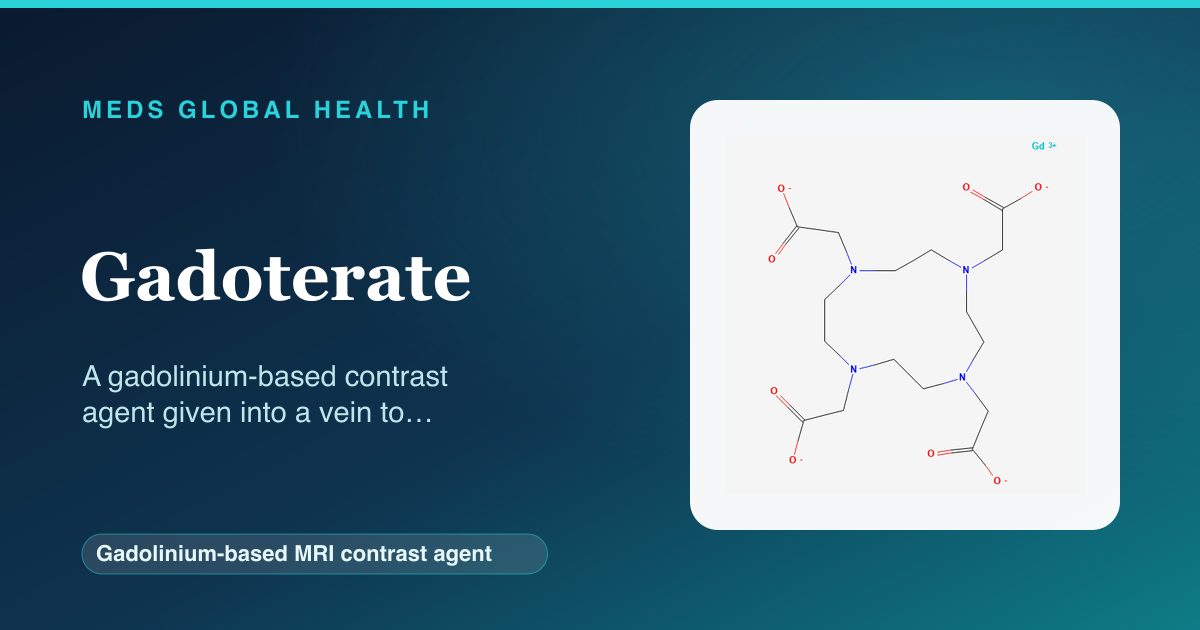
Gadoterate is a contrast agent, a substance given during an MRI scan to make the images sharper and easier to interpret. It contains gadolinium held within a stable carrier so it can be used safely in most people. It is not a treatment for any illness; instead it is a diagnostic aid that helps doctors see tissues, blood vessels, tumours or areas of inflammation more clearly. It is given as an injection into a vein, usually just before or during the scan, by the radiology team.
How it works
Gadolinium changes how nearby tissues respond to the magnetic field used in an MRI scanner, which makes those areas look brighter on the pictures. By highlighting differences between healthy and abnormal tissue, or showing how blood flows through vessels, it helps reveal things that might be hard to see on a plain scan. It works only while it is in the body and is then cleared, mainly through the kidneys. Because it improves the detail of the images rather than acting on the body, it is purely a diagnostic tool.
Company & origin
A contrast agent used in the UK during MRI scans to make certain tissues and blood vessels show up more clearly.
Practical use
How to take Gadoterate
General, dose-free guidance — always follow your prescriber's and the leaflet's specific instructions.
- It is given by the radiology team as an injection into a vein, before or during your MRI scan.
- Tell the team beforehand about any kidney problems, as kidney function may be checked first.
- Tell the team if you have ever had a reaction to a contrast agent or have allergies or asthma.
- Stay as instructed during and after the scan so the team can watch for any reaction.
- Drinking fluids afterwards, if advised, can help your body clear the agent.
Weighing it up
Advantages & disadvantages of Gadoterate
Advantages
- Makes MRI images much clearer, helping doctors reach an accurate diagnosis.
- Given as a single injection for the scan rather than as ongoing treatment.
- A more stable type of gadolinium agent, generally well tolerated in most people.
Disadvantages
- It is a diagnostic aid, not a treatment, so it does not help any condition directly.
- Carries a rare risk of a scarring condition in people with severe kidney problems.
- Can occasionally cause allergic-type reactions, and small amounts may stay in the body for a time.
Practical use
Good to know
The most important thing to understand is that gadoterate is a contrast agent for scans, not a treatment, so it is given once for the purpose of an MRI rather than taken regularly. Most people have it with no problems, but two safety points matter. First, in people with severe kidney problems there is a small risk of a rare scarring condition called nephrogenic systemic fibrosis, which is why kidney function is often checked before contrast is given. Second, like all such agents it can occasionally cause an allergic-type reaction, so the radiology team watches you during and after the scan. It is also known that tiny amounts of gadolinium can stay in the body, including the brain, for a time; current evidence does not link this to harm, but agents like gadoterate are chosen partly because they are more stable. Tell the team if you are pregnant, breastfeeding, have kidney problems or have reacted to contrast before.
Who should not take it / use with caution
- People who have had a serious allergic reaction to gadoterate or similar agents should not be given it.
- It is used with great caution, or avoided, in people with severe kidney problems because of the rare scarring risk.
- It is used with care in pregnancy and breastfeeding, where the team weighs the need for the scan against the risks.
Monitoring
- Checking kidney function before contrast in people who may be at risk.
- Watching for allergic-type reactions during and after the scan.
- Reviewing your history of allergies and previous contrast reactions beforehand.
Side effects
- A feeling of warmth, coldness or mild discomfort where the injection is given.
- Nausea, headache or a temporary odd taste in the mouth in some people.
- Less commonly, allergic-type reactions; rarely, in people with severe kidney problems, a scarring condition called nephrogenic systemic fibrosis.
Key interactions
- There are few routine medicine interactions, but tell the team about all medicines you take.
- Kidney problems and medicines that affect the kidneys are the main thing the team checks before giving it.
- It is used alongside, not instead of, the team's normal precautions for contrast scans.
Available as: A solution given as an injection into a vein.
Answers
Gadoterate: frequently asked questions
What is gadoterate used for?
It is a contrast agent given during an MRI scan to make tissues, blood vessels and abnormal areas show up more clearly, helping doctors make a diagnosis. It is not a treatment.
Is it safe?
Most people have it without any problems. The main risks are allergic-type reactions and, in people with severe kidney problems, a rare scarring condition, which is why kidney function may be checked first.
Why does the team ask about my kidneys?
In people with severe kidney problems there is a small risk of a rare condition called nephrogenic systemic fibrosis, so kidney function is often checked before the contrast is given.
Does the gadolinium stay in my body?
Small amounts can stay in the body for a time, but current evidence does not link this to harm, and more stable agents like gadoterate are chosen partly for this reason.
Will it treat my condition?
No. Gadoterate is only a diagnostic aid that improves the scan images; it does not treat any illness.
Authoritative sources
- BNF
- NICE CKS
Building a medicines information resource?
We create evidence-led, dose-free drug and formulary references for teams.