Gonadotrophin-releasing hormone (GnRH)
Gonadorelin
A copy of the natural releasing hormone, used mainly as a test of how the pituitary gland is working.
What is Gonadorelin?
Gonadorelin is a man-made copy of the body's natural gonadotrophin-releasing hormone (GnRH), which the brain normally uses to tell the pituitary gland to release two hormones, LH and FSH, that control the ovaries and testes. It is used mainly as a test of pituitary function: it is given by injection, and blood tests then check whether the pituitary responds by releasing LH and FSH as expected. This helps doctors find out why hormone or fertility problems are happening. It is given in a clinic setting and is generally well tolerated.
Education and reference only. This is a plain-language guide to Gonadorelin — it deliberately contains no doses. Doses depend on the person, the brand and the reason for treatment, and belong with your prescriber. Always check the BNF, the product labelling (SmPC) and follow medical advice.
What it is
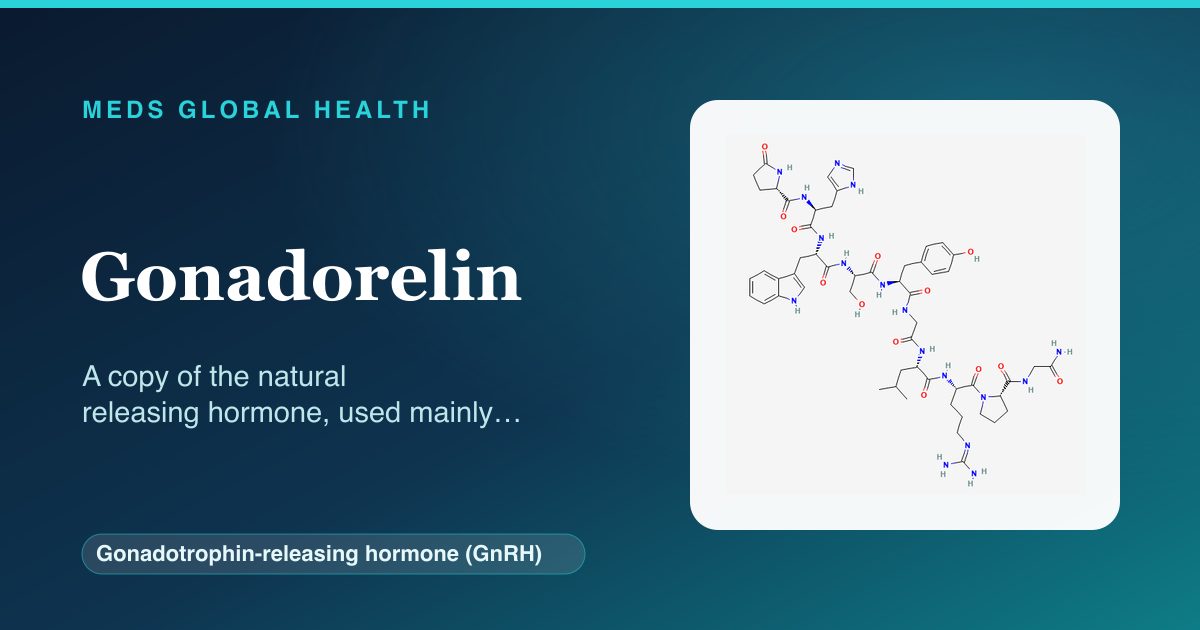
Gonadorelin is a synthetic version of gonadotrophin-releasing hormone (GnRH), a natural hormone made in part of the brain called the hypothalamus. Normally, GnRH signals the nearby pituitary gland to release two hormones — luteinising hormone (LH) and follicle-stimulating hormone (FSH) — which in turn control the ovaries and testes, periods and fertility. Gonadorelin is used mainly as a diagnostic test: by giving it and then measuring how much LH and FSH the pituitary releases, doctors can check whether the pituitary gland is working normally. It is given by injection in a clinic.
How it works
The brain normally releases GnRH in pulses to tell the pituitary gland to send out LH and FSH, which then act on the ovaries or testes. When gonadorelin is given, it lands on the same pituitary receptors and prompts a burst of LH and FSH. By taking blood samples before and after the injection, doctors can see how well the pituitary responds — a normal rise suggests the gland is working, while a poor response can point to where a hormone problem lies. It is the testing role, rather than ongoing treatment, that gonadorelin is mainly used for.
Company & origin
A man-made copy of the body's natural releasing hormone, used in the UK mainly as a test of pituitary gland function.
Practical use
How to take Gonadorelin
General, dose-free guidance — always follow your prescriber's and the leaflet's specific instructions.
- It is given as an injection by a healthcare professional, usually as part of a planned test in a clinic.
- You will normally have blood samples taken before and at intervals after the injection to measure the hormone response.
- Follow any instructions about the timing of the test, including in relation to the menstrual cycle if relevant.
- Tell the team if you feel unwell during the test, although reactions are usually mild and brief.
- Ask the team to explain your results, as the test is used to help diagnose the cause of a hormone or fertility problem.
Weighing it up
Advantages & disadvantages of Gonadorelin
Advantages
- Provides a useful test of how well the pituitary gland releases LH and FSH.
- Helps doctors find the cause of problems with periods, puberty or fertility.
- Given under supervision as a short clinic test, with usually only mild and brief effects.
Disadvantages
- It is mainly a diagnostic test rather than an ongoing treatment.
- Requires an injection and a series of blood samples over a short period.
- Results can sometimes be hard to interpret and may need further tests.
Practical use
Good to know
Gonadorelin is most often used as a one-off test in a clinic rather than a medicine you take at home. The test involves an injection followed by a series of blood samples over a short period to measure the LH and FSH response, helping to work out why periods, puberty or fertility may not be developing as expected. It is generally well tolerated, with only mild and short-lived effects such as flushing, a headache or some discomfort or swelling where the injection is given. Because it is given under supervision, the team will explain what to expect and look after you during the test. It is quite different from the long-acting GnRH-type medicines used to treat conditions such as prostate cancer or endometriosis, which work by switching the system off rather than testing it.
Who should not take it / use with caution
- It is used with caution in anyone who has had an allergic reaction to it before.
- The team will check whether the test is suitable in pregnancy or particular hormone conditions.
- It is not the same as, and should not be confused with, long-acting GnRH medicines used to treat cancer or endometriosis.
Monitoring
- Blood samples for LH and FSH taken before and after the injection to measure the response.
- Observation during the test for any reaction, as it is given under supervision.
- Reviewing the results alongside other tests to reach a diagnosis.
Side effects
- Usually mild; flushing, headache or feeling slightly unwell around the time of the injection.
- Discomfort, redness or swelling where the injection is given.
- Rarely, an allergic-type reaction, which is why it is given under supervision.
Key interactions
- Several hormone medicines, including some contraceptives and steroids, can affect the LH and FSH response, so the team will review what you take.
- Other pituitary or sex-hormone treatments may need to be considered when interpreting the test.
- Medicines that affect prolactin can also influence the results.
Available as: An injection given by a healthcare professional, usually as part of a clinic test.
Answers
Gonadorelin: frequently asked questions
What is gonadorelin used for?
It is a copy of the natural releasing hormone GnRH, used mainly as a test to check how well the pituitary gland releases the hormones LH and FSH.
How is the test done?
It is given as an injection by a healthcare professional, and blood samples are taken before and after to measure the rise in LH and FSH.
Will the test make me feel unwell?
Most people have only mild, brief effects such as flushing, a headache or some discomfort where the injection is given.
Is it the same as the GnRH medicines used for prostate cancer?
No. Those are long-acting GnRH-type medicines that switch the hormone system off as a treatment; gonadorelin is used as a short test of pituitary function.
What will the results tell my doctor?
How the pituitary responds helps show whether the gland is working normally and can point to the cause of problems with periods, puberty or fertility.
Authoritative sources
- BNF
- NICE CKS
Building a medicines information resource?
We create evidence-led, dose-free drug and formulary references for teams.