A non-stimulant for ADHD
Guanfacine
A non-stimulant medicine for ADHD, mainly in children and teenagers, that can also lower blood pressure.
What is Guanfacine?
Guanfacine is a non-stimulant medicine used mainly to treat attention deficit hyperactivity disorder (ADHD), chiefly in children and teenagers, often when stimulant medicines have not suited or are not enough. It works on the brain to improve attention and reduce impulsiveness and overactivity, and because it also relaxes blood vessels it can lower blood pressure too. It commonly causes drowsiness, especially at first. Importantly, it must not be stopped suddenly, as this can cause blood pressure to rebound and rise, so any change is made gradually under medical guidance.
Education and reference only. This is a plain-language guide to Guanfacine — it deliberately contains no doses. Doses depend on the person, the brand and the reason for treatment, and belong with your prescriber. Always check the BNF, the product labelling (SmPC) and follow medical advice.
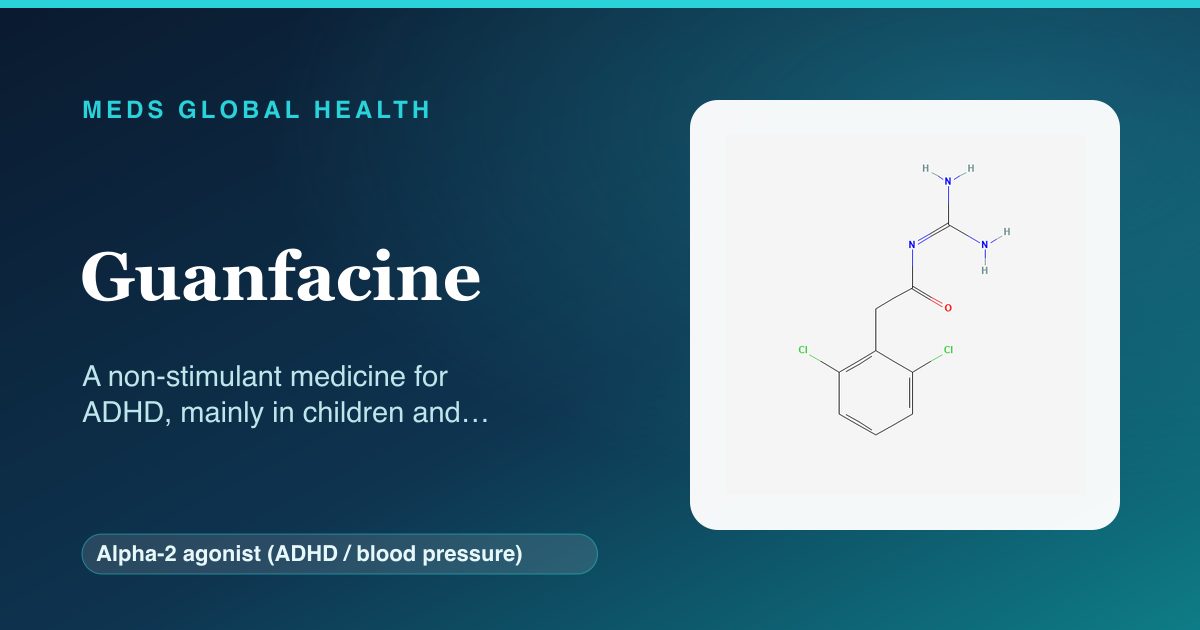
What it is
Guanfacine is a non-stimulant medicine, given as a prolonged-release tablet (brand name Intuniv), used mainly to treat attention deficit hyperactivity disorder (ADHD) in children and teenagers, usually as part of a wider treatment programme. It is often used when stimulant medicines are not suitable, are not tolerated or do not give enough benefit. It belongs to a group of medicines (alpha-2 agonists) that were originally developed to lower blood pressure, and it can still have this effect, which is why blood pressure and heart rate are monitored during treatment.
How it works
Guanfacine acts on alpha-2 receptors in a part of the brain involved in attention and self-control, which is thought to strengthen the signals that help with concentration and reduce impulsive, overactive behaviour. The same type of receptor action on the nervous system relaxes blood vessels and slows the heart slightly, which lowers blood pressure. This dual effect is why it helps ADHD symptoms but also needs monitoring of blood pressure and heart rate, and why it should never be stopped abruptly.
Company & origin
Originated / developed by: Takeda.
A non-stimulant medicine used in the UK mainly for attention deficit hyperactivity disorder (ADHD), chiefly in children and teenagers.
Practical use
How to take Guanfacine
General, dose-free guidance — always follow your prescriber's and the leaflet's specific instructions.
- Take the prolonged-release tablet once a day at about the same time, swallowed whole and not crushed or broken.
- Do not take it with a high-fat meal, as this can increase how much medicine is absorbed.
- Never stop it suddenly; the dose must be reduced gradually under medical guidance.
- See how it affects alertness before doing things that need full concentration, such as driving, as it can cause drowsiness.
- Keep regular appointments so blood pressure, pulse and weight can be checked.
Weighing it up
Advantages & disadvantages of Guanfacine
Advantages
- A non-stimulant option for ADHD, useful when stimulants are unsuitable or not enough.
- Can improve attention and reduce impulsiveness and overactivity.
- Taken once a day as a prolonged-release tablet.
Disadvantages
- Commonly causes drowsiness and tiredness, especially when starting.
- Must not be stopped suddenly, as blood pressure can rebound and rise.
- Needs regular checks of blood pressure, pulse and weight.
Practical use
Good to know
Two points matter most. First, guanfacine commonly causes drowsiness and tiredness, especially in the first few weeks, so it is important to see how it affects activities such as schoolwork, and to avoid driving or operating machinery if affected. Second, it must not be stopped suddenly: stopping abruptly can cause blood pressure to rebound and rise and the heart rate to climb, so the dose is reduced gradually under medical guidance when stopping. Because it can lower blood pressure and slow the heart, blood pressure, pulse and weight are checked during treatment. Fainting can occasionally happen. It is taken at the same time each day and should not be taken with a high-fat meal, which can increase how much is absorbed.
Who should not take it / use with caution
- It is used with caution in young people with heart-rhythm or heart-conduction problems, or a history of fainting.
- Care is needed in those with low blood pressure or who take other medicines that lower blood pressure or slow the heart.
- It should be used cautiously alongside other sedating medicines, which add to drowsiness.
Monitoring
- Checking blood pressure, pulse and weight before and during treatment.
- Reviewing how well ADHD symptoms are controlled and how much drowsiness occurs.
- Reducing the dose gradually, never stopping suddenly, when treatment is changed or stopped.
Side effects
- Drowsiness, tiredness and headache are common, especially at the start.
- Stomach pain, low blood pressure, a slow heartbeat or dizziness can occur.
- Less often, mood changes or fainting; stopping suddenly can cause a rebound rise in blood pressure.
Key interactions
- Other sedating medicines, and alcohol in older teenagers, add to drowsiness.
- Medicines that lower blood pressure or slow the heart can add to those effects.
- Medicines that strongly affect liver enzymes can raise or lower guanfacine levels and may need a dose change.
Available as: Prolonged-release tablets taken by mouth once a day.
Answers
Guanfacine: frequently asked questions
Is guanfacine a stimulant?
No. It is a non-stimulant medicine for ADHD, often used when stimulant medicines are not suitable, not tolerated or not enough on their own.
Why must it not be stopped suddenly?
Stopping abruptly can cause blood pressure to rebound and rise and the heart rate to climb, so the dose is reduced gradually under medical guidance.
Will it make my child sleepy?
Drowsiness and tiredness are common, especially in the first few weeks, so watch how it affects schoolwork and activities that need concentration.
Why are blood pressure and pulse checked?
Guanfacine can lower blood pressure and slow the heart, so blood pressure, pulse and weight are checked before and during treatment.
How should it be taken?
It is taken once a day as a prolonged-release tablet, swallowed whole, and should not be taken with a high-fat meal, which can increase absorption.
Authoritative sources
- BNF
- NICE CKS
Building a medicines information resource?
We create evidence-led, dose-free drug and formulary references for teams.