A dye used to light up bladder cancer during a camera test
Hexaminolevulinate
A dye put into the bladder that makes cancer tissue glow under blue light during a camera examination.
What is Hexaminolevulinate?
Hexaminolevulinate is a specialist diagnostic dye, not a treatment. It is placed into the bladder through a thin tube before a camera examination (cystoscopy). Bladder-cancer cells take it up and then glow pink-red when blue light is shone on them, which is why this is called 'blue-light cystoscopy'. This helps the surgeon spot abnormal areas that can be hard to see in ordinary white light, so more of the cancer can be found and removed. The main side effect is mild bladder irritation, and serious allergic reactions are rare.
Education and reference only. This is a plain-language guide to Hexaminolevulinate — it deliberately contains no doses. Doses depend on the person, the brand and the reason for treatment, and belong with your prescriber. Always check the BNF, the product labelling (SmPC) and follow medical advice.
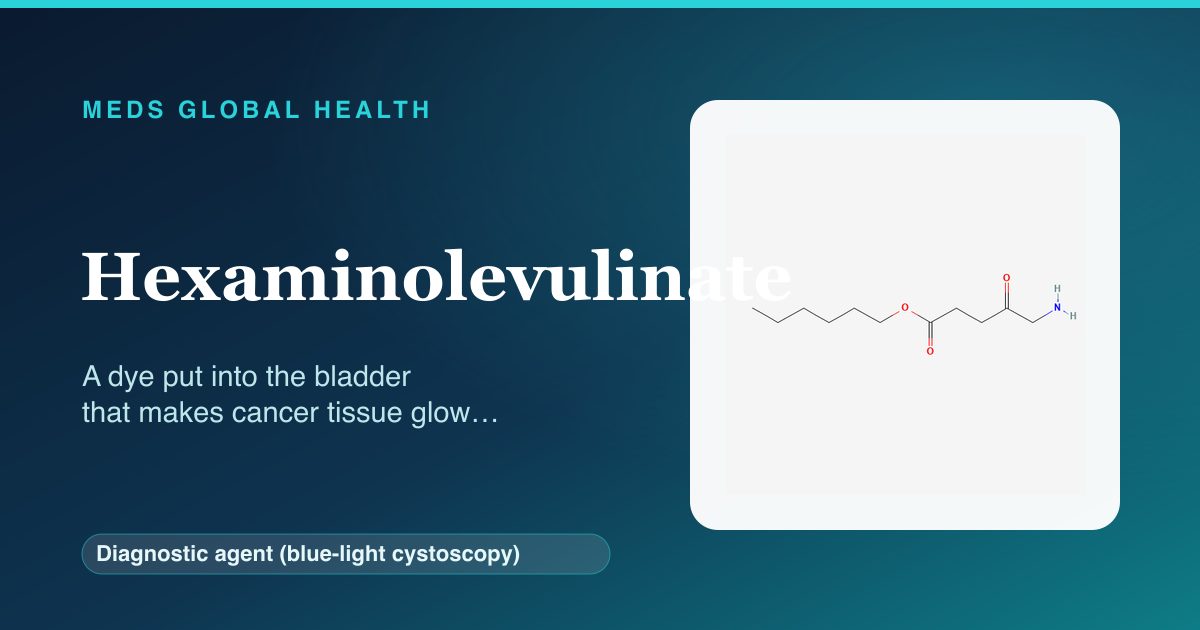
What it is
Hexaminolevulinate is a diagnostic dye used to help find bladder cancer during a camera examination of the bladder. It is instilled (placed) into the bladder through a thin tube and left there for a while before the examination. It is not a medicine that treats the cancer; instead, it acts as a marker that makes cancer tissue stand out. The surgeon then uses a special cystoscope that can switch between ordinary white light and blue light, so abnormal areas glow and are easier to see. It is used in hospital as part of a specialist procedure.
How it works
When hexaminolevulinate is left in the bladder, cancerous and pre-cancerous cells take it up and build up a substance inside themselves that fluoresces, meaning it glows, when blue light is shone on it. Normal bladder lining glows much less, so the abnormal areas appear bright pink-red against the darker background. This 'blue-light' or 'fluorescence' cystoscopy helps the surgeon see tumours, including small or flat ones, that can be easy to miss under ordinary white light. By making these areas visible, it helps guide a more complete examination and removal of bladder cancer.
Company & origin
A specialist diagnostic dye used in the UK during bladder examinations to help surgeons see bladder cancer more clearly.
Practical use
How to take Hexaminolevulinate
General, dose-free guidance — always follow your prescriber's and the leaflet's specific instructions.
- It is given by the hospital team, placed into your bladder through a thin tube before your camera examination.
- You will be asked to hold the dye in your bladder for the recommended time so it can work before the examination.
- It is a one-off diagnostic step during your procedure, not a medicine you take at home.
- Tell the team beforehand about any allergies, bladder infections or inflammation, or recent bladder treatments.
- Expect possibly needing to pass urine more often or a little discomfort afterwards, which usually settles quickly.
Weighing it up
Advantages & disadvantages of Hexaminolevulinate
Advantages
- Helps surgeons see bladder cancer, including small or flat tumours, that can be missed under ordinary white light.
- Can help find more of the cancer so more of it is removed during the procedure.
- Used as a single step during an examination you are already having.
Disadvantages
- It is only a diagnostic aid and does not treat or cure bladder cancer.
- Can cause mild bladder irritation, such as more frequent or uncomfortable passing of urine.
- Needs special blue-light equipment and is only used in hospital during a procedure.
Practical use
Good to know
The key thing to understand is that hexaminolevulinate is a diagnostic aid, not a treatment: it helps the surgeon see bladder cancer better during a camera test, but it does not itself kill or shrink the cancer. It is used once, in hospital, as part of your bladder examination, rather than something you take at home. After the dye is placed in the bladder you will be asked to hold it in for a set time, then the examination is done with blue light. The most common after-effects are mild bladder irritation, such as needing to pass urine more often or a little discomfort or burning, which usually settles quickly. Serious allergic reactions are rare. Tell the team if you have had reactions to similar dyes before, or if you have any bladder inflammation or infection, as these can affect whether and how it is used.
Who should not take it / use with caution
- People who have had a serious allergic reaction to hexaminolevulinate or similar substances should not be given it.
- It is used with care, or avoided, in people with active bladder inflammation or infection, guided by the team.
- It is only used in hospital, by a specialist team, as part of a bladder examination.
Monitoring
- Watching for any allergic-type reaction during and shortly after the procedure.
- Checking for bladder irritation or discomfort afterwards, which usually settles on its own.
- Reviewing the findings from the examination to plan any further treatment.
Side effects
- Mild bladder irritation, such as needing to pass urine more often, urgency or a little burning, usually settling soon.
- Bladder discomfort or a small amount of blood in the urine after the procedure in some people.
- Rarely, allergic-type reactions, which the hospital team is prepared to deal with.
Key interactions
- There are few well-established routine medicine interactions, but tell the team about all your medicines.
- Recent bladder treatments or inflammation can affect how clearly the dye shows abnormal areas, so mention these.
- Let the team know about any previous reactions to dyes or similar substances.
Available as: A powder made up into a solution that is placed into the bladder through a thin tube.
Answers
Hexaminolevulinate: frequently asked questions
What is hexaminolevulinate used for?
It is a diagnostic dye placed into the bladder before a camera examination, making bladder-cancer tissue glow under blue light so the surgeon can see it more clearly.
Is it a treatment for bladder cancer?
No. It is a diagnostic aid that helps the surgeon find the cancer during a camera test; it does not itself treat or shrink the cancer.
How is it given?
It is placed into your bladder through a thin tube in hospital and held there for a set time before the blue-light examination.
Will it cause side effects?
The most common after-effect is mild bladder irritation, such as passing urine more often or a little discomfort, which usually settles quickly; serious allergic reactions are rare.
Why is blue light used?
Cancer cells take up the dye and glow pink-red under blue light, making abnormal areas stand out that can be hard to see in ordinary white light.
Authoritative sources
- BNF
- NICE CKS
Building a medicines information resource?
We create evidence-led, dose-free drug and formulary references for teams.