A vasodilator for high blood pressure
Hydralazine
A vasodilator that relaxes artery walls, used for high blood pressure and in heart failure.
What is Hydralazine?
Hydralazine is a blood pressure medicine that works by relaxing the muscle in the walls of the arteries, so they widen and blood flows more easily. It is used for high blood pressure, including in pregnancy, and in heart failure where it is usually combined with a nitrate medicine. Because it widens the arteries, it can cause a fast heartbeat, flushing, headache and fluid retention, so it is often given with other medicines that balance these effects. Rarely, long-term use can trigger a lupus-like reaction with joint and skin symptoms.
Education and reference only. This is a plain-language guide to Hydralazine — it deliberately contains no doses. Doses depend on the person, the brand and the reason for treatment, and belong with your prescriber. Always check the BNF, the product labelling (SmPC) and follow medical advice.
What it is
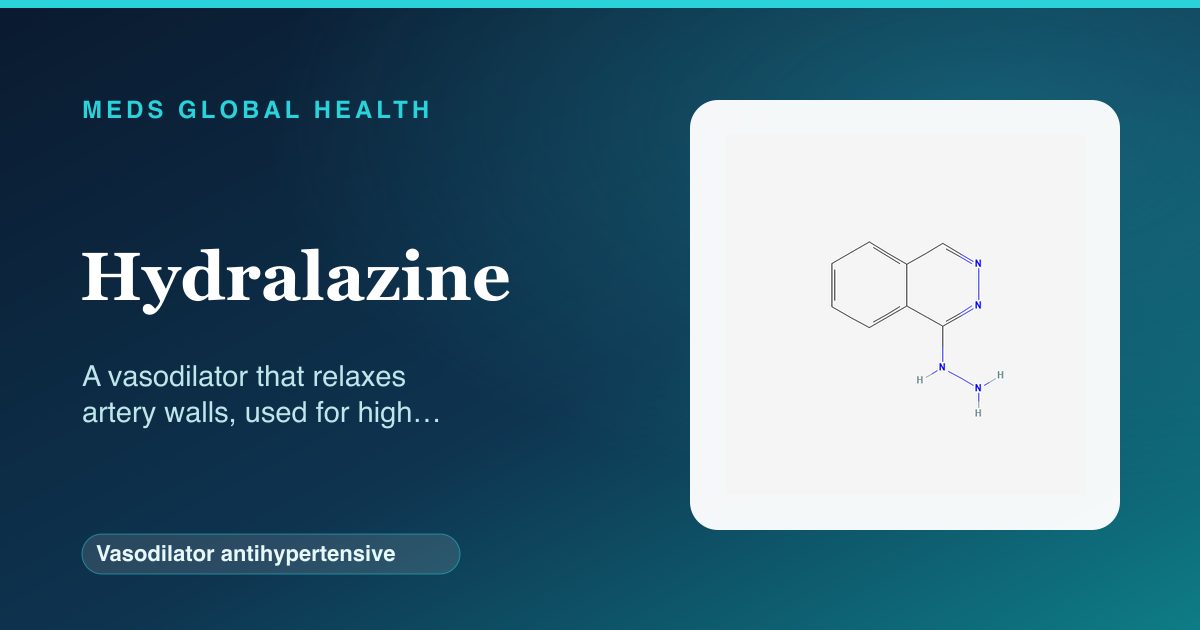
Hydralazine is a vasodilator, a medicine that relaxes the muscle in artery walls so the vessels widen and blood pressure falls. It is used to treat high blood pressure, including raised blood pressure in pregnancy, and forms part of heart failure treatment for some people, usually alongside a nitrate. It is taken by mouth as a tablet, and in hospital it can also be given by injection for severe high blood pressure. It is often combined with other blood pressure medicines.
How it works
Hydralazine acts directly on the muscle in the walls of the arteries, relaxing it so the arteries open up and the heart can pump against less resistance, which lowers blood pressure. Because the body senses the drop, the heart may beat faster and the body may hold on to fluid, which is why hydralazine is often paired with a beta-blocker and a water tablet to offset these responses. In heart failure it is combined with a nitrate to ease the load on the heart.
Company & origin
A long-established blood pressure medicine used in the UK, including in pregnancy and as part of heart failure treatment.
What it treats
Conditions Hydralazine is used for
Practical use
How to take Hydralazine
General, dose-free guidance — always follow your prescriber's and the leaflet's specific instructions.
- Take it regularly as prescribed, usually two or more times a day, at about the same times.
- Get up slowly, as it can make you feel faint or give you a fast heartbeat when your blood pressure drops.
- Expect possible headache, flushing or a stuffy nose at first; these often ease as you continue.
- Tell your prescriber about new joint or muscle pains, a rash or unexplained fevers, which need checking.
- Take any partner medicines, such as a beta-blocker or water tablet, as prescribed to balance its effects.
- Do not stop it suddenly without advice, as your blood pressure could rise.
Weighing it up
Advantages & disadvantages of Hydralazine
Advantages
- Effectively widens the arteries to lower blood pressure, including during pregnancy.
- A valuable part of heart failure treatment when combined with a nitrate.
- Can be given by mouth or, in hospital, by injection for severe high blood pressure.
Disadvantages
- Often causes a fast heartbeat, flushing, headache and fluid retention, so partner medicines are usually needed.
- Needs to be taken more than once a day.
- Rarely, long-term use can trigger a lupus-like reaction with joint, skin and general symptoms.
Practical use
Good to know
Hydralazine is useful in pregnancy and in heart failure, where it is teamed with a nitrate to help the heart. Because it widens the arteries quickly, a fast or pounding heartbeat, flushing, headache and a stuffy nose are common at first, and the body may retain fluid, causing swollen ankles, so it is usually given with other medicines that balance these effects. The most important long-term caution is a rare lupus-like reaction, with joint pains, a rash, fever and feeling unwell, which is more likely with higher doses over a long time and usually settles when the medicine is stopped. Tell your prescriber about new joint or muscle aches, rashes or unexplained fevers.
Who should not take it / use with caution
- People with certain heart conditions, such as some types of fast heartbeat or severe heart valve narrowing, should not take it.
- It is avoided in people who have had a lupus-like reaction to it before, or who have the lupus condition.
- Used with caution in coronary artery disease, where a fast heartbeat could be harmful.
Monitoring
- Blood pressure and heart rate checks to confirm control and watch for a fast heartbeat.
- Watching for swollen ankles or other signs of fluid retention.
- Checking for joint pains, rash or fever, with blood tests if a lupus-like reaction is suspected.
Side effects
- A fast or pounding heartbeat, flushing, headache and a stuffy nose, especially at first.
- Fluid retention with swollen ankles, and feeling faint on standing.
- Rarely, a lupus-like reaction with joint pains, rash, fever and feeling unwell.
Key interactions
- Adds to the blood-pressure-lowering effect of other blood pressure medicines, which can be helpful or excessive.
- Often used deliberately with a beta-blocker and a water tablet to balance heart rate and fluid effects.
- Care is needed with other medicines that lower blood pressure or affect the heart, so tell your prescriber what you take.
Available as: Tablets taken by mouth, and an injection used in hospital.
Answers
Hydralazine: frequently asked questions
How does hydralazine lower blood pressure?
It relaxes the muscle in the walls of the arteries so they widen, letting blood flow more easily and reducing the pressure.
Why is it given with other medicines?
Because it can speed the heart and cause fluid retention, it is often paired with a beta-blocker and a water tablet that balance these effects.
Can it be used in pregnancy?
Yes, it is one of the medicines used for raised blood pressure in pregnancy, including in hospital for severe cases.
What is the lupus-like reaction?
Rarely, long-term use can cause joint pains, a rash, fever and feeling unwell; it usually settles when the medicine is stopped, so report these symptoms.
Does it help heart failure?
For some people it is combined with a nitrate to ease the load on the heart as part of heart failure treatment.
Authoritative sources
- BNF
- NICE CKS
Building a medicines information resource?
We create evidence-led, dose-free drug and formulary references for teams.