A green dye used in eye, liver and surgical imaging
Indocyanine green
A green dye used as a diagnostic tool in eye imaging, liver tests and surgery, not as a treatment.
What is Indocyanine green?
Indocyanine green is a specialist green dye used for imaging, not as a treatment. It is given into a vein and used to look at blood vessels at the back of the eye (angiography), to check how well the liver is working, and during surgery to map blood vessels and lymph nodes using a special camera. An important safety point is that it contains iodide, so it must be used with great caution, or avoided, in people with an iodine allergy, and rare severe allergic reactions can occur. It is used only by trained teams in hospital.
Education and reference only. This is a plain-language guide to Indocyanine green — it deliberately contains no doses. Doses depend on the person, the brand and the reason for treatment, and belong with your prescriber. Always check the BNF, the product labelling (SmPC) and follow medical advice.
What it is
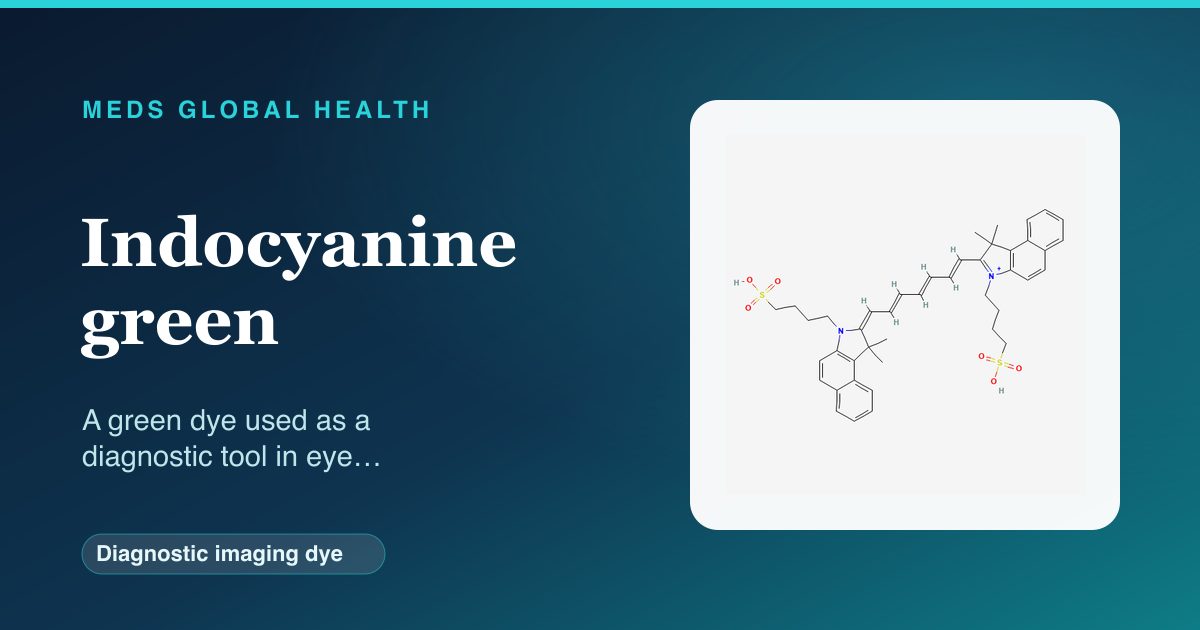
Indocyanine green is a green diagnostic dye used to help doctors see structures inside the body. It is given into a vein and shows up brightly when viewed with special infrared cameras. It has several uses: in the eye, it is used for angiography to study the blood vessels of the retina and the layer beneath it; in liver medicine, it is used to test how well the liver is working and clearing substances; and in surgery, it is used to show blood flow and to map lymph nodes and blood vessels. It is a diagnostic tool, not a treatment, and is used only in hospital by trained teams.
How it works
Once injected into a vein, indocyanine green travels in the blood and glows brightly when viewed with infrared light. In eye angiography, this lets doctors photograph the blood vessels of the eye and spot leaks or abnormal vessels. Because the dye is taken up and cleared by the liver, measuring how quickly it disappears from the blood gives a measure of liver function. In surgery, special cameras detect the glowing dye to show which tissues have a good blood supply and to trace lymph nodes and vessels, helping guide the operation. In all cases it makes structures visible rather than treating anything.
Company & origin
A specialist green dye used in the UK for eye angiography, liver-function testing and to map blood vessels and lymph nodes during surgery.
Practical use
How to take Indocyanine green
General, dose-free guidance — always follow your prescriber's and the leaflet's specific instructions.
- It is given by a hospital team, usually as an injection into a vein during the test or operation.
- It is a one-off diagnostic step rather than a medicine you take at home.
- Tell the team before the test if you are allergic to iodine, shellfish or have reacted to dyes before.
- Mention any thyroid or kidney problems, as these can affect whether and how it is used.
- Do not be alarmed if your urine is briefly tinted afterwards; this fades on its own.
Weighing it up
Advantages & disadvantages of Indocyanine green
Advantages
- Lets doctors clearly see blood vessels in the eye, assess liver function, and map vessels and lymph nodes in surgery.
- Glows brightly under infrared cameras, giving detailed images in real time during operations.
- Used as a single step during a test or operation rather than as ongoing treatment.
Disadvantages
- It is a diagnostic dye and does not treat any condition.
- It contains iodide, so it must be used with caution or avoided in people with iodine allergy.
- Rare but serious allergic reactions can occur, so it is given only in supervised settings.
Practical use
Good to know
The most important safety point is that indocyanine green contains iodide, so it must be used with great caution, or avoided altogether, in people who are allergic to iodine or who have had reactions to iodine-containing dyes; always tell the team about any such allergy. Although serious reactions are uncommon, rare severe allergic reactions, including anaphylaxis, can happen, which is why it is given where staff and equipment are ready to manage this. It is a diagnostic dye, not a treatment, so it is used once during a test or operation rather than taken regularly. It may briefly tint the urine or, occasionally, the skin, which fades. People with overactive thyroid or certain thyroid problems may need extra caution because of the iodide content. Let the team know about thyroid problems, kidney problems or previous dye reactions.
Who should not take it / use with caution
- People who are allergic to iodine, or who have had serious reactions to iodine-containing dyes, should not normally be given it.
- People who have had a serious allergic reaction to indocyanine green should not be given it.
- It is used with caution in people with certain thyroid problems because it contains iodide, and only by trained teams in hospital.
Monitoring
- Checking for allergy to iodine or previous dye reactions before it is given.
- Watching closely for any allergic-type reaction during and shortly after the injection.
- Reviewing the images or test results to guide diagnosis and any further care.
Side effects
- Usually well tolerated, but a brief tint to the urine or, occasionally, the skin that fades.
- Occasionally nausea or a feeling of warmth around the time of injection.
- Rarely, allergic-type reactions, including, very rarely, serious anaphylaxis, which staff are prepared to treat.
Key interactions
- Its iodide content means thyroid problems and thyroid tests should be considered, so tell the team.
- There are few well-established routine medicine interactions, but tell the team about all your medicines.
- Let the team know about previous reactions to dyes or iodine before the test.
Available as: A powder made up into a solution for injection into a vein.
Answers
Indocyanine green: frequently asked questions
What is indocyanine green used for?
It is a green diagnostic dye used for eye angiography, to test liver function, and to map blood vessels and lymph nodes during surgery, using special cameras.
Is it a treatment?
No. It is a diagnostic dye that helps doctors see structures inside the body; it does not treat any condition.
Why does iodine allergy matter?
Indocyanine green contains iodide, so it must be used with great caution, or avoided, in people who are allergic to iodine or iodine-containing dyes.
Can it cause an allergic reaction?
Rarely it can cause allergic-type reactions, including, very rarely, serious anaphylaxis, which is why it is given where staff are ready to treat this.
Will it change the colour of my urine?
It may briefly tint your urine, and occasionally the skin, but this fades on its own and is harmless.
Authoritative sources
- BNF
- NICE CKS
Building a medicines information resource?
We create evidence-led, dose-free drug and formulary references for teams.