A short-course gel for sun-damaged skin (availability now suspended)
Ingenol mebutate
A short-course gel used to treat sun-damaged skin patches (actinic keratosis); its UK and EU availability has been suspended over a possible skin-cancer concern.
What is Ingenol mebutate?
Ingenol mebutate is a gel that was used to treat actinic keratosis, rough scaly patches of sun-damaged skin that can sometimes turn into skin cancer. Its appeal was a very short course of treatment over only a few days. It causes strong local skin reactions, with redness, swelling, blistering and scabbing where it is applied. Importantly, its availability in the UK and EU has been suspended after studies raised a possible concern that it might be linked to more skin cancers in treated areas. Because of this, other treatments for actinic keratosis are now used instead.
Education and reference only. This is a plain-language guide to Ingenol mebutate — it deliberately contains no doses. Doses depend on the person, the brand and the reason for treatment, and belong with your prescriber. Always check the BNF, the product labelling (SmPC) and follow medical advice.
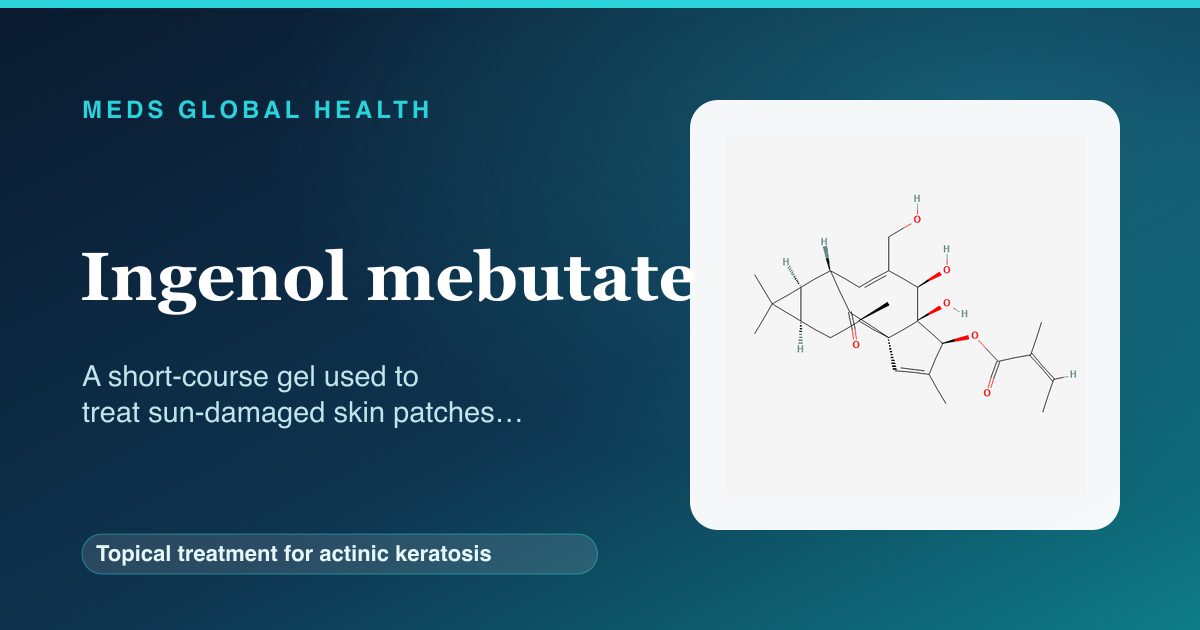
What it is
Ingenol mebutate is a topical gel that was used to treat actinic keratosis, patches of rough, scaly skin caused by long-term sun damage that carry a small risk of becoming skin cancer. It was applied to the affected area over a short course of just a few days, which made it convenient compared with longer treatments. Its supply in the UK and Europe has since been suspended because of a safety review, so it is no longer routinely available; this entry is included for information, and other treatments are now used in its place.
How it works
Ingenol mebutate works on sun-damaged skin in two ways: it damages the abnormal skin cells directly over the first day or so, and then triggers an inflammatory immune reaction that helps clear the remaining abnormal cells over the following days. This combination is what allowed a very short course to treat the area. The same actions are responsible for the marked redness, swelling, blistering and crusting that the treated skin develops during and just after the short course before it heals.
Company & origin
A short-course skin gel that was used in the UK to treat sun-damaged skin (actinic keratosis); its availability in the UK and EU has since been suspended.
Practical use
How to take Ingenol mebutate
General, dose-free guidance — always follow your prescriber's and the leaflet's specific instructions.
- Ingenol mebutate is not currently routinely available in the UK or EU, as its supply has been suspended; speak to your prescriber about alternatives.
- When it was used, it was applied to the sun-damaged area over a short course of a few days as directed.
- Hands were washed after applying it, and contact with the eyes, lips and inside the mouth was avoided.
- Strong redness, swelling and blistering were expected in the treated area during and just after the short course.
- If you used it in the past, have any new or changing skin lesions in the treated area checked by a clinician.
Weighing it up
Advantages & disadvantages of Ingenol mebutate
Advantages
- Offered a very short course of treatment over only a few days for sun-damaged skin.
- Could be applied at home rather than needing a procedure.
- Worked both by damaging abnormal cells and by prompting an immune clear-up.
Disadvantages
- Its availability in the UK and EU has been suspended over a possible skin-cancer concern.
- Caused intense local skin reactions, with redness, swelling, blistering and scabbing.
- Other treatments for sun-damaged skin are now used in its place.
Practical use
Good to know
The single most important point about ingenol mebutate is that its availability in the UK and EU has been suspended following a safety review: studies raised a possible concern that more skin cancers occurred in skin treated with it than with some comparison treatments. Because of this, it is no longer routinely supplied and other treatments for actinic keratosis are recommended instead, so anyone who previously used it should speak to their prescriber about alternatives and about keeping an eye on the treated skin. When it was in use, it caused intense but short-lived local skin reactions, with redness, swelling, blistering and scabbing over a few days, and it was important to avoid getting it in the eyes and to wash the hands after applying it. If you have used it in the past and notice new or changing skin lesions in a treated area, it is sensible to have them checked.
Who should not take it / use with caution
- It is not currently routinely available, so it should not be sought out; other treatments are now used.
- People who had a serious allergic reaction to it should not use it.
- It was avoided on broken or infected skin and near the eyes, lips and inside the mouth.
Monitoring
- Anyone who used it in the past should have new or changing skin lesions in treated areas checked.
- Reviewing sun-damaged skin and arranging a suitable alternative treatment.
- Keeping up regular skin checks if you are prone to sun-damaged skin or skin cancers.
Side effects
- Strong redness, swelling, blistering, scabbing and soreness where it was applied.
- Itching, pain or temporary changes in skin colour at the treated site.
- A safety review raised a possible concern about more skin cancers in treated areas, leading to its suspension.
Key interactions
- There were few well-established interactions with other medicines.
- Using other skin treatments on the same area at the same time was best checked with a prescriber.
- As it is no longer routinely supplied, the practical concern now is choosing a suitable alternative with your clinician.
Available as: A gel that was applied to the skin (no longer routinely available).
Answers
Ingenol mebutate: frequently asked questions
What was ingenol mebutate used for?
It was used as a short-course gel to treat actinic keratosis, rough scaly patches of sun-damaged skin that can sometimes turn into skin cancer.
Why is it no longer available?
Its availability in the UK and EU has been suspended after a safety review raised a possible concern that more skin cancers occurred in skin treated with it than with some comparison treatments.
I used it in the past — should I worry?
If you notice new or changing skin lesions in an area you treated, have them checked by a clinician; it is sensible to keep an eye on previously treated skin.
What can I use instead?
Other treatments for sun-damaged skin are now used in its place; your prescriber can advise on a suitable alternative for you.
Why did it make the skin blister?
It worked partly by damaging abnormal cells and partly by triggering an immune reaction, which caused the strong but short-lived redness, swelling and blistering.
Authoritative sources
- BNF
- NICE CKS
Building a medicines information resource?
We create evidence-led, dose-free drug and formulary references for teams.