A long-acting (basal) insulin
Insulin glargine
A long-acting (basal) insulin that gives steady background insulin cover, usually injected once a day.
What is Insulin glargine?
Insulin glargine is a long-acting insulin that provides a steady background (basal) level of insulin over roughly a whole day, helping to keep blood glucose stable between meals and overnight. It is usually injected under the skin once a day at about the same time, and in type 1 diabetes it is combined with a separate mealtime insulin. Because it lowers blood glucose, the main risk is a hypo (low blood glucose), so it is important to recognise and treat the warning signs. Always rotate injection sites and never share your pen or needles with anyone else.
Education and reference only. This is a plain-language guide to Insulin glargine — it deliberately contains no doses. Doses depend on the person, the brand and the reason for treatment, and belong with your prescriber. Always check the BNF, the product labelling (SmPC) and follow medical advice.
What it is
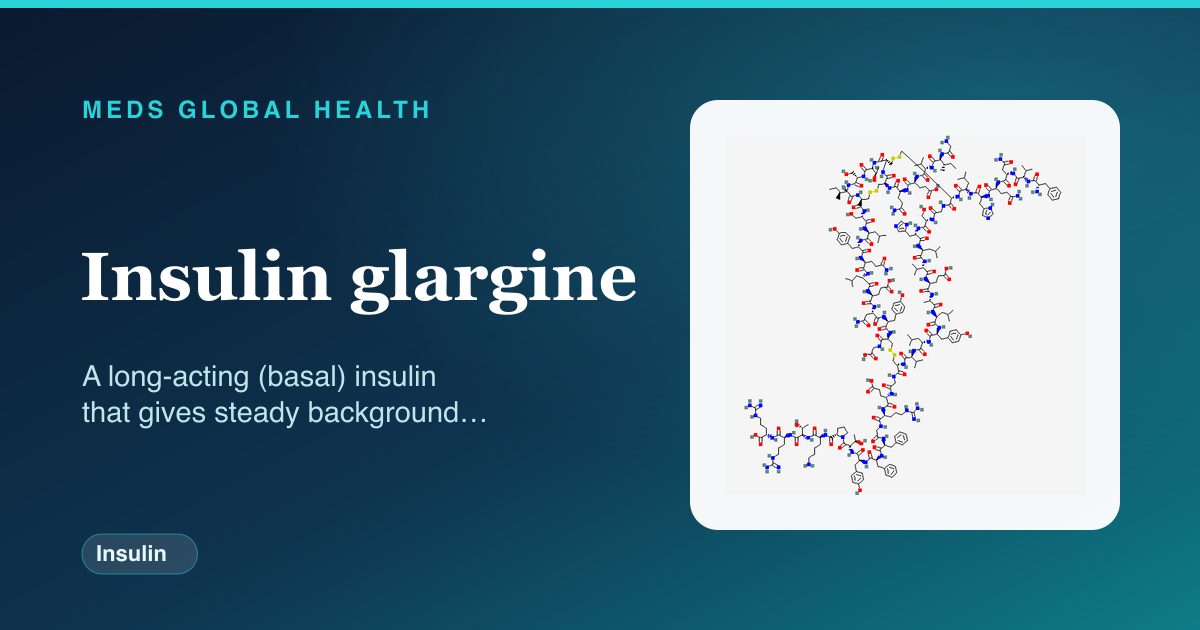
Insulin glargine is a long-acting insulin analogue used as the background, or basal, part of insulin treatment in type 1 and type 2 diabetes. After injection under the skin it forms a tiny depot that releases slowly, giving a smooth, fairly flat effect over close to a full day without a strong peak. This steady cover handles the glucose your body releases between meals and overnight. It comes in prefilled pens and cartridges, including a more concentrated version, and in type 1 diabetes it is paired with a fast-acting mealtime insulin.
How it works
Insulin is the hormone that lets glucose move from the blood into the body's cells for energy and tells the liver to stop making extra glucose. In diabetes the body either makes too little insulin or cannot use it well, so blood glucose rises. Glargine replaces the slow, steady background insulin a healthy pancreas would release, dissolving gradually under the skin so it works smoothly over roughly twenty-four hours. Because its action is fairly flat, it is designed to lower the risk of dips overnight compared with older background insulins.
Company & origin
Originated / developed by: Sanofi (Lantus, Toujeo); Eli Lilly/Boehringer Ingelheim (Abasaglar).
A long-acting human insulin analogue first approved around the turn of the millennium and now one of the most widely used basal insulins in the UK, available in standard and more concentrated pens.
What it treats
Conditions Insulin glargine is used for
Practical use
How to take Insulin glargine
General, dose-free guidance — always follow your prescriber's and the leaflet's specific instructions.
- Inject under the skin once a day at roughly the same time each day, into the tummy, thigh, buttock or upper arm.
- Rotate your injection site within an area each time to prevent lumpy or hardened skin that changes how the insulin is absorbed.
- Use a new needle each time, prime the pen as instructed, and never share a pen or needle with anyone else.
- Do not shake the pen; glargine is a clear solution and should not be mixed in the same syringe with other insulins.
- Recognise hypo warning signs and always carry fast-acting sugar such as glucose tablets or a sugary drink.
- On sick days keep taking your insulin, check your blood glucose more often and follow your sick-day plan.
Weighing it up
Advantages & disadvantages of Insulin glargine
Advantages
- Gives smooth, long-lasting background cover with a fairly flat action, usually with just one injection a day.
- Tends to cause fewer overnight lows than older background insulins because it has little peak.
- Available in convenient prefilled pens, including a more concentrated option for those needing larger amounts.
Disadvantages
- Like all insulin it can cause hypoglycaemia, which needs prompt treatment and ongoing awareness.
- It only covers background needs, so in type 1 diabetes a separate mealtime insulin is still required.
- The concentrated version is not interchangeable unit-for-unit with the standard strength, which can cause confusion.
Practical use
Good to know
Glargine is a background insulin, not a mealtime one, so it controls glucose between meals and overnight rather than covering the rise after eating. The most important thing to understand is hypoglycaemia (a hypo): warning signs include shakiness, sweating, hunger, a fast heartbeat, confusion or irritability, and a hypo should be treated promptly with a sugary drink or glucose tablets followed by a snack. Always inject under the skin (not into a vein or muscle), rotate where you inject to avoid lumpy skin that affects absorption, and never share a pen or needle even if the needle is changed, because of infection risk. On sick days do not stop your insulin; illness often raises blood glucose, so keep taking it and seek advice. The more concentrated version is not interchangeable unit-for-unit with the standard strength, so any switch must be made by a prescriber.
Who should not take it / use with caution
- It must not be used during an episode of low blood glucose (hypoglycaemia).
- People with a known allergy to insulin glargine or its ingredients should not use it.
- It is not suitable on its own for diabetic ketoacidosis, which needs urgent hospital treatment with fast-acting insulin.
Monitoring
- Regular blood glucose checks, and HbA1c over time, to guide the background insulin amount.
- Reviewing injection sites for lumps or hardened skin that can affect absorption.
- Watching the frequency and pattern of hypos, especially overnight, to adjust treatment.
Side effects
- Hypoglycaemia (low blood glucose) is the most important side effect, with shakiness, sweating, hunger and confusion.
- Redness, itching or lumpy, hardened skin at injection sites, especially if sites are not rotated.
- Weight gain and, rarely, allergic reactions or swelling.
Key interactions
- Other glucose-lowering medicines, alcohol and some painkillers can increase the risk of a hypo.
- Steroids, some diuretics and certain other medicines can raise blood glucose and reduce insulin's effect.
- Beta-blockers can mask the warning signs of a hypo, so extra glucose monitoring may be needed.
Available as: Solution for injection under the skin, in prefilled pens and cartridges, in standard and concentrated strengths.
Answers
Insulin glargine: frequently asked questions
Is insulin glargine a background or a mealtime insulin?
It is a long-acting background (basal) insulin that gives steady cover over about a day; in type 1 diabetes a separate fast-acting insulin is still needed for meals.
When should I inject it?
Usually once a day at about the same time each day; your team will advise the best time for you. Consistency matters more than the exact hour.
What do I do if my blood glucose goes low?
Treat a hypo straight away with fast-acting sugar such as glucose tablets or a sugary drink, then a snack; learn the warning signs and always carry sugar.
Can I share my insulin pen with a family member?
No. Pens and needles should never be shared, even with a new needle, because of the risk of passing on infection.
Should I stop my insulin if I am unwell?
No. Illness often raises blood glucose, so keep taking your insulin, check your glucose more often and follow your sick-day advice.
The wider class
About Insulin
Insulin glargine belongs to the insulin class. For how the class as a whole works, its shared safety principles and monitoring, see the full guide.
Browse by body system
Authoritative sources
- BNF
- NICE CKS
Building a medicines information resource?
We create evidence-led, dose-free drug and formulary references for teams.