Also called diiodohydroxyquinoline
Iodoquinol
An older medicine that clears amoebae living in the gut, usually given as a follow-on after the main infection is treated.
What is Iodoquinol?
Iodoquinol is an older anti-amoeba medicine that works inside the gut to clear the carrier (cyst) stage of amoebiasis, the form that lingers in the bowel. It is usually used as a follow-on after a different medicine has dealt with the active, tissue-invading infection. It is taken by mouth, normally as a short course. The most important safety point is that long or high-dose use has been linked to damage to the optic nerve and other nerves, so courses are kept short. It also contains iodine, so it is used with caution in people with thyroid problems.
Education and reference only. This is a plain-language guide to Iodoquinol — it deliberately contains no doses. Doses depend on the person, the brand and the reason for treatment, and belong with your prescriber. Always check the BNF, the product labelling (SmPC) and follow medical advice.
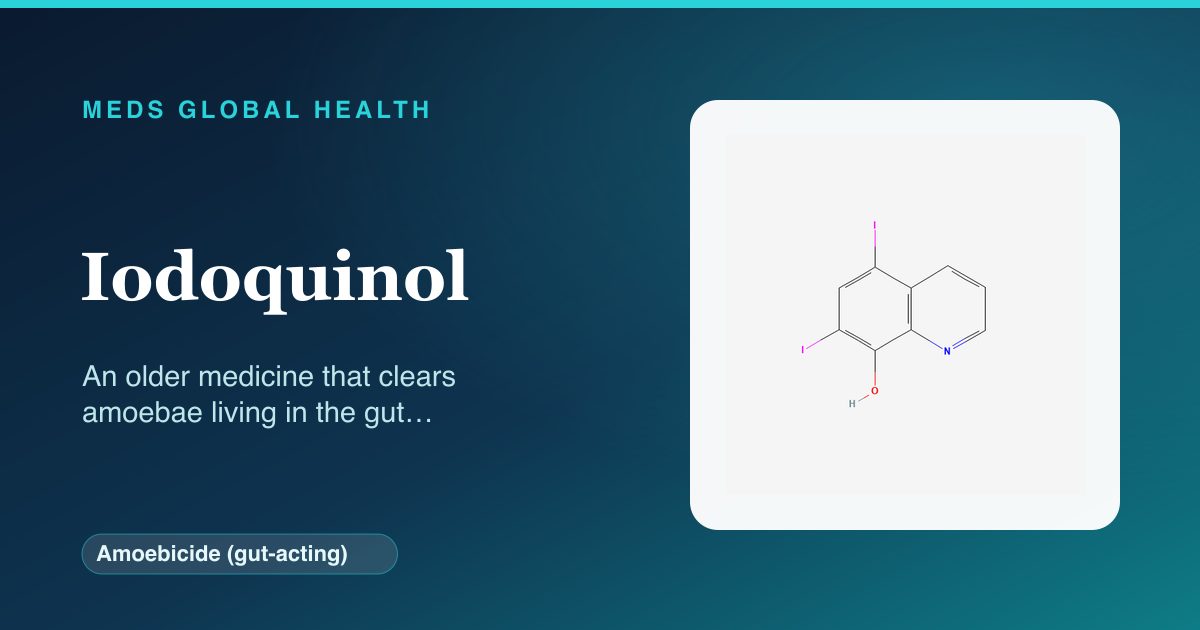
What it is
Iodoquinol, also called diiodohydroxyquinoline, is a long-established medicine used to treat amoebiasis, an infection caused by a parasite called Entamoeba histolytica. It works mainly inside the gut, against the form of the parasite that lives in the bowel rather than the form that invades tissue. For this reason it is often used as a clean-up or follow-on treatment after another medicine has cleared the active infection. It is taken by mouth as a tablet. Because it contains iodine and because long use has been linked to nerve problems, it is used carefully and usually for a short, defined course.
How it works
Iodoquinol acts where amoebae live inside the bowel, killing the parasite in its gut (carrier) stage so that the infection is cleared from the intestine and the person stops carrying and passing it on. Because it stays mainly in the gut and is not well absorbed into the rest of the body, it is good at clearing this bowel-dwelling form but is not the right choice on its own for amoebae that have invaded tissue, such as the liver. That is why it is usually paired with, or follows, a medicine that treats the invasive infection.
Company & origin
An older anti-amoeba medicine used to clear the parasite from the gut, often after another medicine has treated the active infection.
Practical use
How to take Iodoquinol
General, dose-free guidance — always follow your prescriber's and the leaflet's specific instructions.
- Take it by mouth for the full course you are given, usually with or after food to reduce stomach upset.
- Do not take it for longer than prescribed, as long or high-dose use has been linked to nerve and eyesight problems.
- Finish the whole course even if you feel better, so the parasite is fully cleared from the gut.
- Tell your prescriber straight away about any change in your eyesight or any numbness or tingling.
- Mention any thyroid problems before starting, as the medicine contains iodine.
Weighing it up
Advantages & disadvantages of Iodoquinol
Advantages
- Effective at clearing the gut-dwelling carrier stage of amoebiasis to stop ongoing infection and spread.
- Taken by mouth as a short course.
- A long-established medicine with decades of experience behind its use.
Disadvantages
- Long or high-dose use has been linked to damage to the optic nerve and other nerves.
- Contains iodine, so it needs caution in people with thyroid problems and can affect thyroid tests.
- Works mainly in the gut, so it is not suitable on its own for amoebae that have invaded tissue.
Practical use
Good to know
The most important thing to understand is that iodoquinol is usually a follow-on treatment: it clears the amoebae left in the gut after another medicine has dealt with the active infection, rather than being used alone for severe disease. The key safety point is that taking it for too long or at high doses has been linked to damage to the optic nerve (affecting eyesight) and to other nerves, which is why courses are kept short and the recommended length is not exceeded. Because the medicine contains iodine, it is used with caution in people with thyroid problems and can affect some thyroid blood tests. The most common side effects are tummy-related, such as nausea, diarrhoea or stomach cramps. Report any change in vision promptly.
Who should not take it / use with caution
- People who have had a serious allergic reaction to iodoquinol or to iodine should not take it.
- It is avoided in people with optic-nerve or significant eyesight problems, because of the risk to vision.
- It is used with caution in people with thyroid disease, because it contains iodine.
- It is used with care in people with liver problems, under medical guidance.
Monitoring
- Keeping the course short and not exceeding the recommended length, to lower the risk to nerves and eyesight.
- Watching for any change in vision or any numbness, tingling or weakness.
- Reviewing thyroid status where relevant, as the medicine contains iodine.
Side effects
- Nausea, diarrhoea, stomach cramps or other tummy upset.
- Headache, itching or a skin rash in some people.
- With long or high-dose use, damage to the optic nerve affecting eyesight, or nerve problems such as numbness, tingling or weakness.
- Changes in thyroid blood tests because the medicine contains iodine.
Key interactions
- It can affect some thyroid blood tests because it contains iodine, so labs should know you are taking it.
- There are few well-established routine medicine interactions, but tell your prescriber everything you take.
- It is often used alongside, or after, another anti-amoeba medicine as part of a planned course.
Available as: Tablets taken by mouth.
Answers
Iodoquinol: frequently asked questions
What is iodoquinol used for?
It is used to clear the gut-dwelling (carrier) stage of amoebiasis, usually as a follow-on after another medicine has treated the active infection.
Why must the course be kept short?
Taking it for too long or at high doses has been linked to damage to the optic nerve and other nerves, so courses are kept short and the recommended length is not exceeded.
Does it contain iodine?
Yes, iodoquinol contains iodine, which is why it is used with caution in people with thyroid problems and can affect some thyroid blood tests.
Is it used on its own?
Usually not for serious disease; because it works mainly in the gut, it is often paired with or follows a medicine that treats amoebae which have invaded tissue.
What should I do if my vision changes?
Tell your prescriber straight away about any change in your eyesight, as this can be a sign of an effect on the optic nerve.
Authoritative sources
- BNF
- NICE CKS
Building a medicines information resource?
We create evidence-led, dose-free drug and formulary references for teams.