An iodine-based contrast agent for X-ray and CT scans
Iomeprol
A non-ionic, low-osmolar iodine contrast agent used for CT and angiography, chosen for its low viscosity when injecting quickly.
What is Iomeprol?
Iomeprol is an iodine-based contrast agent used during X-ray and CT scans, not a medicine that treats a condition. It is given by injection so that blood vessels, organs or other structures show up more clearly on the pictures, helping doctors make a diagnosis. The main concerns are allergic or anaphylactoid reactions, a risk of kidney injury in people whose kidneys are already vulnerable, and the need for care with the diabetes medicine metformin and in people with thyroid disease. Most people have it without any trouble.
Education and reference only. This is a plain-language guide to Iomeprol — it deliberately contains no doses. Doses depend on the person, the brand and the reason for treatment, and belong with your prescriber. Always check the BNF, the product labelling (SmPC) and follow medical advice.
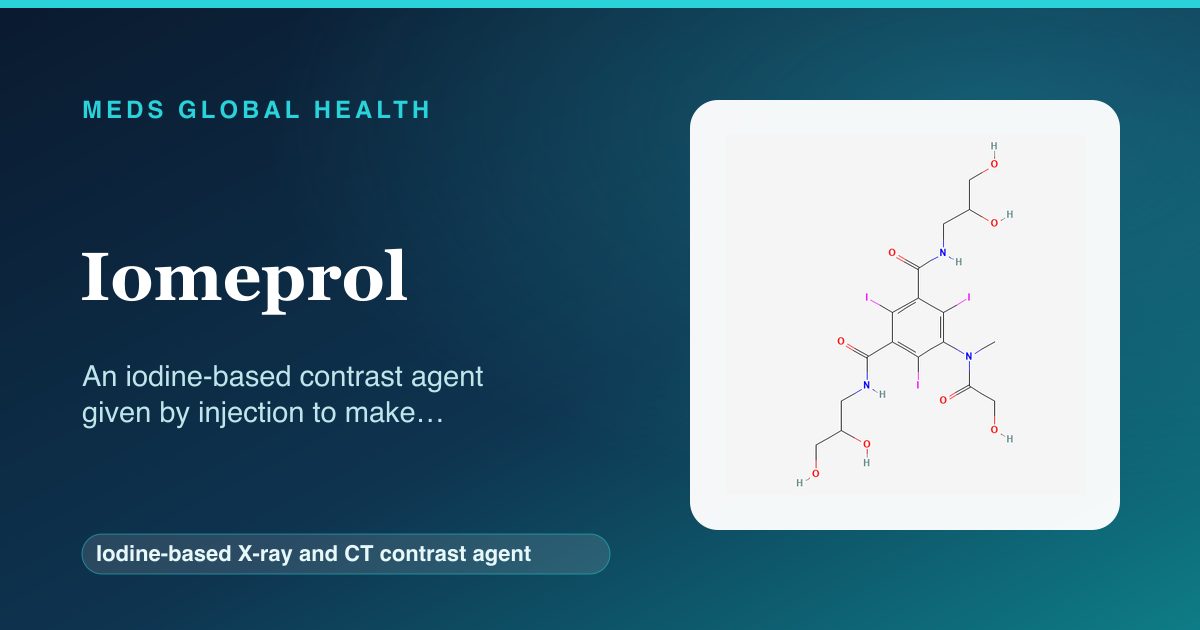
What it is
Iomeprol is a contrast agent, a substance containing iodine that is given during X-ray or CT scans to make the images clearer and easier to interpret. It is not a treatment for any illness; it is a diagnostic aid that highlights blood vessels, organs, the urinary tract or other structures so that abnormalities can be seen more easily. It is usually given as an injection into a vein, and sometimes into other spaces depending on the scan. It is given by the radiology team, who take precautions to make it as safe as possible.
How it works
Iomeprol contains iodine, which absorbs X-rays more than the surrounding tissues, so the areas it reaches appear brighter on X-ray and CT images. By outlining blood vessels, showing how organs take up the agent, or filling structures such as the urinary tract, it reveals detail that a plain scan might miss. It works only while it is in the body and is then cleared, mainly through the kidneys. Because it improves the images rather than acting on the body, it is purely a diagnostic tool.
Company & origin
An iodine-containing contrast agent used in the UK during X-ray and CT scans to make tissues and blood vessels show up more clearly.
Practical use
How to take Iomeprol
General, dose-free guidance — always follow your prescriber's and the leaflet's specific instructions.
- It is given by the radiology team, usually as an injection into a vein, for your X-ray or CT scan.
- Tell the team beforehand about any kidney or thyroid problems, allergies, asthma or previous contrast reactions.
- Tell the team if you take the diabetes medicine metformin, as you may be asked to pause it around the scan.
- Drink fluids before and after the scan if advised, to help protect and support your kidneys.
- Stay as instructed during and after the scan so the team can watch for any reaction.
Weighing it up
Advantages & disadvantages of Iomeprol
Advantages
- Makes X-ray and CT images much clearer, helping doctors reach an accurate diagnosis.
- Given as part of a single scan rather than as ongoing treatment.
- Well established and tolerated by most people when the usual precautions are taken.
Disadvantages
- It is a diagnostic aid, not a treatment, so it does not help any condition directly.
- Can cause allergic or anaphylactoid reactions and can strain the kidneys in vulnerable people.
- Needs care with the diabetes medicine metformin and in people with thyroid disease, as it contains iodine.
Practical use
Good to know
The most important thing to understand is that iomeprol is a contrast agent for scans, not a treatment, so it is given for a single scan rather than taken regularly. Most people have it without problems, but a few cautions matter. It can occasionally cause an allergic or anaphylactoid reaction, so the radiology team watches you during and after the scan and is prepared to treat reactions. It can put strain on the kidneys, so kidney function is often checked first and you may be encouraged to drink fluids. People taking the diabetes medicine metformin may be asked to pause it around the time of the scan, because if the kidneys are affected, metformin can rarely build up. It also contains iodine, so it is used with care in people with thyroid disease. Tell the team if you are pregnant, breastfeeding, have kidney or thyroid problems, take metformin or have reacted to contrast before.
Who should not take it / use with caution
- People who have had a serious reaction to iodine-based contrast agents should generally avoid it, or be given it only with special precautions.
- It is used with great caution in people with significant kidney problems because of the risk of kidney injury.
- It is used with care in people with thyroid disease and in pregnancy and breastfeeding, where the team weighs the need for the scan against the risks.
Monitoring
- Checking kidney function before contrast in people who may be at risk.
- Watching for allergic or anaphylactoid reactions during and after the scan.
- Reviewing thyroid and diabetes history, including metformin, before the scan.
Side effects
- A feeling of warmth, flushing or a metallic taste when it is injected, which is usually brief.
- Nausea or mild discomfort where the injection is given in some people.
- Less commonly, allergic or anaphylactoid reactions; in vulnerable people, contrast-related kidney injury.
Key interactions
- The diabetes medicine metformin may be paused around the scan, because kidney effects can rarely let it build up.
- Other medicines that can affect the kidneys may add to the risk, so tell the team about all your medicines.
- It is used alongside the team's usual precautions, including checking kidney function and watching for reactions.
Available as: A solution given by injection, usually into a vein.
Answers
Iomeprol: frequently asked questions
What is iomeprol used for?
It is an iodine-based contrast agent given during X-ray or CT scans to make blood vessels, organs and other structures show up more clearly. It is not a treatment.
Why does the team ask about my kidneys?
Iodine-based contrast can strain the kidneys, so kidney function is often checked first, and you may be advised to drink fluids to help protect them.
Why might I need to pause metformin?
If the kidneys are affected by the contrast, the diabetes medicine metformin can rarely build up, so you may be asked to pause it for a short time around the scan.
Can I have it if I am allergic to iodine contrast?
If you have reacted to iodine-based contrast before, tell the team; it may be avoided or given only with special precautions.
Will it treat my condition?
No. Iomeprol is only a diagnostic aid that improves the scan images; it does not treat any illness.
Authoritative sources
- BNF
- NICE CKS
Building a medicines information resource?
We create evidence-led, dose-free drug and formulary references for teams.