A short-acting inhaler that opens the airways
Ipratropium
An inhaled bronchodilator that relaxes and opens the airways in COPD and asthma, also used as a nasal spray for a runny nose.
What is Ipratropium?
Ipratropium is a short-acting antimuscarinic bronchodilator, an inhaled medicine that relaxes and widens the airways to make breathing easier in COPD and asthma. It is breathed in from an inhaler or through a nebuliser. A separate nasal spray form is used to dry up a persistently runny nose. Common effects include a dry mouth. Important cautions are to take care in glaucoma, avoiding eye contact especially with the nebulised form, and in men with prostate problems, where it can affect passing urine.
Education and reference only. This is a plain-language guide to Ipratropium — it deliberately contains no doses. Doses depend on the person, the brand and the reason for treatment, and belong with your prescriber. Always check the BNF, the product labelling (SmPC) and follow medical advice.
What it is
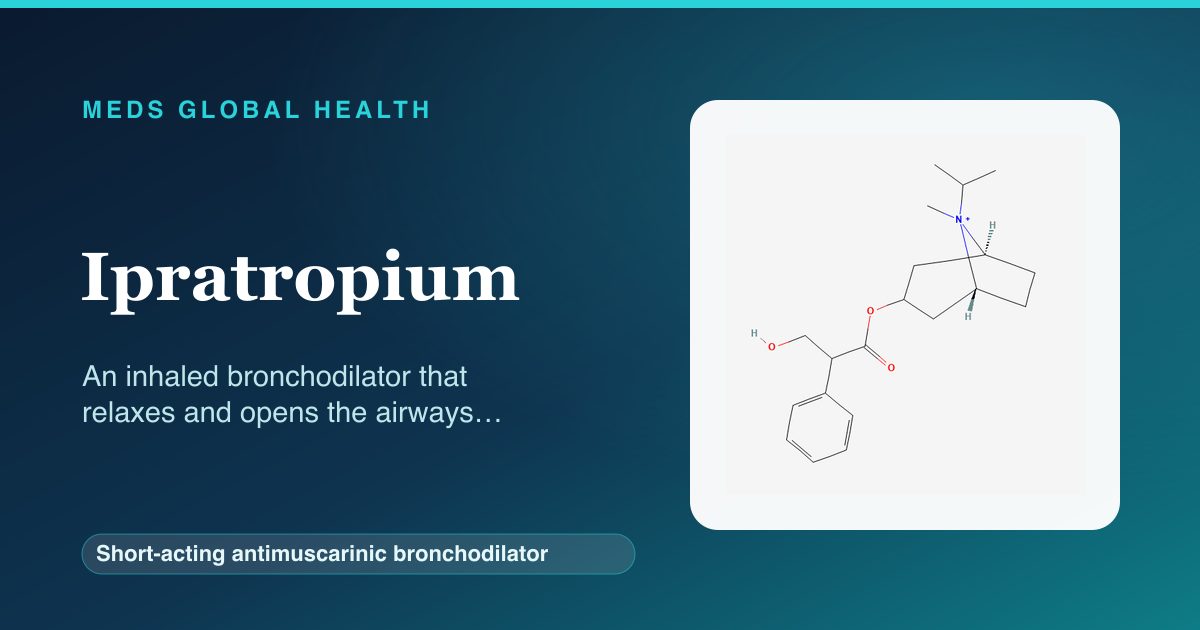
Ipratropium is a bronchodilator, a medicine that opens up the airways, belonging to a group called short-acting antimuscarinics. It is breathed into the lungs, either from a hand-held inhaler or through a nebuliser, to relieve the tight, narrowed airways seen in chronic obstructive pulmonary disease (COPD) and, sometimes, asthma. There is also a separate nasal spray version that is used in the nose to reduce a persistently runny nose. It is used as part of a wider breathing-treatment plan and is prescribed by a doctor, nurse or pharmacist.
How it works
The muscles around the airways can tighten and narrow them, making it harder to breathe. Ipratropium blocks a natural signal (acting on muscarinic receptors) that causes this tightening, so the airway muscles relax and the airways open up, easing breathlessness and wheeze. Because it is a short-acting medicine, its effect comes on over a little while and lasts for a few hours, so it is used regularly through the day in COPD or as part of treatment in asthma. In the nose, blocking the same kind of signal reduces the watery secretions that cause a runny nose.
Company & origin
An inhaled medicine used in the UK to open the airways in COPD and asthma, also available as a nasal spray for a runny nose.
What it treats
Conditions Ipratropium is used for
Practical use
How to take Ipratropium
General, dose-free guidance — always follow your prescriber's and the leaflet's specific instructions.
- Breathe it in using the correct inhaler technique, so the medicine reaches the lungs.
- Use it regularly through the day for COPD, or as part of your plan in asthma, as prescribed.
- If using the nebulised form, take care to keep the mist out of your eyes, especially if you have glaucoma.
- Use the nasal spray version only in the nose, as it is a separate product for a runny nose.
- Report eye pain, redness or blurred vision, or new difficulty passing urine.
Weighing it up
Advantages & disadvantages of Ipratropium
Advantages
- Relaxes and opens the airways to ease breathlessness and wheeze in COPD and asthma.
- Available as both an inhaler and a nebulised form for different needs.
- A separate nasal spray form helps dry up a persistently runny nose.
Disadvantages
- Commonly causes a dry mouth and sometimes a dry or irritated throat.
- Needs care in glaucoma, as eye contact (especially with the nebulised form) can raise eye pressure.
- Can make passing urine harder in men with prostate problems or others prone to this.
Practical use
Good to know
Ipratropium is a steady, short-acting opener of the airways used mainly in COPD and sometimes in asthma, often alongside other inhalers. The most common nuisance effect is a dry mouth, and a dry or irritated throat. Two cautions matter most. First, in people with glaucoma, the medicine can raise pressure in the eye if it gets into the eyes, which is a particular risk with the nebulised form; using a mouthpiece rather than a mask, or protecting the eyes, helps avoid this, and any eye pain, redness or blurred vision should be reported. Second, in men with prostate problems or anyone with difficulty passing urine, it can occasionally make passing urine harder. Using the inhaler with the correct technique gets the medicine into the lungs where it is needed, and the nasal spray form is a separate product used only in the nose.
Who should not take it / use with caution
- People who have had a serious allergic reaction to ipratropium should not use it.
- It is used with care in people with glaucoma, who should avoid getting it in the eyes.
- It is used with care in men with prostate problems or anyone who has difficulty passing urine.
- It is used with care during pregnancy and breastfeeding, under advice.
Monitoring
- Reviewing how well breathing symptoms are controlled and checking inhaler technique.
- Watching for eye symptoms in people with glaucoma and for urinary symptoms.
- Reviewing the overall breathing-treatment plan over time.
Side effects
- A dry mouth, or a dry or irritated throat.
- Headache, cough or, occasionally, a bad taste in the mouth.
- Blurred vision or eye discomfort if it gets into the eyes, especially with the nebulised form.
- Less commonly, difficulty passing urine, particularly in men with prostate problems.
Key interactions
- It is often used alongside other inhalers, such as reliever and preventer inhalers, as part of a plan.
- Other medicines that dry secretions may add to effects like dry mouth, so tell your prescriber.
- Tell your prescriber about glaucoma or prostate problems, as these affect how it is used.
Available as: An inhaler and a nebuliser solution for the lungs, and a separate nasal spray for the nose.
Answers
Ipratropium: frequently asked questions
What is ipratropium used for?
It is an inhaled bronchodilator that relaxes and opens the airways to ease breathing in COPD and asthma; a separate nasal spray form is used for a persistently runny nose.
Why does it give me a dry mouth?
A dry mouth is the most common effect because of the way the medicine works; sipping water and good mouth care can help, and it usually does not stop treatment.
I have glaucoma — is it safe?
It can be used with care, but it can raise pressure in the eye if it gets into the eyes, especially the nebulised form, so keep the mist away from your eyes and report any eye pain or blurred vision.
Can it affect passing urine?
Occasionally it can make passing urine harder, particularly in men with prostate problems, so report any new difficulty passing urine to your prescriber.
Is the nasal spray the same medicine?
Yes, the nasal spray contains ipratropium too, but it is a separate product used only in the nose to dry up a runny nose, not for the lungs.
The wider class
About Short-acting antimuscarinic bronchodilator
Ipratropium belongs to the short-acting antimuscarinic bronchodilator class. For how the class as a whole works, its shared safety principles and monitoring, see the full guide.
Browse by body system
Authoritative sources
- BNF
- NICE CKS
Building a medicines information resource?
We create evidence-led, dose-free drug and formulary references for teams.