A drip given in hospital to speed up a dangerously slow heartbeat
Isoprenaline
A hospital drip used to temporarily speed up a dangerously slow heartbeat, such as in serious heart block, until more permanent treatment can be arranged.
What is Isoprenaline?
Isoprenaline is a medicine given as a drip into a vein in hospital to temporarily speed up the heart when it is beating dangerously slowly, for example in serious heart block or certain slow heart rhythms. It is a beta-agonist, meaning it stimulates the heart to beat faster and harder. It is used as a short-term measure, often while waiting for a pacemaker or other treatment, and is given with close heart monitoring. Because it drives the heart, it can cause palpitations, a fast or irregular heartbeat and chest discomfort, which is why it is only used under careful supervision.
Education and reference only. This is a plain-language guide to Isoprenaline — it deliberately contains no doses. Doses depend on the person, the brand and the reason for treatment, and belong with your prescriber. Always check the BNF, the product labelling (SmPC) and follow medical advice.
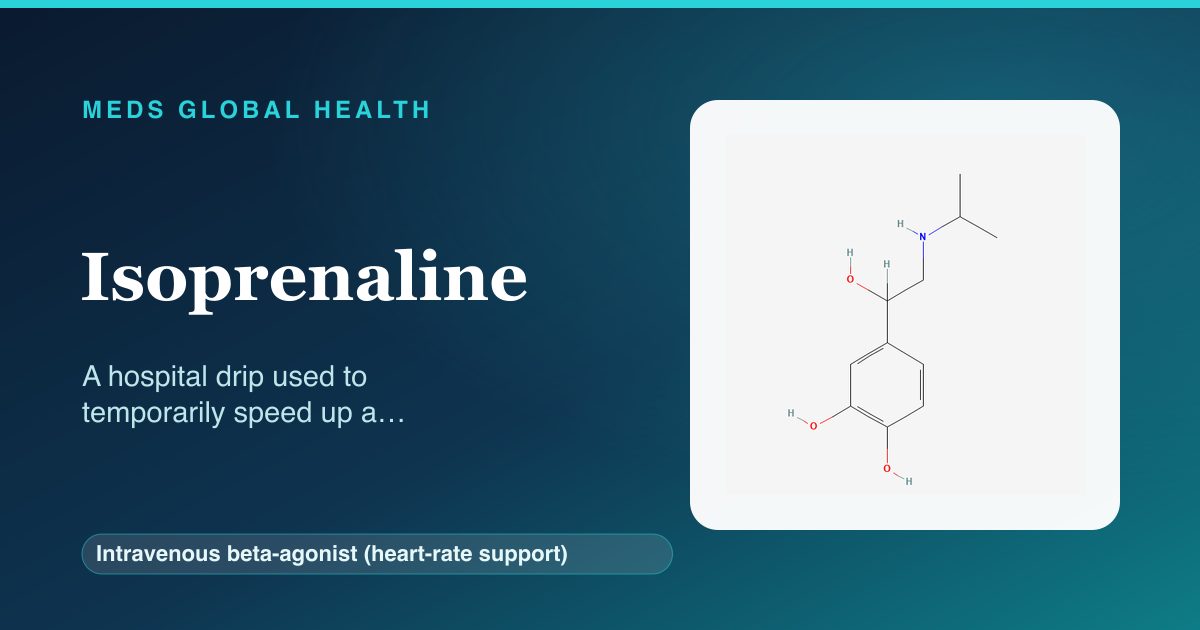
What it is
Isoprenaline is a hospital medicine that stimulates the heart, used to manage a dangerously slow heartbeat. It belongs to a group of medicines called beta-agonists, which act on the heart to make it beat faster and more forcefully. It is given as a controlled infusion into a vein, usually in an emergency or high-dependency setting, to support the heart rate in conditions such as serious heart block or other slow rhythms. It is a short-term, bridging treatment, often used while a more lasting solution such as a pacemaker is being arranged, and is always given with close monitoring.
How it works
Isoprenaline acts on receptors in the heart known as beta-receptors. By stimulating these, it increases the rate at which the heart's natural pacemaker fires and improves how electrical signals travel through the heart, so the heart beats faster. This helps lift a dangerously slow heart rate back towards a safer level and keeps enough blood flowing to the body. Because its effect is short-lived, it is given as a continuous drip that can be adjusted moment to moment, and it is used as a temporary support rather than a long-term treatment.
Company & origin
A hospital medicine given into a vein in the UK to temporarily speed up a dangerously slow heartbeat, such as in serious heart block.
Practical use
How to take Isoprenaline
General, dose-free guidance — always follow your prescriber's and the leaflet's specific instructions.
- It is given by the hospital team as a controlled drip into a vein, not something you take yourself.
- The rate of the drip is adjusted carefully to keep your heart rate in a safe range.
- You will be on continuous heart monitoring throughout treatment.
- Tell the staff straight away if you feel palpitations, chest discomfort or feel unwell.
- It is usually used only as a short-term measure while a longer-term treatment is arranged.
Weighing it up
Advantages & disadvantages of Isoprenaline
Advantages
- Can quickly lift a dangerously slow heartbeat back towards a safer level.
- Given as a drip that can be adjusted moment to moment to match how the heart responds.
- Provides a temporary bridge while a more permanent treatment, such as a pacemaker, is arranged.
Disadvantages
- Can cause palpitations, a fast or irregular heartbeat and chest discomfort.
- Only suitable as a short-term hospital treatment under close monitoring.
- May trigger abnormal heart rhythms or strain the heart if the heart is already under stress.
Practical use
Good to know
Isoprenaline is very much a hospital medicine: it is given as a carefully controlled drip into a vein with continuous heart monitoring, because it works by driving the heart faster. The main things the team watches for are palpitations, an overly fast or irregular heartbeat and chest discomfort, since pushing the heart harder can sometimes trigger abnormal rhythms or strain. It is usually a temporary, bridging measure used while a more permanent treatment, such as a pacemaker, is being arranged, rather than something used for long. The dose is adjusted to keep the heart rate in a safe range, and it is stopped or reduced if the heart rhythm or blood pressure changes in an unwanted way. Because it is given and managed entirely by the hospital team, there is nothing for the patient to do other than report symptoms such as palpitations or chest discomfort.
Who should not take it / use with caution
- It is used with great caution, or avoided, in people with certain fast or irregular heart rhythms.
- It is used with care in people with reduced blood flow to the heart, such as recent heart attack or severe angina.
- People who have had a serious allergic reaction to it should not be given it.
Monitoring
- Continuous monitoring of the heart's rhythm (ECG) throughout treatment.
- Close checking of heart rate and blood pressure as the drip is adjusted.
- Watching for palpitations, chest discomfort or abnormal heart rhythms.
Side effects
- Palpitations or a fast, pounding heartbeat.
- An irregular heart rhythm, tremor, sweating or headache.
- Chest discomfort, and rarely more serious heart-rhythm disturbances, which the monitoring is designed to catch.
Key interactions
- Beta-blockers can blunt its effect, as they work in the opposite direction on the heart.
- Other medicines that affect the heart's rhythm can combine with it to increase the risk of abnormal rhythms.
- The hospital team reviews all your medicines before and during treatment.
Available as: A solution given as a controlled infusion into a vein in hospital.
Answers
Isoprenaline: frequently asked questions
What is isoprenaline used for?
It is given in hospital to temporarily speed up the heart when it is beating dangerously slowly, such as in serious heart block, until more permanent treatment can be arranged.
How is it given?
It is given as a carefully controlled drip into a vein by the hospital team, with continuous heart monitoring, and the rate is adjusted to keep your heart rate in a safe range.
Why might I feel my heart racing?
Isoprenaline works by stimulating the heart to beat faster, so palpitations and a fast heartbeat are expected effects; tell the staff if you feel unwell.
Is it a long-term treatment?
No. It is a short-term, bridging measure used while a longer-term solution, such as a pacemaker, is being arranged.
Is it safe?
It is used safely under close hospital monitoring because it drives the heart harder; the team watches for abnormal rhythms and adjusts or stops it if needed.
Authoritative sources
- BNF
- NICE CKS
Building a medicines information resource?
We create evidence-led, dose-free drug and formulary references for teams.