A tumour-agnostic tablet for cancers with an NTRK gene fusion
Larotrectinib
A targeted tablet used for cancers carrying an NTRK gene fusion, regardless of where the cancer started, and generally well tolerated.
What is Larotrectinib?
Larotrectinib is a specialist targeted cancer medicine used to treat cancers that carry a specific gene change called an NTRK fusion, whatever part of the body the cancer started in (a tumour-agnostic treatment). It is taken by mouth as a tablet or liquid under the care of a cancer specialist. It is generally well tolerated, but it can affect liver blood tests and cause dizziness or other effects on the nervous system, such as tiredness or unsteadiness. Like other targeted cancer medicines, it can harm an unborn baby, so reliable contraception is important.
Education and reference only. This is a plain-language guide to Larotrectinib — it deliberately contains no doses. Doses depend on the person, the brand and the reason for treatment, and belong with your prescriber. Always check the BNF, the product labelling (SmPC) and follow medical advice.
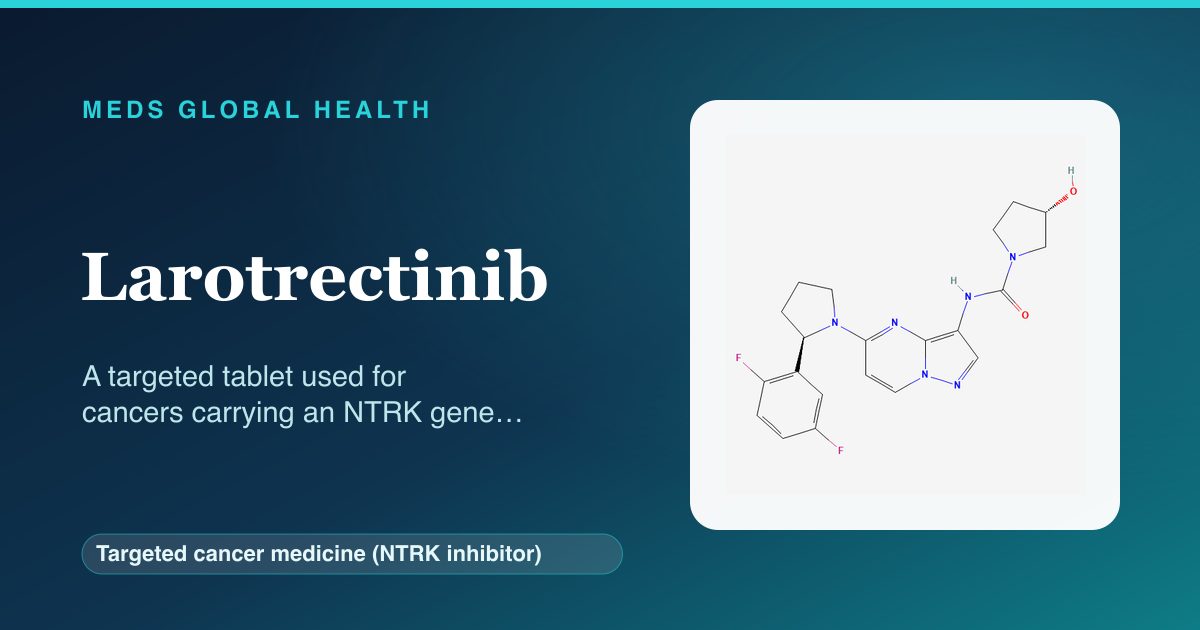
What it is
Larotrectinib is a targeted cancer treatment used for tumours that carry a particular gene change known as an NTRK fusion, which a laboratory test confirms. Unusually, it is tumour-agnostic, meaning it is used based on this gene change rather than on where in the body the cancer began. It is taken by mouth as a tablet or a liquid, which is helpful for children and people who cannot swallow tablets. It is prescribed and supervised by a cancer specialist, usually after testing has shown the NTRK fusion is present.
How it works
An NTRK fusion is a gene change that produces an abnormal protein which constantly signals cancer cells to grow. Larotrectinib blocks this faulty protein (the TRK protein), switching off the growth signal so the cancer cells are less able to multiply and survive. Because the medicine targets the NTRK fusion itself rather than a particular organ, it can work in many different cancer types as long as that gene change is present. It is taken regularly so the blocking effect is maintained.
Company & origin
A specialist cancer medicine used in the UK to treat cancers that have a specific gene change called an NTRK fusion, whatever part of the body they started in.
Practical use
How to take Larotrectinib
General, dose-free guidance — always follow your prescriber's and the leaflet's specific instructions.
- Take it by mouth as a tablet or liquid, as your cancer specialist prescribes, at about the same times each day.
- It is used only when a laboratory test has shown your cancer carries an NTRK fusion.
- Attend appointments for regular liver blood tests.
- Take care with driving or tasks needing concentration if you feel dizzy, tired or unsteady, especially early on.
- Use reliable contraception during treatment and for the advised time afterwards, and tell your team about other medicines.
Weighing it up
Advantages & disadvantages of Larotrectinib
Advantages
- Targets cancers based on a specific gene change, so it can work across many different cancer types.
- Generally well tolerated compared with many cancer treatments.
- Available as a liquid as well as tablets, which helps with giving it to children.
Disadvantages
- Only suitable when a laboratory test shows an NTRK fusion is present.
- Can affect liver blood tests and cause dizziness, tiredness or unsteadiness.
- Can harm an unborn baby, so reliable contraception is needed.
Practical use
Good to know
The standout feature of larotrectinib is that it is chosen on the basis of a gene change (an NTRK fusion) rather than where the cancer started, so a laboratory test is needed first to confirm the fusion is present. It is generally well tolerated compared with many cancer treatments. The main things the team keeps an eye on are the liver, through regular blood tests, and effects on the nervous system, such as dizziness, tiredness or unsteadiness, which can affect activities like driving, especially early on. It is available as a liquid as well as tablets, which helps with giving it to children. As with other targeted cancer medicines, it can harm an unborn baby, so reliable contraception is important during and for a time after treatment, and certain other medicines can change its levels.
Who should not take it / use with caution
- People who have had a serious allergic reaction to larotrectinib should not take it.
- It should not be used in pregnancy because it can harm an unborn baby.
- It is not suitable for cancers that do not carry an NTRK fusion, so testing is needed first.
Monitoring
- Regular liver blood tests during treatment.
- Watching for nervous-system effects such as dizziness, tiredness or unsteadiness.
- Reviewing how the cancer is responding through scans and clinical checks.
Side effects
- Tiredness, dizziness or unsteadiness, which can affect concentration and driving.
- Changes in liver blood tests, which is why these are monitored.
- Nausea, constipation or muscle aches in some people.
Key interactions
- Some medicines change the levels of larotrectinib, so a full medicines list is important.
- It can affect the levels of certain other medicines, so combinations are checked by the team.
- Tell your team about all medicines and supplements, as some can reduce or increase its effect.
Available as: Capsules and an oral liquid taken by mouth.
Answers
Larotrectinib: frequently asked questions
What is larotrectinib used for?
It is used to treat cancers that carry a specific gene change called an NTRK fusion, whatever part of the body the cancer started in, confirmed by a laboratory test.
What does tumour-agnostic mean?
It means the medicine is chosen based on a gene change in the cancer (an NTRK fusion) rather than on where in the body the cancer began, so it can work across many cancer types.
Is it well tolerated?
It is generally well tolerated compared with many cancer treatments, though it can affect liver blood tests and cause dizziness, tiredness or unsteadiness.
Can I drive while taking it?
Take care with driving or tasks needing concentration if you feel dizzy, tired or unsteady, especially early in treatment, and follow your team's advice.
Can I take it if I might become pregnant?
Larotrectinib can harm an unborn baby, so reliable contraception is needed during treatment and for the advised time afterwards.
Authoritative sources
- BNF
- NICE CKS
Building a medicines information resource?
We create evidence-led, dose-free drug and formulary references for teams.