A medicine to prevent CMV infection after a stem-cell transplant
Letermovir
An antiviral used to prevent cytomegalovirus (CMV) infection after a stem-cell transplant.
What is Letermovir?
Letermovir is a specialist antiviral used to prevent cytomegalovirus, known as CMV, from becoming active in people who have had a stem-cell (bone marrow) transplant. CMV is a common virus that usually causes no trouble but can become dangerous when the immune system is weakened after a transplant. Letermovir blocks the virus from copying itself. It is generally well tolerated. Its most important feature is that it interacts with many other medicines, including the transplant medicine ciclosporin, so doses are carefully managed.
Education and reference only. This is a plain-language guide to Letermovir — it deliberately contains no doses. Doses depend on the person, the brand and the reason for treatment, and belong with your prescriber. Always check the BNF, the product labelling (SmPC) and follow medical advice.
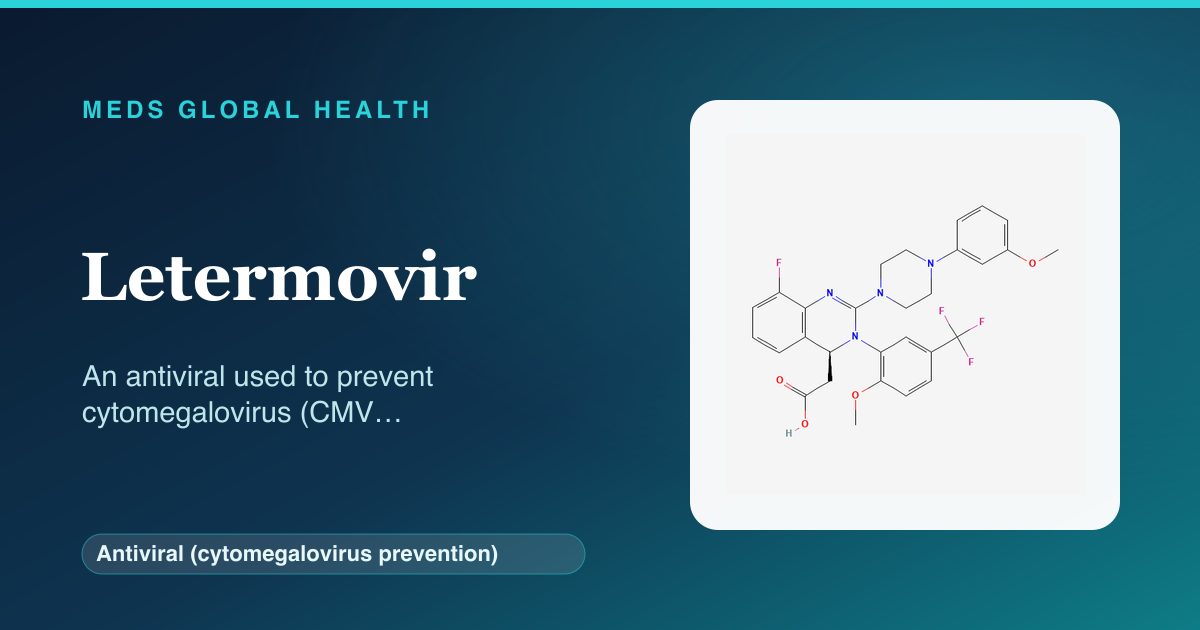
What it is
Letermovir is a specialist antiviral medicine used to prevent cytomegalovirus (CMV) becoming active in people who have had a stem-cell, or bone marrow, transplant. CMV is a common virus that most people carry harmlessly, but after a transplant the immune system is weakened and CMV can reactivate and cause serious illness. Letermovir is given to stop this happening during the high-risk period. It can be given as a tablet or by drip into a vein, and is used under the care of the transplant team for a set period after the transplant.
How it works
Letermovir stops cytomegalovirus from multiplying by blocking a step the virus needs to package and produce new copies of itself. By preventing the virus from replicating, it stops a quiet, dormant infection from flaring up into active, harmful disease while the immune system is still recovering after a transplant. It is used as prevention during the period of highest risk rather than as a treatment for established CMV disease. Because it is taken regularly during this time, steady use keeps the virus in check until the immune system recovers.
Company & origin
A specialist antiviral used in the UK to prevent cytomegalovirus (CMV) becoming active in people who have had a stem-cell transplant.
Practical use
How to take Letermovir
General, dose-free guidance — always follow your prescriber's and the leaflet's specific instructions.
- Take it exactly as the transplant team prescribes, as a tablet or by drip, during the period advised after transplant.
- Take the tablet at about the same time each day, with or without food.
- Give the team a full list of your medicines, as letermovir interacts with many of them.
- Do not change the dose of ciclosporin or other medicines yourself, as doses are carefully balanced.
- Keep all your monitoring appointments, including blood tests, during the prevention period.
Weighing it up
Advantages & disadvantages of Letermovir
Advantages
- Effectively prevents CMV reactivating during the high-risk period after a stem-cell transplant.
- Generally well tolerated, with relatively few troublesome side effects.
- Can be given as a tablet or a drip, allowing flexibility.
Disadvantages
- Interacts with many other medicines, including the transplant medicine ciclosporin.
- Used for prevention during a set period rather than to treat established CMV disease.
- Needs close coordination of all medicines by the transplant team.
Practical use
Good to know
The main thing to understand is that letermovir is preventive: it is given to stop CMV reactivating after a stem-cell transplant, during the time when the immune system is most vulnerable. It is generally well tolerated, which is one of its advantages. By far its most important practical feature is that it interacts with a large number of other medicines, both raising and lowering their levels, and being affected by them in turn. This is especially important with ciclosporin, a medicine used after transplant to prevent rejection, as the two affect each other and doses need careful adjustment. Because of this, the transplant team keeps a close eye on all the medicines being taken. It can be switched between a tablet and a drip depending on what suits the person at the time.
Who should not take it / use with caution
- People who have had a serious allergic reaction to letermovir should not take it.
- It is used with great care alongside certain medicines because of strong interactions.
- It should only be used under the supervision of a specialist transplant team.
Monitoring
- Regular blood tests to check for CMV and to monitor blood counts and organ function.
- Careful review of all medicines for interactions, especially ciclosporin.
- Reviewing how well CMV is being kept in check during the prevention period.
Side effects
- Nausea, diarrhoea or vomiting in some people.
- Headache or tiredness.
- Effects linked to interactions with other medicines, which is why doses are managed closely.
Key interactions
- It interacts strongly with ciclosporin, used to prevent transplant rejection, so doses are carefully adjusted.
- It can raise or lower the levels of many other medicines, so a full medicines list is essential.
- Some medicines change how well letermovir works, so tell the team about everything you take.
Available as: Tablets taken by mouth, and a solution given as a drip into a vein.
Answers
Letermovir: frequently asked questions
What is letermovir used for?
It is used to prevent cytomegalovirus (CMV) becoming active in people who have had a stem-cell transplant, during the time their immune system is most vulnerable.
Does it treat CMV that is already active?
It is mainly used to prevent CMV reactivating rather than to treat established CMV disease; the transplant team decides the right approach.
Is it well tolerated?
Yes, letermovir is generally well tolerated, with relatively few troublesome side effects compared with some other options.
Why do my medicines need such careful checking?
Letermovir interacts with many other medicines, including ciclosporin used after transplant, so doses are carefully balanced by your team.
Is it a tablet or a drip?
It can be given either as a tablet or as a drip into a vein, depending on what suits you at the time.
Authoritative sources
- BNF
- NICE CKS
Building a medicines information resource?
We create evidence-led, dose-free drug and formulary references for teams.