Leuprolide; a GnRH agonist hormone treatment
Leuprorelin
A hormone treatment given as a depot injection that lowers sex hormones, used in prostate cancer, breast cancer, endometriosis and fibroids.
What is Leuprorelin?
Leuprorelin is a hormone treatment given as a long-acting injection on a regular schedule. It lowers the body's testosterone in men or oestrogen in women, which helps treat prostate cancer, some breast cancers and conditions such as endometriosis and fibroids. When it is first started it briefly raises hormone levels (a flare) before lowering them, so a cover medicine is sometimes given at the start. It commonly causes menopause-type effects such as hot flushes, and long-term use can thin the bones.
Education and reference only. This is a plain-language guide to Leuprorelin — it deliberately contains no doses. Doses depend on the person, the brand and the reason for treatment, and belong with your prescriber. Always check the BNF, the product labelling (SmPC) and follow medical advice.
What it is
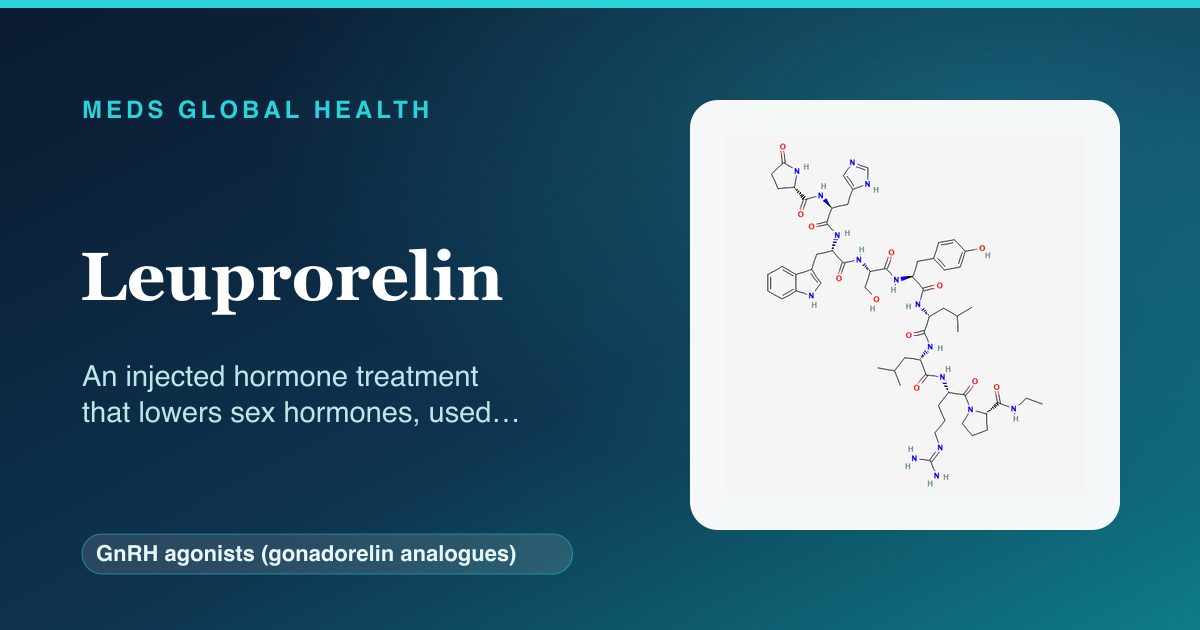
Leuprorelin is a gonadorelin analogue, closely related to goserelin, that ultimately lowers the body's sex hormones. It is given as a long-acting injection that slowly releases the medicine over several weeks or months. In men it is used mainly for prostate cancer; in women it is used for some breast cancers, endometriosis, fibroids and certain other situations. By reducing testosterone or oestrogen, it can slow hormone-driven conditions.
How it works
Like other medicines in its group, leuprorelin constantly stimulates the brain gland that controls sex hormones. This first causes a brief rise in testosterone or oestrogen, the flare, and then the gland switches off, so the testes or ovaries stop being told to make hormones and levels fall to very low. Because many prostate and breast cancers and conditions like endometriosis depend on these hormones, lowering them can slow or shrink the condition.
Company & origin
A hormone treatment given by injection in the UK for prostate cancer, breast cancer, endometriosis and some other conditions.
Practical use
How to take Leuprorelin
General, dose-free guidance — always follow your prescriber's and the leaflet's specific instructions.
- It is given as a long-acting injection by a healthcare professional, on a regular schedule.
- Keep to the appointment timetable so each injection is given on time.
- In prostate cancer, take any cover medicine you are prescribed around the start, to manage the initial hormone flare.
- Expect menopause-type effects such as hot flushes, and tell your team if they are hard to cope with.
- Discuss bone protection and follow advice on calcium, vitamin D or weight-bearing exercise for longer courses.
- Do not miss appointments without telling your team, as a gap can reduce how well it controls your condition.
Weighing it up
Advantages & disadvantages of Leuprorelin
Advantages
- Effectively lowers sex hormones to treat prostate cancer, some breast cancers and conditions such as endometriosis and fibroids.
- Given as a long-acting injection, sometimes covering several weeks or months at a time.
- Avoids surgical removal of the testes or ovaries while achieving a similar hormone-lowering effect.
Disadvantages
- Commonly causes menopause-type effects such as hot flushes, sweats and reduced sex drive.
- Can cause an initial symptom flare, so cover medicine is sometimes needed at the start.
- Long-term use can thin the bones, so bone health needs attention.
Practical use
Good to know
Leuprorelin is given as a regular long-acting injection, so keeping to appointments matters for steady control. The initial flare can briefly worsen symptoms, so in prostate cancer a separate cover medicine is often started first to prevent problems from the temporary rise. Because it lowers sex hormones, it commonly causes menopause-type effects such as hot flushes, sweats, reduced sex drive and mood changes, and in men it can reduce erections. Longer-term use can thin the bones, so bone health is considered and sometimes monitored or protected. In endometriosis or fibroids it is used for a limited period, often with add-back hormone support to ease side effects and protect bone.
Who should not take it / use with caution
- It is not used in pregnancy or breastfeeding, and non-hormonal contraception is advised where pregnancy is possible.
- It is used cautiously in people at higher risk of bone thinning or fractures.
- In men with prostate cancer that has spread to the spine, the initial flare needs careful management or alternatives.
Monitoring
- Reviewing how well your condition is responding, with blood tests or scans as appropriate.
- Watching for and managing menopause-type side effects and the initial flare.
- Considering bone-density checks or bone protection with longer-term use.
Side effects
- Hot flushes, sweats, reduced sex drive, mood changes and tiredness are common.
- Injection-site reactions, headache and, with longer use, bone thinning.
- In men, reduced erections and breast tenderness; in women, vaginal dryness and irregular bleeding.
Key interactions
- It has few routine medicine interactions, but tell your team about all medicines you take.
- Medicines or conditions that affect heart rhythm may need consideration, so share your full history.
- Other hormone treatments are only combined with it under specialist guidance.
Available as: A long-acting injection given under the skin or into a muscle by a healthcare professional.
Answers
Leuprorelin: frequently asked questions
How often do I need the injection?
Leuprorelin is long-acting, so each injection can cover several weeks or months depending on the product; your team will set the schedule.
What is the flare at the start?
When first started, it briefly raises hormone levels before lowering them; in prostate cancer a cover medicine is often given beforehand to manage this.
Why does it cause hot flushes?
By switching off the body's sex hormones, it produces menopause-type effects such as hot flushes and sweats, which are common.
Can it affect my bones?
Used over a longer time it can thin the bones, so your team may advise bone protection or monitoring.
Is it similar to goserelin?
Yes, both are GnRH agonists that lower sex hormones and are used for similar conditions; they mainly differ in how and how often they are given.
Authoritative sources
- BNF
- NICE CKS
Building a medicines information resource?
We create evidence-led, dose-free drug and formulary references for teams.