A hospital drip that helps a struggling heart pump more strongly
Levosimendan
A hospital drip used in acute, severe worsening of heart failure to help the heart pump more strongly.
What is Levosimendan?
Levosimendan is a medicine given as a drip into a vein in hospital to help a weakened heart pump more effectively during a serious, sudden worsening of heart failure. It is a calcium-sensitiser inotrope, which means it makes the heart muscle respond more strongly to the calcium already present in its cells, improving the force of each heartbeat, and it also relaxes blood vessels. It can lower the blood pressure, speed up the heart and cause headache, so it is given with close monitoring. It is a short-term hospital treatment used in specific situations.
Education and reference only. This is a plain-language guide to Levosimendan — it deliberately contains no doses. Doses depend on the person, the brand and the reason for treatment, and belong with your prescriber. Always check the BNF, the product labelling (SmPC) and follow medical advice.
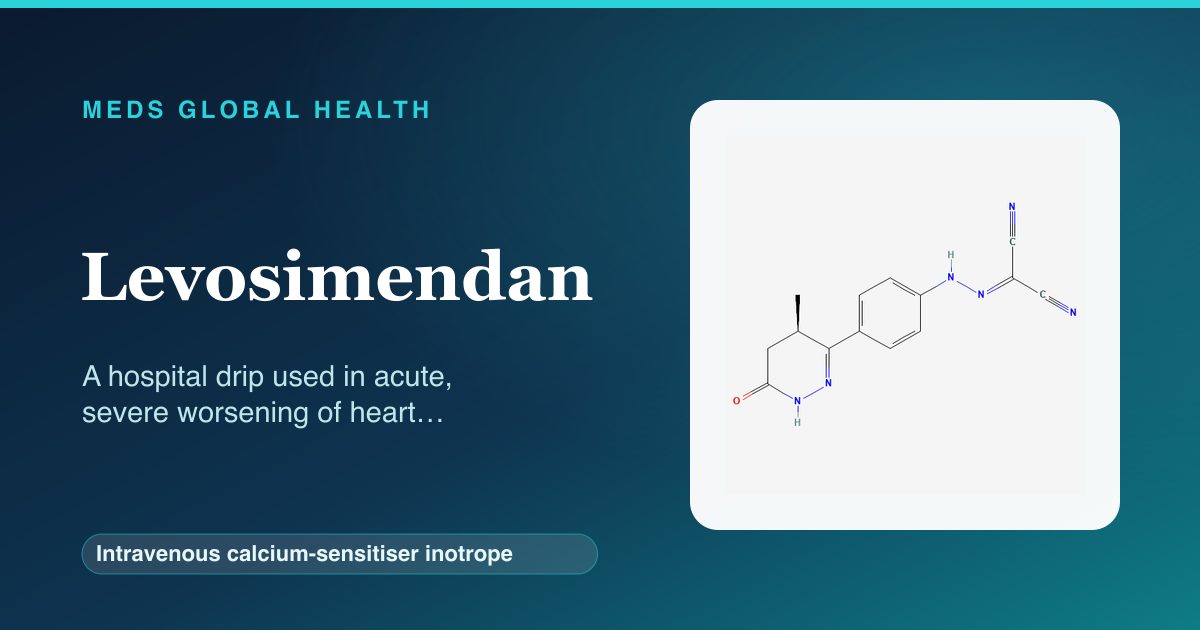
What it is
Levosimendan is a hospital medicine used to support the heart in acute decompensated heart failure, where the heart is suddenly struggling to pump enough blood and a person becomes very unwell. It belongs to a group called inotropes, which strengthen the heart's pumping, and it works in a particular way as a calcium-sensitiser. It is given as a controlled infusion into a vein, usually in a high-dependency or intensive setting, for a limited time. It is not a long-term treatment but a way of helping the heart through a serious episode while other care is given, all under close monitoring.
How it works
Levosimendan makes the heart muscle more sensitive to calcium, the mineral that triggers each contraction, so the heart squeezes more forcefully without simply being whipped harder. At the same time, it relaxes and widens blood vessels, which reduces the resistance the heart has to pump against and can ease the workload on a failing heart. Together these effects help the heart move blood around the body more effectively during a serious episode. Because widening blood vessels can lower blood pressure and the stronger, sometimes faster heartbeat can affect the rhythm, it is given carefully with continuous monitoring.
Company & origin
A hospital medicine given into a vein in the UK to support the heart in acute, severe worsening of heart failure.
Practical use
How to take Levosimendan
General, dose-free guidance — always follow your prescriber's and the leaflet's specific instructions.
- It is given by the hospital team as a controlled drip into a vein, not something you take yourself.
- The rate is adjusted carefully, and you will be on continuous heart and blood-pressure monitoring.
- Tell the staff straight away if you feel dizzy, light-headed, have palpitations or a bad headache.
- Monitoring usually continues for some time after the drip finishes, as the effect can last for several days.
- It is used as a short-term treatment for a serious episode, not as an ongoing medicine.
Weighing it up
Advantages & disadvantages of Levosimendan
Advantages
- Helps a failing heart pump more strongly during a serious, sudden worsening of heart failure.
- Eases the heart's workload by also relaxing and widening blood vessels.
- Its helpful effect can continue for some days after the infusion has finished.
Disadvantages
- Can lower the blood pressure and speed up the heart.
- Commonly causes headache, and can occasionally trigger abnormal heart rhythms.
- Only suitable as a short-term hospital treatment under close monitoring.
Practical use
Good to know
Levosimendan is strictly a hospital medicine for serious episodes: it is given as a controlled drip into a vein, usually in a high-dependency or intensive care setting, with continuous monitoring. The main things the team watches for are a fall in blood pressure and a faster heartbeat, because the medicine both strengthens the heart and relaxes blood vessels; headache is also common for the same reasons. The heart rhythm is watched closely, as a stronger, faster heartbeat can sometimes trigger irregular rhythms. One feature of this medicine is that its helpful effect can last for some days after the infusion finishes, because the body forms a long-lasting active substance from it, so monitoring continues for a while afterwards. As it is given and managed entirely by the hospital team, the patient's role is simply to report symptoms such as dizziness, palpitations or headache.
Who should not take it / use with caution
- It is avoided in people with very low blood pressure or a very fast heartbeat.
- It is used with caution, or avoided, in people with certain severe heart-valve, kidney or liver problems, or a history of serious heart-rhythm disturbances.
- People who have had a serious allergic reaction to it should not be given it.
Monitoring
- Continuous monitoring of heart rate, heart rhythm (ECG) and blood pressure.
- Blood tests, including potassium levels, during and after treatment.
- Continued monitoring for some time after the drip finishes, as the effect can last several days.
Side effects
- A fall in blood pressure, which may cause light-headedness.
- A fast heartbeat, palpitations or headache.
- Less commonly, abnormal heart rhythms or low blood potassium, which monitoring is designed to catch.
Key interactions
- Other medicines that lower blood pressure can combine with it to lower it further.
- Medicines that affect the heart's rhythm may add to the risk of abnormal rhythms.
- The hospital team reviews all your medicines before and during treatment.
Available as: A concentrate made up into a solution and given as a controlled infusion into a vein in hospital.
Answers
Levosimendan: frequently asked questions
What is levosimendan used for?
It is given in hospital to help a weakened heart pump more effectively during a serious, sudden worsening of heart failure (acute decompensated heart failure).
How does it help the heart?
It makes the heart muscle more sensitive to calcium so it squeezes more forcefully, and it relaxes blood vessels to ease the heart's workload.
How is it given?
It is given as a controlled drip into a vein by the hospital team, usually in a high-dependency or intensive setting, with continuous heart and blood-pressure monitoring.
Why does monitoring continue after the drip ends?
The body forms a long-lasting active substance from levosimendan, so its helpful effect can last for several days, and monitoring continues during that time.
What are the main side effects?
It can lower the blood pressure, speed up the heart and cause headache, and occasionally trigger abnormal heart rhythms, which is why it is given under close monitoring.
Authoritative sources
- BNF
- NICE CKS
Building a medicines information resource?
We create evidence-led, dose-free drug and formulary references for teams.