Thyroid hormone T3
Liothyronine
A fast-acting thyroid hormone (T3) used in specific underactive-thyroid situations rather than as routine treatment.
What is Liothyronine?
Liothyronine is the active, fast-acting thyroid hormone known as T3. Most people with an underactive thyroid are treated with levothyroxine (the slower, longer-acting T4 hormone) instead, but liothyronine is used in specific situations, such as severe hypothyroid states or some specialist cases. It works more quickly than levothyroxine but wears off faster, so it is usually taken more than once a day. Taking too much causes a racing heart, feeling hot, sweating and anxiety, and it needs care in people with heart problems.
Education and reference only. This is a plain-language guide to Liothyronine — it deliberately contains no doses. Doses depend on the person, the brand and the reason for treatment, and belong with your prescriber. Always check the BNF, the product labelling (SmPC) and follow medical advice.
What it is
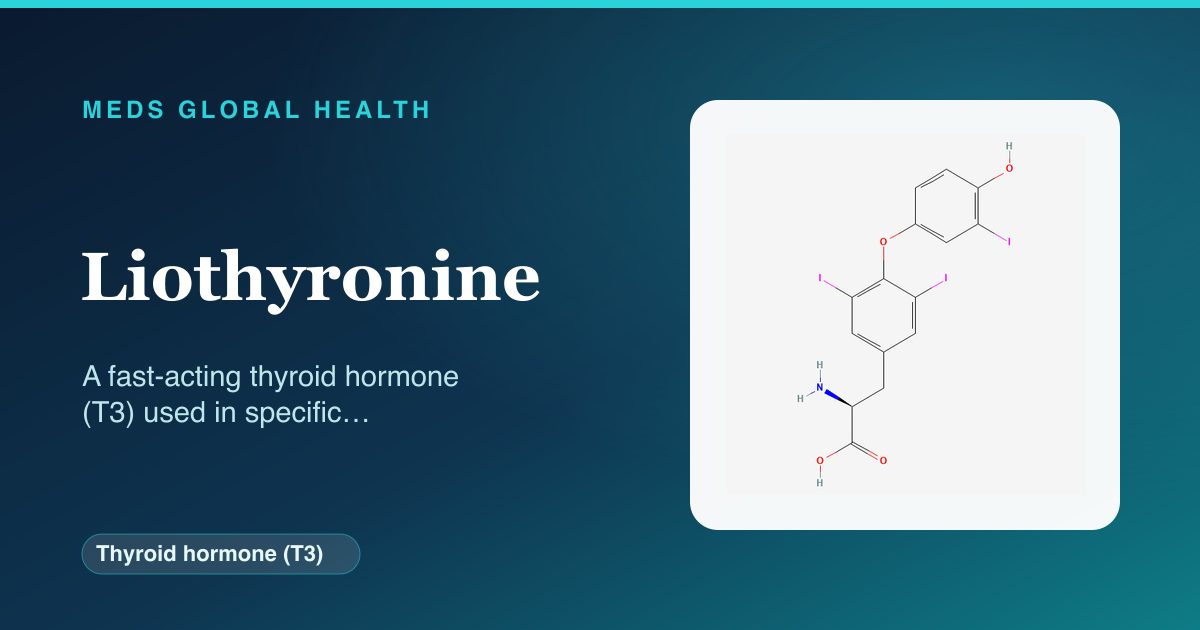
Liothyronine is a synthetic form of triiodothyronine, the body's most active thyroid hormone, usually called T3. The thyroid gland normally makes mostly T4 (levothyroxine), which the body converts into T3 as it is needed. Liothyronine supplies ready-made T3, so it acts faster and more strongly but does not last as long. Because of this, levothyroxine is the standard treatment for an underactive thyroid, while liothyronine is reserved for particular situations, often started and overseen by a specialist.
How it works
Thyroid hormones control the body's metabolic rate — how quickly cells use energy. In an underactive thyroid the body slows down, causing tiredness, weight gain, feeling cold and low mood. Liothyronine replaces the active T3 hormone directly, switching the body's metabolism back up. Because it is the ready-made active form, it acts quickly but is cleared from the body faster than levothyroxine, which is why it is usually divided through the day and why its effects, good and bad, come on more sharply.
Company & origin
A fast-acting thyroid hormone (T3) used in the UK for certain hypothyroid situations, usually under specialist guidance.
What it treats
Conditions Liothyronine is used for
Practical use
How to take Liothyronine
General, dose-free guidance — always follow your prescriber's and the leaflet's specific instructions.
- Take it exactly as prescribed; because it is short-acting it is often split into more than one time a day.
- Try to take it at consistent times each day to keep your hormone levels steady.
- Do not change or stop it suddenly without advice, as this can make symptoms swing.
- Tell your prescriber if you have heart problems, as the amount may need to be built up slowly and carefully.
- Report a racing or pounding heart, chest pain, feeling very hot, shaky or anxious, as these can mean the amount is too high.
Weighing it up
Advantages & disadvantages of Liothyronine
Advantages
- Acts faster than levothyroxine, which can be useful in specific or urgent situations.
- Useful in certain specialist cases where standard T4 treatment is not enough or not suitable.
- Directly supplies the body's active thyroid hormone (T3).
Disadvantages
- Wears off quickly, so it usually has to be taken more than once a day.
- Easier to over-replace, causing a racing heart, sweating, anxiety and sleep problems.
- Needs extra caution in heart disease and in older people, and is far more expensive than levothyroxine.
Practical use
Good to know
Liothyronine is not the usual first choice for an underactive thyroid — levothyroxine is — so being given T3 often means there is a specific reason, decided with a specialist. Because it acts fast and wears off quickly, getting the amount right matters: too much causes symptoms of an overactive thyroid, such as a fast or pounding heartbeat, feeling hot, sweating, shakiness, anxiety and trouble sleeping, while too little leaves the underactive symptoms unresolved. It needs particular caution in older people and anyone with heart disease, because speeding up the metabolism puts more demand on the heart and can trigger chest pain or an irregular heartbeat. Blood tests guide how much is needed, and it should not be stopped or changed suddenly without advice. It is also used in some emergency hospital settings, but that is a different specialist situation.
Who should not take it / use with caution
- It is used with great caution, and usually built up slowly, in people with heart disease or an irregular heartbeat.
- People with an overactive thyroid that has not been corrected should not take additional thyroid hormone.
- It should not be used to try to lose weight or boost energy in people with a normal thyroid.
Monitoring
- Regular blood tests to check thyroid hormone levels and guide how much is needed.
- Watching for signs of too much hormone, such as a fast heartbeat, sweating or anxiety.
- Closer heart monitoring in older people and anyone with heart disease.
Side effects
- Most side effects come from too much hormone: a fast or pounding heartbeat, feeling hot, sweating and shakiness.
- Anxiety, restlessness, trouble sleeping and weight loss can occur if the amount is too high.
- Rarely, chest pain or an irregular heartbeat, which need urgent attention, especially in those with heart disease.
Key interactions
- Iron and calcium supplements and some indigestion remedies can reduce its absorption, so separate the timing.
- It can change how much warfarin is needed, so blood-clotting tests may need closer monitoring.
- Some medicines for diabetes, epilepsy and the heart can be affected, so tell your prescriber what you take.
Available as: Tablets taken by mouth; an injectable form is used in some hospital emergencies.
Answers
Liothyronine: frequently asked questions
How is liothyronine different from levothyroxine?
Levothyroxine is the slower, longer-acting T4 hormone and is the standard treatment for an underactive thyroid; liothyronine is the fast-acting active T3 hormone used in specific situations, usually under specialist guidance.
Why do I take it more than once a day?
Liothyronine is short-acting and wears off quickly, so it is often split through the day to keep your hormone levels steadier.
What are the signs I am taking too much?
A fast or pounding heartbeat, feeling hot, sweating, shakiness, anxiety and trouble sleeping suggest the amount may be too high, and you should tell your prescriber.
Is it safe if I have a heart condition?
It can be used but with extra caution, usually built up slowly, because speeding up the metabolism puts more demand on the heart; your prescriber will monitor you closely.
Can I use it to lose weight or boost energy?
No. It should only be used for a genuine thyroid reason, as taking thyroid hormone with a normal thyroid can be dangerous for the heart.
The wider class
About Thyroid hormone (T3)
Liothyronine belongs to the thyroid hormone (t3) class. For how the class as a whole works, its shared safety principles and monitoring, see the full guide.
Browse by body system
Authoritative sources
- BNF
- NICE CKS
Building a medicines information resource?
We create evidence-led, dose-free drug and formulary references for teams.