A specialist cholesterol-lowering medicine (MTP inhibitor)
Lomitapide
A specialist cholesterol-lowering medicine used for a rare inherited condition with very high cholesterol.
What is Lomitapide?
Lomitapide is a specialist medicine used to lower cholesterol in adults with homozygous familial hypercholesterolaemia, a rare inherited condition that causes very high cholesterol from an early age. It works in the gut and liver to reduce the cholesterol the body puts into the blood, and is used alongside a low-fat diet and other cholesterol treatments. Its most important risk is a build-up of fat in the liver, which can damage it, so liver function is monitored closely under a restricted programme. It also commonly causes stomach and bowel problems, needs fat-soluble vitamin supplements, and interacts with many other medicines.
Education and reference only. This is a plain-language guide to Lomitapide — it deliberately contains no doses. Doses depend on the person, the brand and the reason for treatment, and belong with your prescriber. Always check the BNF, the product labelling (SmPC) and follow medical advice.
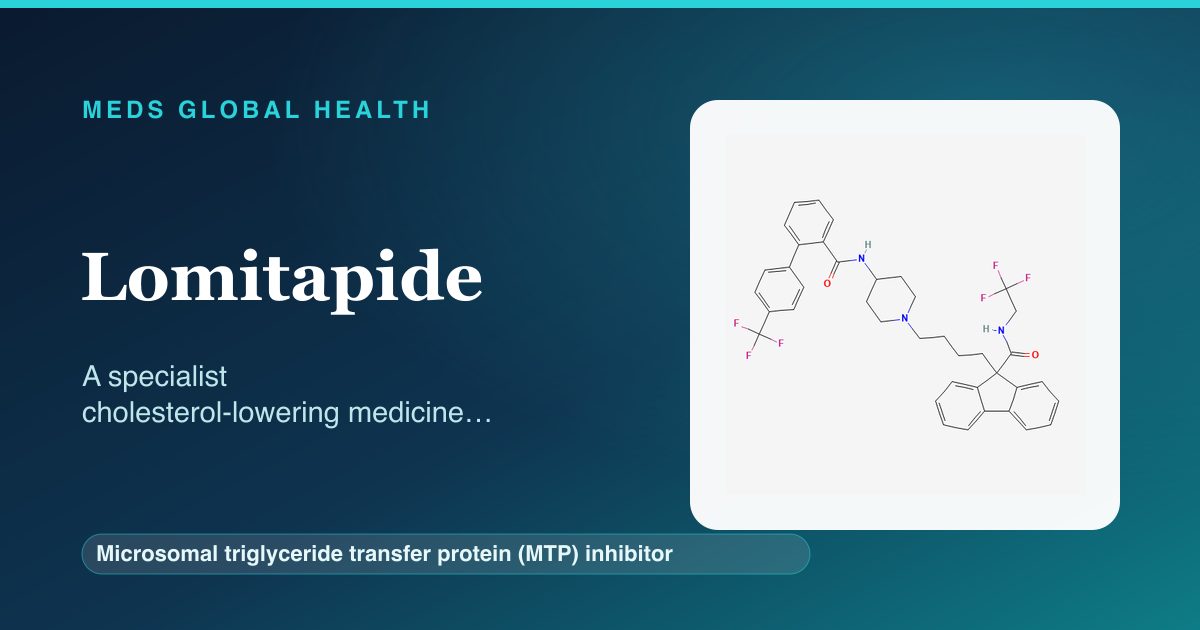
What it is
Lomitapide is a microsomal triglyceride transfer protein (MTP) inhibitor, a specialist medicine used to lower cholesterol in adults with homozygous familial hypercholesterolaemia. This is a rare, severe inherited condition in which cholesterol is extremely high from childhood, greatly raising the risk of early heart disease. Lomitapide is used in addition to a strict low-fat diet and other cholesterol-lowering treatments when these are not enough. Because of its risks, especially to the liver, it is only prescribed by specialists through a controlled programme and needs careful monitoring.
How it works
Cholesterol and fats are packaged in the gut and liver into particles that carry them into the bloodstream, a process that needs a protein called MTP. Lomitapide blocks MTP, so the liver and gut put fewer of these cholesterol-carrying particles into the blood, which lowers blood cholesterol. However, because the same process normally moves fat out of the liver, blocking it can cause fat to build up inside the liver, which can lead to liver damage. This is why liver tests are checked closely, why a low-fat diet is essential, and why fat-soluble vitamin supplements are needed, as less fat is absorbed.
Company & origin
A specialist lipid-lowering medicine used in the UK for a rare inherited condition with very high cholesterol, under a restricted programme.
What it treats
Conditions Lomitapide is used for
Practical use
How to take Lomitapide
General, dose-free guidance — always follow your prescriber's and the leaflet's specific instructions.
- Take it exactly as your specialist directs, alongside a strict low-fat diet to help it work and reduce bowel side effects.
- Take the fat-soluble vitamin and fatty acid supplements you are given every day, as the medicine reduces how much fat you absorb.
- Avoid grapefruit juice and limit alcohol, as both add to the risk of liver problems or higher medicine levels.
- Give your specialist a full list of your other medicines, as lomitapide interacts with many of them.
- Attend all your blood tests and appointments, as liver function must be monitored regularly.
Weighing it up
Advantages & disadvantages of Lomitapide
Advantages
- Lowers very high cholesterol in a rare inherited condition when other treatments are not enough.
- Taken by mouth as a capsule alongside diet and other cholesterol treatments.
- Offers an option for people at very high risk of early heart disease.
Disadvantages
- Can cause fat to build up in the liver and damage it, needing close monitoring and a restricted programme.
- Very commonly causes stomach and bowel problems, especially early on.
- Needs a strict low-fat diet, daily vitamin supplements, and avoidance of grapefruit and much alcohol.
Practical use
Good to know
The most important thing to understand about lomitapide is that it can cause fat to build up in the liver, which can harm it, so liver function is checked before and regularly during treatment, and it is only available through a restricted specialist programme. A strict low-fat diet is essential, both to help the medicine work and to reduce stomach and bowel side effects such as diarrhoea, nausea, wind and tummy pain, which are very common, especially early on. Because the medicine reduces how much fat is absorbed, daily supplements of fat-soluble vitamins (such as vitamin E) and essential fatty acids are needed. Lomitapide also interacts with a large number of other medicines, including some antibiotics, antifungals and grapefruit juice, which can raise its levels and risks, so a full medicines list is vital. Alcohol should be limited because of the liver risk. It is used only under close specialist supervision.
Who should not take it / use with caution
- People with significant liver disease or unexplained, persistently abnormal liver blood tests should not take it.
- It must not be used in pregnancy, and effective contraception is needed.
- It must not be combined with certain medicines that strongly raise its levels, such as some antibiotics and antifungals.
- It should only be used under a specialist through the restricted prescribing programme.
Monitoring
- Liver function blood tests before and regularly during treatment to check for fat build-up and damage.
- Checking cholesterol levels to see how well it is working.
- Reviewing diet, vitamin supplements and other medicines for interactions.
Side effects
- Diarrhoea, nausea, wind, tummy pain or vomiting, especially in the first weeks.
- A build-up of fat in the liver and raised liver blood tests, which monitoring is designed to catch.
- Low levels of fat-soluble vitamins if supplements are not taken.
- Less commonly, weight loss or other digestive problems.
Key interactions
- Some antibiotics and antifungals, and grapefruit juice, can strongly raise lomitapide levels and its risks.
- It can affect the levels of other medicines, such as warfarin and some statins, so doses may need adjusting.
- Alcohol adds to the risk of liver problems and should be limited.
Available as: Capsules taken by mouth.
Answers
Lomitapide: frequently asked questions
What is lomitapide used for?
It is a specialist medicine used to lower very high cholesterol in adults with homozygous familial hypercholesterolaemia, a rare inherited condition, alongside diet and other treatments.
Why is the liver monitored so closely?
Lomitapide can cause fat to build up in the liver, which can damage it, so liver blood tests are checked before and regularly during treatment under a restricted programme.
Why do I need a low-fat diet and vitamin supplements?
A strict low-fat diet helps the medicine work and reduces bowel side effects, and because less fat is absorbed you need daily fat-soluble vitamin and fatty acid supplements.
Can I drink grapefruit juice or alcohol?
No to grapefruit juice, which raises lomitapide levels and its risks, and alcohol should be limited because both add to the risk of liver problems.
Why does my specialist need my full medicines list?
Lomitapide interacts with many other medicines, some of which can raise its levels dangerously, so a complete medicines list is essential for safety.
Authoritative sources
- BNF
- NICE CKS
Building a medicines information resource?
We create evidence-led, dose-free drug and formulary references for teams.