A tablet that raises platelets before a procedure in liver disease
Lusutrombopag
A tablet used for a short course to raise platelets before a planned procedure in people with chronic liver disease.
What is Lusutrombopag?
Lusutrombopag is a specialist tablet used to raise the platelet count in people with chronic liver disease who have a low count and need a planned procedure or operation. Platelets help blood clot, so raising them for a short time lowers the bleeding risk around the procedure. It is a thrombopoietin-receptor agonist, taken as a short course leading up to the procedure rather than long term. The most important safety point is the risk of blood clots (thrombosis), especially in advanced liver disease, so it is used carefully and for a limited time.
Education and reference only. This is a plain-language guide to Lusutrombopag — it deliberately contains no doses. Doses depend on the person, the brand and the reason for treatment, and belong with your prescriber. Always check the BNF, the product labelling (SmPC) and follow medical advice.
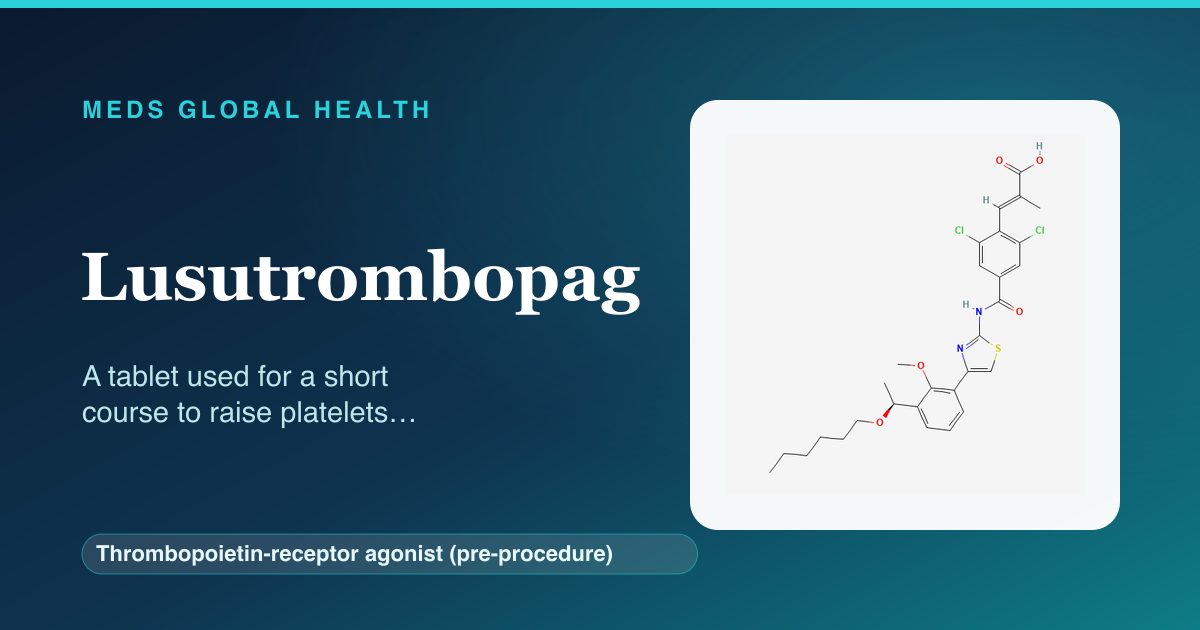
What it is
Lusutrombopag is a specialist medicine used in people with chronic liver disease who have a low platelet count, which is common in advanced liver disease. Platelets are the tiny blood cells that help the blood clot, so a low count raises the risk of bleeding during procedures. Lusutrombopag is a thrombopoietin-receptor agonist, a medicine that prompts the body to make more platelets. It is taken as a short course of tablets in the run-up to a planned procedure or operation to lift the platelet count enough to reduce bleeding risk. It is not a long-term treatment, and it is used under specialist liver care.
How it works
The body makes platelets in the bone marrow in response to a natural hormone called thrombopoietin. Lusutrombopag acts like this hormone, switching on the thrombopoietin receptor and prompting the bone marrow to produce more platelets. By raising the platelet count for a period of time, it makes the blood better able to clot around the time of a planned procedure, lowering the risk of bleeding. Because the aim is only to cover the procedure, it is given as a short course beforehand rather than continuously, and the platelet count is checked to time the procedure appropriately.
Company & origin
A specialist oral medicine used in the UK to raise platelet counts before a planned procedure in people with chronic liver disease.
Practical use
How to take Lusutrombopag
General, dose-free guidance — always follow your prescriber's and the leaflet's specific instructions.
- Take the tablets by mouth as a short course before your planned procedure, exactly as your specialist instructs.
- Take it for the full short course leading up to the procedure rather than long term.
- Attend the blood tests used to check your platelet count and to time the procedure correctly.
- Report signs of a possible blood clot, such as tummy pain, leg swelling, breathlessness or chest pain, straight away.
- Tell the team about any history of blood clots or clotting problems before starting.
Weighing it up
Advantages & disadvantages of Lusutrombopag
Advantages
- Raises the platelet count to lower the bleeding risk around a planned procedure in chronic liver disease.
- Taken by mouth as a short course rather than needing platelet transfusions in many cases.
- Used for a limited time, targeted at covering the procedure.
Disadvantages
- Carries a risk of blood clots (thrombosis), especially in advanced liver disease.
- Only intended for short-term use around a procedure, not as ongoing treatment.
- Needs blood tests and specialist planning to time the procedure correctly.
Practical use
Good to know
The main purpose of lusutrombopag is short-term: it raises platelets to cover a planned procedure in people with chronic liver disease, not as an ongoing treatment, so it is taken as a brief course beforehand. The most important safety concern is the risk of blood clots (thrombosis), including clots in the veins that drain the liver and gut, which is a particular worry in advanced liver disease; the specialist team weighs this risk carefully and watches for symptoms such as tummy pain, leg swelling or breathlessness. Because the goal is to time the procedure for when platelets have risen enough, the count is checked and the procedure planned accordingly. Tell the team about any history of blood clots or clotting problems, and report any signs of a clot promptly.
Who should not take it / use with caution
- People who have had a serious allergic reaction to lusutrombopag should not take it.
- It is used with great caution, or avoided, in people at high risk of, or with a history of, blood clots.
- It should only be used under specialist liver care, as a short course before a planned procedure.
Monitoring
- Blood tests to check the platelet count and to time the planned procedure.
- Watching for signs of blood clots, such as tummy pain, leg swelling or breathlessness.
- Reviewing the bleeding risk around the procedure with the specialist team.
Side effects
- Headache or nausea in some people.
- Blood clots (thrombosis), which can be serious, especially in advanced liver disease.
- Rarely, other reactions, which should be reported to the specialist team.
Key interactions
- It is used with care alongside other medicines that affect clotting or the risk of clots, so give a full medicines list.
- There are few other well-established routine interactions, but tell your team about everything you take.
- Tell the team about any over-the-counter or herbal products as well as prescribed medicines.
Available as: Tablets taken by mouth.
Answers
Lusutrombopag: frequently asked questions
What is lusutrombopag used for?
It is used to raise the platelet count in people with chronic liver disease who have a low count and need a planned procedure, to lower the bleeding risk.
How long do I take it?
It is taken as a short course of tablets in the run-up to the procedure, not as a long-term treatment.
How does it raise platelets?
It acts like the natural hormone thrombopoietin, prompting the bone marrow to make more platelets, the cells that help blood clot.
What is the main risk?
The main concern is the risk of blood clots (thrombosis), especially in advanced liver disease, so it is used carefully and for a limited time.
What clot symptoms should I report?
Report tummy pain, leg swelling, breathlessness or chest pain straight away, as these can be signs of a blood clot.
Authoritative sources
- BNF
- NICE CKS
Building a medicines information resource?
We create evidence-led, dose-free drug and formulary references for teams.