A worm (anthelmintic) treatment
Mebendazole
A worm treatment used mainly for threadworm, and for some other intestinal worm infections.
What is Mebendazole?
Mebendazole is an anthelmintic (worm treatment). It is used most often for threadworm — a common, harmless but irritating gut worm that causes an itchy bottom — and for some other intestinal worms. It works by stopping the worms absorbing the sugars they need, so they die and are passed out. For threadworm, the whole household is often treated together with strict hygiene measures.
Education and reference only. This is a plain-language guide to Mebendazole — it deliberately contains no doses. Doses depend on the person, the brand and the reason for treatment, and belong with your prescriber. Always check the BNF, the product labelling (SmPC) and follow medical advice.
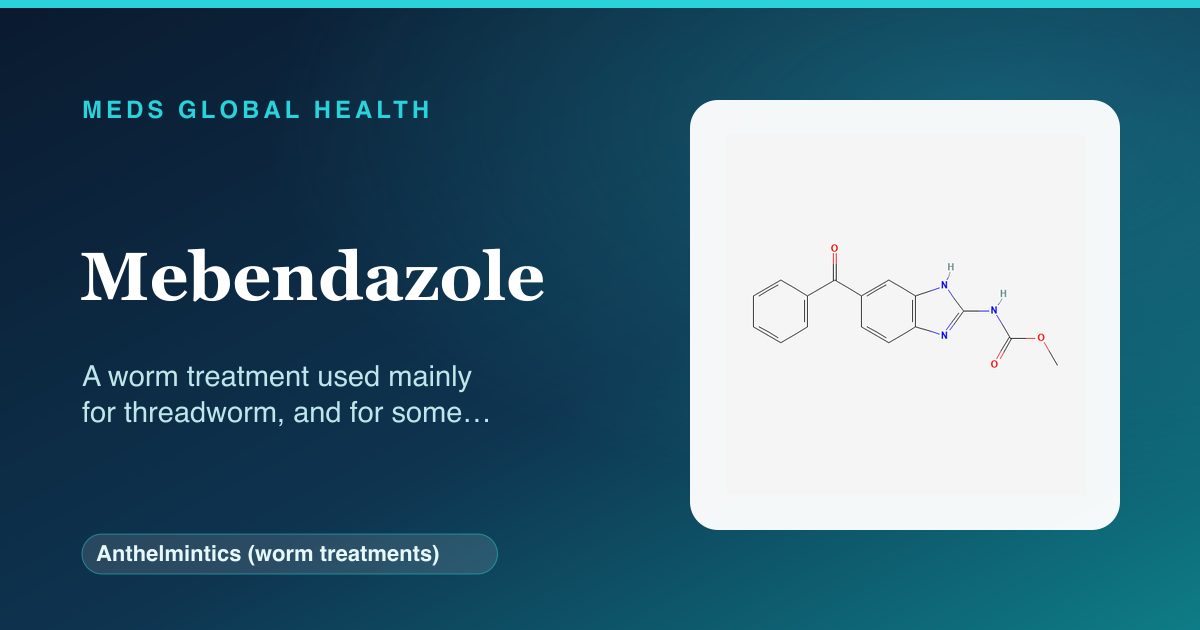
What it is
Mebendazole is a medicine that kills several types of intestinal worm. In the UK it is most often bought from a pharmacy to treat threadworm (pinworm), the small white worms that cause an itchy bottom, especially at night. It is also used on prescription for some other worm infections such as roundworm, whipworm and hookworm. Many people only need a single dose for threadworm, sometimes repeated after a couple of weeks.
How it works
Mebendazole stops worms taking up glucose, the sugar they rely on for energy. Without their fuel supply the worms gradually run out of energy, lose the ability to survive in the gut and are passed out in the stool. It acts mainly on the worms inside the bowel rather than being heavily absorbed into the body, which is part of why it is generally well tolerated.
Company & origin
Originated / developed by: Janssen (originator).
An anthelmintic used in the UK to treat threadworm and some other worm infections.
Practical use
How to take Mebendazole
General, dose-free guidance — always follow your prescriber's and the leaflet's specific instructions.
- For threadworm, treat everyone in the household at the same time, even those without symptoms, unless advised otherwise.
- Combine the medicine with strict hygiene for two weeks: wash bedding, towels and nightwear, shower or wash the bottom first thing each morning, and keep nails short and clean.
- Encourage thorough handwashing after using the toilet and before eating, and discourage scratching the bottom or biting nails.
- A repeat dose after about two weeks is often advised because the medicine does not kill newly hatched eggs.
- If you miss a dose for a course covering other worms, take it when you remember; for a single threadworm dose, simply take it as planned and ask a pharmacist if unsure.
Weighing it up
Advantages & disadvantages of Mebendazole
Advantages
- Often clears threadworm with a single dose, making treatment simple.
- Available without prescription from pharmacies for threadworm in suitable people.
- Generally very well tolerated because little is absorbed into the body.
Disadvantages
- Does not kill worm eggs, so reinfection is common without strict hygiene.
- Usually avoided in pregnancy and in very young children without advice.
- May need repeating, and the whole household has to be treated for threadworm.
Practical use
Good to know
Threadworm spreads very easily, so for threadworm the whole household is usually treated at the same time even if only one person has symptoms. Medicine alone is not enough — strict hygiene for a couple of weeks is essential to stop reinfection, because eggs are swallowed again from hands, nails and surfaces. It is generally avoided in pregnancy, particularly the first three months, so seek advice if you are or might be pregnant. It is also not usually recommended for children under two without medical advice. If symptoms continue after treatment and good hygiene, speak to a pharmacist or GP.
Who should not take it / use with caution
- People who are pregnant or trying to conceive should seek advice, as it is generally avoided especially in the first trimester.
- Children under two should not be given it without medical advice.
- Anyone who has had an allergic reaction to mebendazole should avoid it.
Monitoring
- No routine monitoring is needed for a short threadworm course.
- If longer treatment is given for other worms, a doctor may review symptoms and occasionally blood tests.
- Return to a pharmacist or GP if worms persist despite treatment and good hygiene.
Side effects
- Often none; some people get mild tummy ache, wind or loose stools.
- Occasionally headache or feeling sick.
- Rarely, a rash or signs of an allergic reaction such as swelling or itching — seek help if this happens.
Key interactions
- Tell the pharmacist about all your medicines, as some such as certain epilepsy or stomach-acid medicines can affect it.
- Metronidazole is sometimes avoided alongside it because of a rare reaction.
- Always check with a pharmacist before combining it with other treatments.
Available as: Chewable tablets; also an oral suspension.
Answers
Mebendazole: frequently asked questions
Why does the whole family need treating?
Threadworm spreads very easily through swallowed eggs, so others are often infected without symptoms; treating everyone at once helps stop it bouncing back.
Do I need to repeat the dose?
A repeat after about two weeks is often advised because the medicine kills the worms but not their eggs, which can hatch later.
Can I take it in pregnancy?
It is generally avoided in pregnancy, especially the first three months, so speak to a pharmacist or GP for advice first.
Is hygiene really necessary if I take the medicine?
Yes. Without washing bedding, morning showers and good hand and nail hygiene for two weeks, eggs are easily swallowed again and the infection returns.
Can young children take it?
It is not usually recommended under the age of two without medical advice, so check with a pharmacist or GP.
The wider class
About Anthelmintics (worm treatments)
Mebendazole belongs to the anthelmintics (worm treatments) class. For how the class as a whole works, its shared safety principles and monitoring, see the full guide.
Browse by body system
Authoritative sources
- BNF
- NICE CKS
Building a medicines information resource?
We create evidence-led, dose-free drug and formulary references for teams.