A medicine that protects the bladder during certain chemotherapy
Mesna
A protective medicine given alongside the chemotherapy drugs cyclophosphamide and ifosfamide to guard the bladder from damage.
What is Mesna?
Mesna is a supportive medicine given alongside the chemotherapy drugs cyclophosphamide and ifosfamide to protect the bladder. These chemotherapy drugs produce a substance that can irritate and damage the bladder lining, causing bleeding into the urine, a problem called haemorrhagic cystitis. Mesna mops up that harmful substance in the bladder so the lining is protected. It is given around the time of the chemotherapy, often into a vein or sometimes by mouth, and is generally well tolerated, with allergic reactions being uncommon.
Education and reference only. This is a plain-language guide to Mesna — it deliberately contains no doses. Doses depend on the person, the brand and the reason for treatment, and belong with your prescriber. Always check the BNF, the product labelling (SmPC) and follow medical advice.
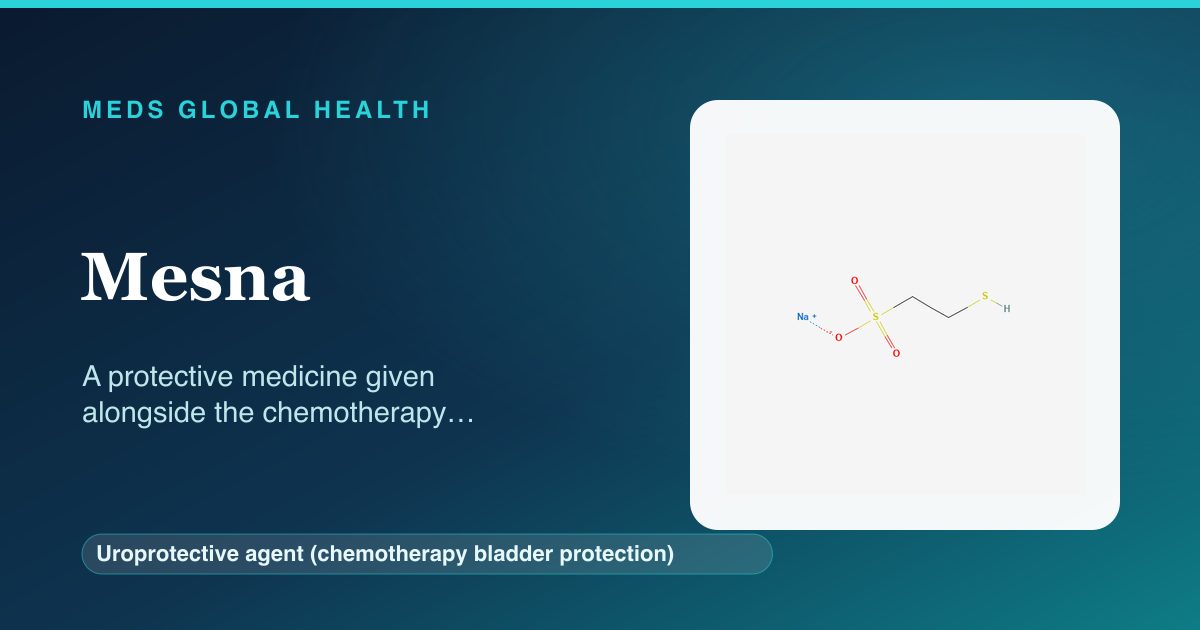
What it is
Mesna is a protective (uroprotective) medicine used in cancer treatment. It is not a chemotherapy drug itself and does not treat cancer; instead it is given together with certain chemotherapy drugs, mainly cyclophosphamide and ifosfamide, to protect the bladder from a known side effect of those drugs. Without protection, these chemotherapy drugs can irritate the bladder lining and cause bleeding into the urine. Mesna is given by a cancer team, usually into a vein but sometimes by mouth, around the time the chemotherapy is given.
How it works
Cyclophosphamide and ifosfamide are broken down in the body into substances, one of which collects in the bladder and can irritate and damage its lining, leading to bleeding into the urine. Mesna travels to the bladder and binds to that harmful substance, neutralising it before it can cause damage. Because the chemotherapy by-product keeps appearing for a while, mesna is timed and repeated to cover that whole period, which is why it is given around and after the chemotherapy rather than as a one-off. Drinking plenty of fluids alongside it also helps flush the bladder.
Company & origin
A supportive medicine used in UK cancer care to protect the bladder when certain chemotherapy drugs are given.
Practical use
How to take Mesna
General, dose-free guidance — always follow your prescriber's and the leaflet's specific instructions.
- It is usually given into a vein by the cancer team around the time of your chemotherapy, sometimes by mouth as your team directs.
- Take or receive all the scheduled doses, as they are timed to protect your bladder during and after the chemotherapy.
- Drink plenty of fluids and pass urine regularly, as this helps flush the bladder and protect it.
- Tell your team straight away about any rash, flushing, swelling or difficulty breathing, as these can signal a reaction.
- Report any blood in your urine or burning when passing urine to your cancer team.
Weighing it up
Advantages & disadvantages of Mesna
Advantages
- Effectively protects the bladder from damage caused by cyclophosphamide and ifosfamide.
- Helps prevent haemorrhagic cystitis, a painful bleeding irritation of the bladder.
- Generally well tolerated, allowing important chemotherapy to be given more safely.
Disadvantages
- Does not treat cancer itself; it is purely a protective medicine.
- Must be timed carefully around the chemotherapy to give proper protection.
- Can rarely cause allergic or hypersensitivity reactions.
Practical use
Good to know
The key point about mesna is that it is a protective medicine, not a treatment for cancer: its whole job is to guard the bladder when cyclophosphamide or ifosfamide are used, preventing the bleeding bladder irritation called haemorrhagic cystitis. Because the harmful chemotherapy by-product lingers, mesna is given on a schedule that covers the period during and after the chemotherapy, so it is important the doses are not missed. Keeping well hydrated and passing urine regularly helps the bladder stay protected. Mesna is generally well tolerated; the main thing the team watches for is an uncommon allergic or hypersensitivity reaction, such as a rash, flushing or, rarely, more serious reactions. The cancer team will monitor your urine for any signs of blood.
Who should not take it / use with caution
- People who have had a serious allergic reaction to mesna should not be given it.
- It is used with care, under specialist guidance, where there is a history of allergic-type reactions.
- It should only be given as part of supervised cancer treatment by a specialist team.
Monitoring
- Checking the urine for blood, the main sign of bladder irritation.
- Watching for any allergic or hypersensitivity reaction during and after treatment.
- Reviewing fluid intake and urine output to keep the bladder well flushed.
Side effects
- Nausea, stomach upset, headache or tiredness, often partly due to the chemotherapy itself.
- Flushing, rash or itching, which can signal a hypersensitivity reaction.
- Rarely, more serious allergic reactions with swelling or difficulty breathing, which need urgent attention.
Key interactions
- It is given specifically alongside cyclophosphamide and ifosfamide as part of a chemotherapy plan.
- There are few well-established routine interactions, but tell your team about all your medicines.
- Your team coordinates the timing of mesna with your chemotherapy so protection is complete.
Available as: A solution given into a vein, and tablets taken by mouth.
Answers
Mesna: frequently asked questions
What is mesna used for?
It is a protective medicine given alongside the chemotherapy drugs cyclophosphamide and ifosfamide to guard the bladder from damage and prevent bleeding into the urine.
Does mesna treat cancer?
No. Mesna does not treat cancer; its only job is to protect the bladder from a side effect of certain chemotherapy drugs.
Why do I need it with my chemotherapy?
Cyclophosphamide and ifosfamide produce a substance that can irritate and damage the bladder lining; mesna neutralises that substance so the bladder is protected.
Why is it given more than once?
The harmful chemotherapy by-product keeps appearing for a while, so mesna is given on a schedule that covers the whole period during and after the chemotherapy.
Is mesna usually well tolerated?
Yes, it is generally well tolerated; the main thing the team watches for is an uncommon allergic or hypersensitivity reaction such as a rash or flushing.
Authoritative sources
- BNF
- NICE CKS
Building a medicines information resource?
We create evidence-led, dose-free drug and formulary references for teams.