A warming rub for muscle and joint aches
Methyl salicylate (oil of wintergreen)
An over-the-counter warming rub applied to the skin to relieve minor muscle and joint aches.
What is Methyl salicylate (oil of wintergreen)?
Methyl salicylate is a salicylate, related to aspirin, used in warming rubs and creams for minor muscle and joint aches. Massaged into the skin it creates a warm, soothing sensation that helps distract from the ache beneath, acting as a counter-irritant rather than treating the underlying problem. It is for external use only and must be kept off broken skin, the eyes and mucous membranes. Because it is a salicylate, extra care is needed in anyone sensitive to aspirin and in children.
Education and reference only. This is a plain-language guide to Methyl salicylate (oil of wintergreen) — it deliberately contains no doses. Doses depend on the person, the brand and the reason for treatment, and belong with your prescriber. Always check the BNF, the product labelling (SmPC) and follow medical advice.
What it is
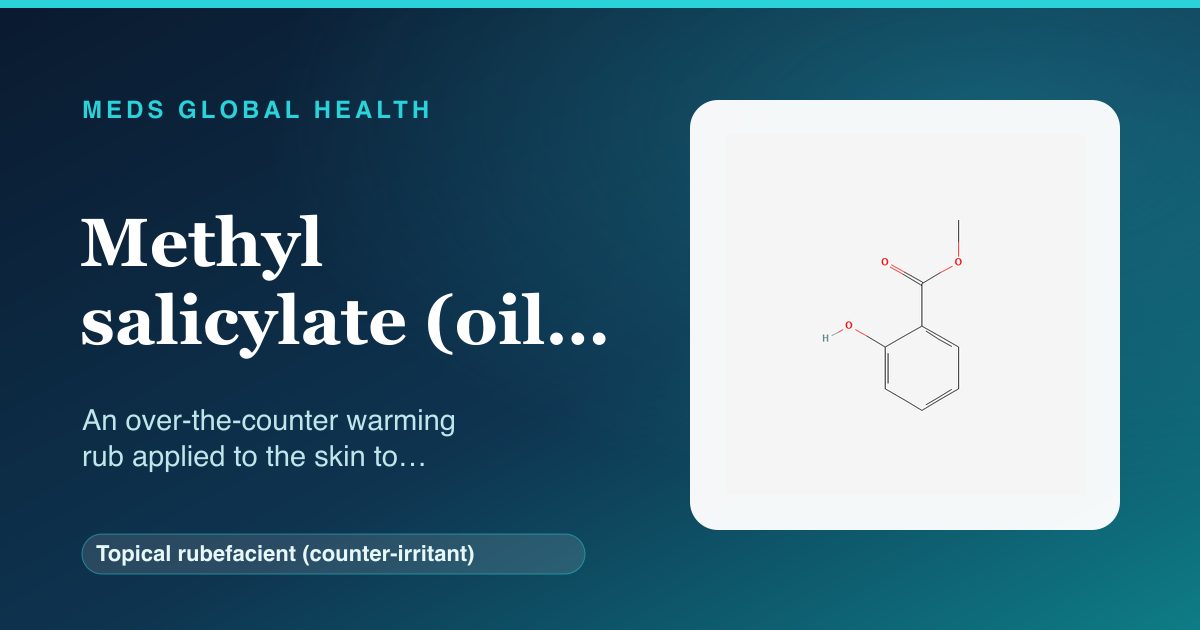
Methyl salicylate is a topical pain-relief ingredient used in warming rubs, balms and creams for everyday aches and strains. It belongs to the salicylate family, the same group as aspirin. Rather than being swallowed, it is rubbed into the skin over the sore area, where it produces warmth and a soothing sensation. It is a symptom-relief product for minor musculoskeletal discomfort and is available without prescription.
How it works
When massaged into the skin, methyl salicylate acts as a rubefacient, gently irritating the skin to create a feeling of warmth and increased blood flow at the surface. This warm sensation works as a counter-irritant, giving the brain a competing feeling that helps take attention away from the deeper muscle or joint ache. The massage itself also helps. It works mainly at the surface and is not a treatment for the underlying cause of the pain.
Company & origin
A salicylate-based warming agent, related to aspirin, traditionally derived from wintergreen oil. It is a long-standing ingredient in pharmacy rubs and creams used to ease aching muscles and joints, and is found in familiar UK products marketed for sports knocks, stiffness and minor everyday aches.
Practical use
How to take Methyl salicylate (oil of wintergreen)
General, dose-free guidance — always follow your prescriber's and the leaflet's specific instructions.
- Massage a thin layer gently into the intact skin over the sore area until absorbed.
- Wash your hands thoroughly afterwards and keep the product away from the eyes and mouth.
- Do not apply heat, a hot water bottle or a tight dressing to the treated area, as this can cause burns.
- Keep it off broken, irritated or sensitive skin and do not use on large raw areas.
- Stop and seek advice if the skin blisters, burns or becomes very red and sore.
Weighing it up
Advantages & disadvantages of Methyl salicylate (oil of wintergreen)
Advantages
- Gives soothing, warming relief from minor muscle and joint aches.
- Available without prescription and easy to apply at home.
- Works at the skin surface with little swallowed into the body when used correctly.
Disadvantages
- Treats the sensation of pain rather than the underlying cause.
- Can burn the skin if the area is heated or tightly covered.
- Not suitable for everyone, including those sensitive to aspirin and young children.
Practical use
Good to know
This is an external-use-only product. It must be kept away from the eyes, mouth, broken or irritated skin and sensitive areas, where it can burn. Crucially, the treated area should not be heated further or covered with a tight bandage or heat pad, because trapping the warmth can cause burns. As a salicylate it should be used cautiously by anyone allergic or sensitive to aspirin, and it is not suitable for young children unless a product specifically allows it.
Who should not take it / use with caution
- Anyone with a known allergy or sensitivity to aspirin or other salicylates.
- Young children, unless a specific product is labelled as suitable for their age.
- Anyone wanting to apply it to broken, irritated or infected skin.
Monitoring
- No blood tests are needed; judge success by whether the ache eases.
- Watch the treated skin for burning, blistering or worsening redness.
- Review persistent or severe pain with a clinician rather than relying on the rub alone.
Side effects
- Local skin redness, warmth or mild irritation, which is expected with this type of rub.
- Stinging or burning, especially if applied to sensitive or broken skin.
- Rarely, skin burns if heat or tight coverings are applied over the treated area.
Key interactions
- Take care if you also take oral aspirin or other salicylates, as both add to salicylate exposure.
- Avoid using it alongside other warming or strong topical products on the same area.
- Tell a pharmacist about your other medicines if you use it often or over large areas.
Available as: Creams, gels, balms and sprays for application to the skin.
Answers
Methyl salicylate (oil of wintergreen): frequently asked questions
Is methyl salicylate related to aspirin?
Yes, it is a salicylate, the same chemical family as aspirin. That is why people who are allergic or sensitive to aspirin should be cautious with it, even though it is rubbed on the skin rather than swallowed.
Why must I not put heat on the treated area?
These warming rubs already increase the sensation of heat at the skin. Adding a hot water bottle, heat pad or tight bandage can trap and intensify that heat and cause skin burns, so the area should be left uncovered and unheated.
Can children use it?
Many warming rubs are not suitable for young children, partly because they are salicylates. Only use it in children if the specific product clearly states it is suitable for their age, and ask a pharmacist if unsure.
Does it actually heal the injury?
No. It relieves the feeling of an ache by creating a warm, distracting sensation at the skin surface. It does not treat the underlying strain or injury, which may still need rest, gentle movement or other care.
What if it burns my skin?
Stop using it, wash the area gently to remove the product, and avoid heat. If the skin blisters, burns badly or the soreness does not settle, seek advice from a pharmacist or doctor.
Authoritative sources
- BNF
- NICE CKS
Building a medicines information resource?
We create evidence-led, dose-free drug and formulary references for teams.