An opioid blocker for opioid-induced constipation
Methylnaltrexone
An opioid blocker that relieves opioid-induced constipation without reversing the pain relief.
What is Methylnaltrexone?
Methylnaltrexone is used to treat constipation caused by opioid painkillers when ordinary laxatives have not worked well enough. It blocks the effect of opioids on the bowel, which gets things moving again, but it is designed not to enter the brain, so it does not reverse the pain relief or cause withdrawal. The most important safety point is that, rarely, it can cause a tear (perforation) in the bowel, so any severe or persistent tummy pain should prompt you to stop and seek medical help. Common effects include tummy cramps and diarrhoea.
Education and reference only. This is a plain-language guide to Methylnaltrexone — it deliberately contains no doses. Doses depend on the person, the brand and the reason for treatment, and belong with your prescriber. Always check the BNF, the product labelling (SmPC) and follow medical advice.
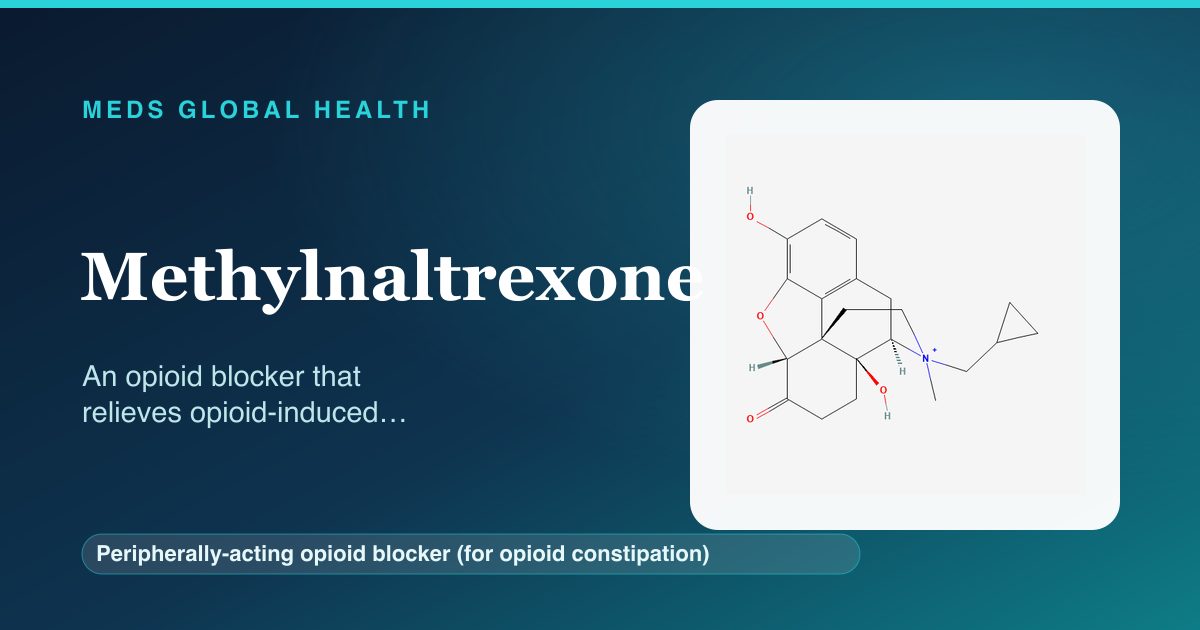
What it is
Methylnaltrexone is a medicine used to treat constipation brought on by opioid painkillers, a common and troublesome problem for people taking strong pain relief. It is a peripherally-acting opioid blocker, meaning it blocks the opioid effect on the bowel but is designed to stay out of the brain. This is the key idea: it relieves the constipation that opioids cause without undoing the pain relief the person needs. It is usually used when ordinary laxatives have not been enough, and is given as an injection under the skin or, in some cases, by mouth, under medical supervision.
How it works
Opioid painkillers relieve pain by acting on opioid receptors, but they also act on those same receptors in the gut, which slows the bowel right down and causes constipation. Methylnaltrexone blocks the opioid receptors in the bowel, freeing up the gut to move normally again. Crucially, it is built so it does not cross into the brain, so it blocks the unwanted effect on the bowel while leaving the pain-relieving effect in the brain untouched, and without causing opioid withdrawal. Because it acts on a stalled bowel, it can work quite quickly once given.
Company & origin
A medicine used in the UK to treat constipation caused by opioid painkillers, without reducing pain relief.
Practical use
How to take Methylnaltrexone
General, dose-free guidance — always follow your prescriber's and the leaflet's specific instructions.
- Use it for opioid-induced constipation as your prescriber directs, often when ordinary laxatives have not been enough.
- Stop it and seek medical help straight away if you get severe, sharp or persistent tummy pain.
- Expect possible tummy cramps, wind or diarrhoea as the bowel starts moving again.
- Make sure your prescriber knows if your bowel may be blocked, as it should not be used then.
- Keep taking your opioid pain relief as prescribed, as this medicine does not reduce its effect.
Weighing it up
Advantages & disadvantages of Methylnaltrexone
Advantages
- Relieves constipation caused by opioids when ordinary laxatives have not been enough.
- Does not enter the brain, so it does not reduce pain relief or cause opioid withdrawal.
- Can work quite quickly to get a stalled bowel moving.
Disadvantages
- Rarely, it can cause a tear (perforation) in the bowel, so severe tummy pain needs urgent attention.
- Commonly causes tummy cramps, wind or diarrhoea.
- Used with care, or avoided, if the bowel may be blocked.
Practical use
Good to know
The most important safety point with methylnaltrexone is bowel perforation: although it is rare, it can cause a tear in the bowel wall, so any severe, sharp or persistent tummy pain means you should stop the medicine and seek medical help straight away. More common, and usually less serious, are tummy cramps, wind and diarrhoea, which reflect the bowel getting moving again. It is used for constipation that is specifically caused by opioids and when ordinary laxatives have not done enough, rather than as a first step. Because it does not enter the brain, a reassuring point is that it does not reduce the pain relief from opioids or trigger withdrawal. It is used with extra care if there is any sign the bowel might be blocked.
Who should not take it / use with caution
- People with a known or suspected blockage of the bowel must not use it, because of the risk of perforation.
- People who have had a serious allergic reaction to methylnaltrexone should not use it.
- It is used with care in people with conditions that weaken the bowel wall, under medical guidance.
Monitoring
- Watching for severe or persistent tummy pain that could signal a bowel problem.
- Checking that constipation is improving without troublesome cramps or diarrhoea.
- Reviewing whether it is still needed as opioid pain relief changes.
Side effects
- Tummy cramps, wind or diarrhoea as the bowel starts to move.
- Nausea or dizziness in some people.
- Rarely but seriously, a tear (perforation) in the bowel, which needs urgent medical attention.
Key interactions
- It is used together with opioid pain relief, which it does not reverse in the brain.
- Other laxatives may be used alongside it, guided by your prescriber.
- Tell your prescriber about all your medicines so treatment can be coordinated.
Available as: A solution for injection under the skin, and tablets taken by mouth.
Answers
Methylnaltrexone: frequently asked questions
What is methylnaltrexone used for?
It treats constipation caused by opioid painkillers, usually when ordinary laxatives have not worked well enough.
Will it stop my pain relief working?
No. It is designed not to enter the brain, so it relieves the constipation opioids cause without reducing the pain relief or causing withdrawal.
What is the most important warning?
Rarely it can cause a tear (perforation) in the bowel, so stop it and seek medical help straight away if you get severe or persistent tummy pain.
What side effects are common?
Tummy cramps, wind and diarrhoea are common as the bowel starts moving again.
Who should not use it?
It must not be used if the bowel is, or may be, blocked, because of the risk of perforation.
Authoritative sources
- BNF
- NICE CKS
Building a medicines information resource?
We create evidence-led, dose-free drug and formulary references for teams.