Also called methylene blue
Methylthioninium chloride
An antidote, also called methylene blue, used to treat methaemoglobinaemia and as a dye in some surgery.
What is Methylthioninium chloride?
Methylthioninium chloride, better known as methylene blue, is a specialist medicine with two main uses: as an antidote that treats methaemoglobinaemia, a condition where the blood cannot carry oxygen properly, and as a blue dye used to mark tissues in some operations. It is given into a vein by hospital staff. The most important safety point is a serious interaction with serotonin-raising antidepressants (such as SSRIs, SNRIs and MAOIs), which can cause serotonin syndrome. It should also be avoided in people with the inherited condition G6PD deficiency, and it harmlessly turns the urine and skin blue-green.
Education and reference only. This is a plain-language guide to Methylthioninium chloride — it deliberately contains no doses. Doses depend on the person, the brand and the reason for treatment, and belong with your prescriber. Always check the BNF, the product labelling (SmPC) and follow medical advice.
What it is
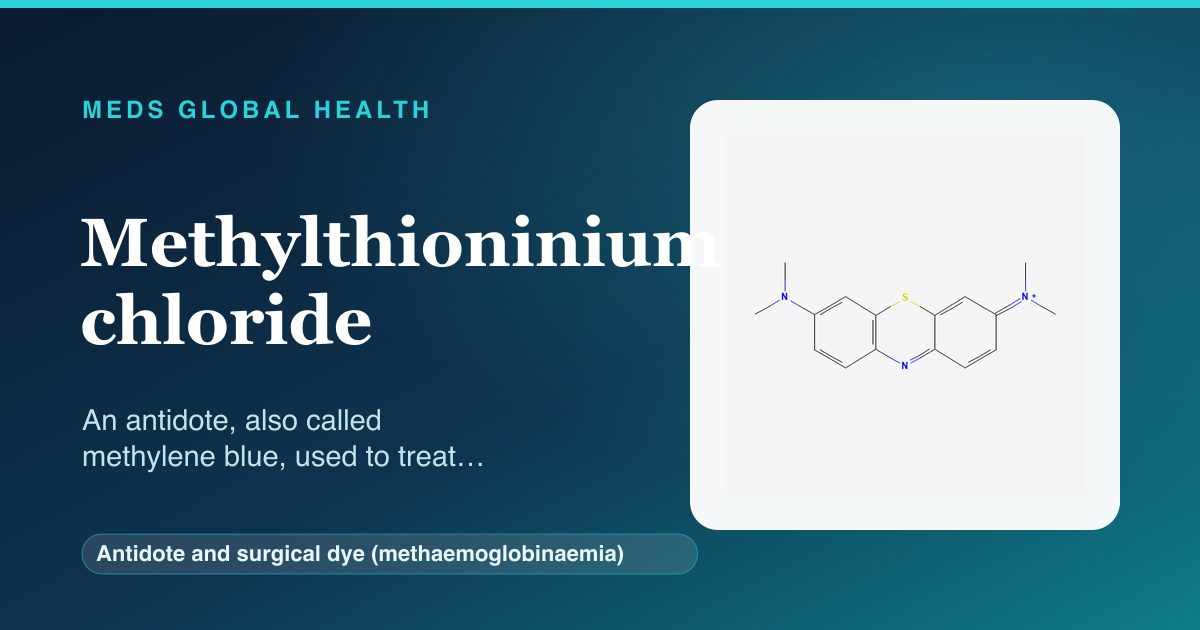
Methylthioninium chloride, almost always called methylene blue, is a deep blue medicine used in hospitals. Its main medical use is as an antidote for methaemoglobinaemia, a condition in which the iron in the blood's oxygen-carrying pigment is changed into a form that cannot carry oxygen, leaving the person short of oxygen even though they are breathing normally. It is also used as a dye to stain and mark tissues during certain operations and tests. It is given into a vein by trained staff under close supervision because of its important interactions and cautions.
How it works
In methaemoglobinaemia, the blood's oxygen-carrying pigment is locked in a form that cannot pick up oxygen. Methylene blue acts as an antidote by helping the body convert that faulty pigment back into normal pigment that can carry oxygen again, so the blood can deliver oxygen properly. As a surgical dye, it simply stains tissues blue so surgeons can see and follow particular structures during an operation. Because it is itself a deeply coloured chemical, it predictably turns urine, and sometimes the skin, a blue-green colour for a while, which is harmless.
Company & origin
A specialist medicine used in UK hospitals as an antidote for methaemoglobinaemia and, in some operations, as a marker dye.
Practical use
How to take Methylthioninium chloride
General, dose-free guidance — always follow your prescriber's and the leaflet's specific instructions.
- It is given into a vein by trained hospital staff, who control the timing and rate carefully.
- Tell the team about every medicine you take, especially any antidepressant, because of the serious serotonin interaction.
- Mention if you have, or might have, the inherited condition G6PD deficiency, as the medicine is generally avoided in this case.
- Do not be alarmed that your urine, and possibly your skin, turns blue-green; this is harmless and passes.
- Report any agitation, high temperature, shivering or confusion straight away, as these can be signs of a serious reaction.
Weighing it up
Advantages & disadvantages of Methylthioninium chloride
Advantages
- An effective antidote that can quickly reverse methaemoglobinaemia and restore the blood's ability to carry oxygen.
- Also useful as a dye to mark tissues during certain operations.
- Given and monitored by hospital staff who can manage its effects.
Disadvantages
- Interacts seriously with serotonin-raising antidepressants, risking serotonin syndrome.
- Must be avoided in people with G6PD deficiency because it can cause red blood cells to break down.
- Harmlessly turns urine and skin blue-green and can disturb oxygen-monitor readings.
Practical use
Good to know
Two safety points dominate the use of methylene blue. First, it interacts seriously with medicines that raise serotonin levels, including many antidepressants such as SSRIs, SNRIs and MAOIs; combining them can trigger serotonin syndrome, a dangerous reaction with agitation, fever, shivering and confusion, so your full medicines list is essential before it is given. Second, it should be avoided in people with the inherited condition G6PD deficiency, because it can cause red blood cells to break down. A harmless and expected effect is that it turns the urine, and sometimes the skin, blue-green for a time. It is always given in hospital so staff can watch for these problems. It can also briefly affect the readings on an oxygen finger-clip monitor because of its colour.
Who should not take it / use with caution
- People taking serotonin-raising antidepressants such as SSRIs, SNRIs or MAOIs should avoid it unless a specialist judges it essential.
- People with the inherited condition G6PD deficiency should generally not be given it.
- People who have had a serious allergic reaction to it, and it is used with care in pregnancy under specialist guidance.
Monitoring
- Checking the level of the faulty blood pigment to see how well the antidote is working.
- Watching closely for signs of serotonin syndrome, especially in anyone on antidepressants.
- Watching for red-blood-cell breakdown, particularly where G6PD deficiency is a concern.
Side effects
- A harmless blue-green colouring of the urine and sometimes the skin.
- Nausea, headache, dizziness or a metallic taste.
- Rarely but seriously, serotonin syndrome when combined with serotonin-raising medicines, or red-blood-cell breakdown in G6PD deficiency.
Key interactions
- Serotonin-raising antidepressants such as SSRIs, SNRIs and MAOIs can cause serotonin syndrome and are a major concern.
- It can briefly affect the readings of an oxygen finger-clip monitor because of its colour.
- Tell the team about all your medicines, as it can interact with several of them.
Available as: A solution given into a vein.
Answers
Methylthioninium chloride: frequently asked questions
What is methylthioninium chloride used for?
Also called methylene blue, it is used as an antidote to treat methaemoglobinaemia, where the blood cannot carry oxygen properly, and as a dye to mark tissues in some surgery.
Why does it matter if I take an antidepressant?
Methylene blue interacts seriously with serotonin-raising antidepressants such as SSRIs, SNRIs and MAOIs and can cause serotonin syndrome, so your team must know everything you take.
Why has my urine turned blue-green?
The medicine is a deeply coloured chemical, so it harmlessly turns the urine, and sometimes the skin, blue-green for a while; this passes on its own.
Why is it avoided in G6PD deficiency?
In people with the inherited condition G6PD deficiency it can cause red blood cells to break down, so it is generally avoided in this group.
Is it the same as methylene blue?
Yes, methylthioninium chloride and methylene blue are two names for the same medicine.
Authoritative sources
- BNF
- NICE CKS
Building a medicines information resource?
We create evidence-led, dose-free drug and formulary references for teams.