Substrate-reduction therapy
Miglustat
An oral capsule that reduces production of the stored substance, used in mild-to-moderate Gaucher disease when enzyme therapy is unsuitable, and in Niemann-Pick type C.
What is Miglustat?
Miglustat is a capsule taken by mouth that works differently from the enzyme drips: instead of replacing a missing enzyme, it reduces the body's production of the substance that builds up. It is used in mild-to-moderate type 1 Gaucher disease when enzyme replacement is not suitable, and in Niemann-Pick type C to help with certain neurological symptoms. It is started and supervised by a specialist metabolic centre. The most common problems are diarrhoea and weight loss, and it can also cause tremor and nerve effects such as tingling.
Education and reference only. This is a plain-language guide to Miglustat — it deliberately contains no doses. Doses depend on the person, the brand and the reason for treatment, and belong with your prescriber. Always check the BNF, the product labelling (SmPC) and follow medical advice.
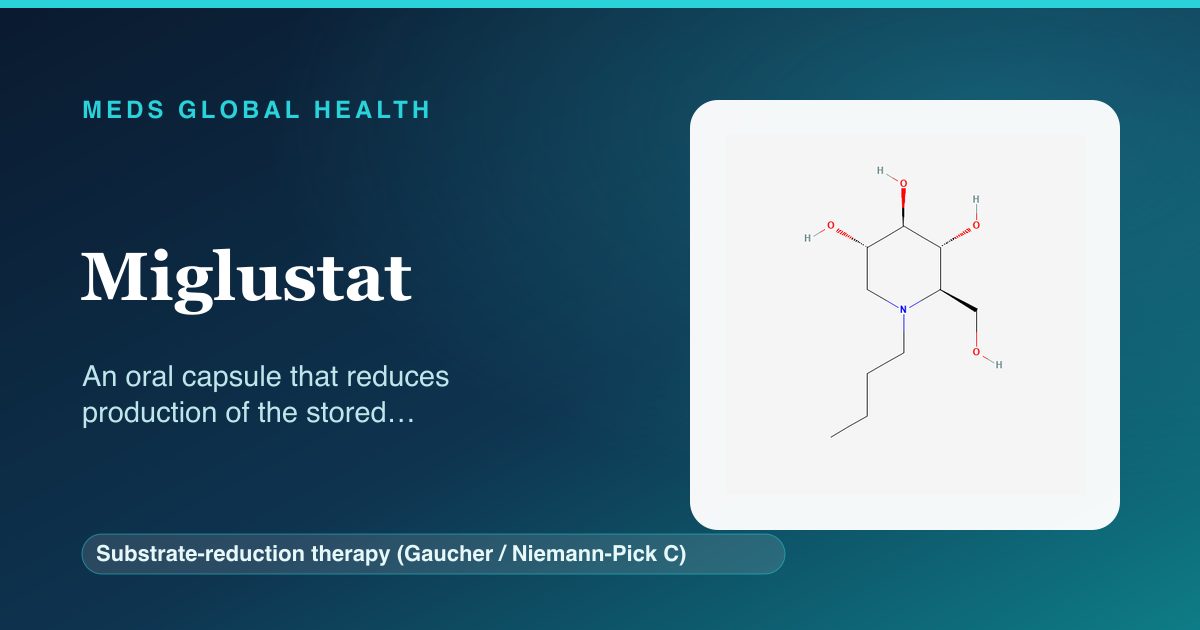
What it is
Miglustat is a capsule taken by mouth for certain lysosomal storage disorders. Rather than replacing a missing enzyme like the enzyme drips do, it is a 'substrate-reduction therapy', meaning it reduces how much of the stored substance the body makes in the first place. It is used in mild-to-moderate type 1 Gaucher disease for people in whom enzyme replacement is not suitable, and in Niemann-Pick type C to help slow certain neurological symptoms. Miglustat (brand name Zavesca) is started and supervised by a specialist metabolic team.
How it works
Miglustat works by partly blocking an early step in the body's production of the fatty substance that builds up in these conditions. By making less of the substance, the aim is for the body to better keep up with breaking it down, so less of it accumulates in cells. In type 1 Gaucher disease this can help control the condition when enzyme replacement cannot be used, and in Niemann-Pick type C, because the capsule can reach the brain, it is used to help slow the worsening of certain neurological symptoms. It is taken as regular oral capsules rather than as a drip.
Company & origin
Originated / developed by: Specialist (Janssen).
An oral capsule used in UK specialist metabolic centres that reduces the production of a stored substance, used in some forms of Gaucher disease and in Niemann-Pick type C.
Practical use
How to take Miglustat
General, dose-free guidance — always follow your prescriber's and the leaflet's specific instructions.
- Take the capsules by mouth as directed by your specialist team, spread through the day.
- If you get diarrhoea or tummy upset at the start, ask the team about diet changes, such as reducing certain sugars, which often helps.
- Tell the team if you notice a tremor, numbness or tingling, as the nerves are checked before and during treatment.
- Use reliable contraception during treatment and for a time afterwards, for both women and men, as advised.
- Keep your regular appointments so the team can monitor how well it is working and watch for side effects.
Weighing it up
Advantages & disadvantages of Miglustat
Advantages
- Taken by mouth as a capsule, avoiding the need for regular drips.
- Offers an option for mild-to-moderate type 1 Gaucher disease when enzyme replacement is not suitable.
- Can reach the brain, so it is used to help slow certain neurological symptoms in Niemann-Pick type C.
Disadvantages
- Commonly causes diarrhoea and weight loss, especially at the start.
- Can cause a tremor and nerve effects such as numbness or tingling.
- Needs reliable contraception for both women and men because of effects on a developing baby and on sperm.
Practical use
Good to know
Miglustat is taken by mouth, which suits some people better than the enzyme drips, but it is generally reserved for mild-to-moderate type 1 Gaucher disease when enzyme replacement is not suitable, and for Niemann-Pick type C. The most common problems are tummy effects, especially diarrhoea and weight loss, which often improve over time and can be eased by adjusting the diet (for example reducing certain sugars) at the start. It can also cause a tremor and nerve effects such as numbness or tingling, so the team checks the nerves before and during treatment. Because of effects on the developing baby and on sperm, effective contraception is needed for both women and men during treatment and for a time afterwards, so this should be discussed with the team.
Who should not take it / use with caution
- It is not suitable in pregnancy, and reliable contraception is needed during and for a time after treatment.
- It is used with extra care, and the dose may be adjusted, in people with reduced kidney function.
- People with existing nerve problems are assessed carefully, as it can affect the nerves.
Monitoring
- Checks of the nerves (for numbness, tingling or tremor) before starting and during treatment.
- Monitoring weight, bowel symptoms and, in Gaucher disease, blood counts and organ size.
- Reviewing how well it is controlling the condition and whether to continue it.
Side effects
- Diarrhoea, wind, tummy discomfort and weight loss are the most common, often improving with diet changes and time.
- Tremor, headache, dizziness and tiredness can occur.
- Nerve effects such as numbness or tingling, which is why the nerves are checked during treatment.
Key interactions
- Tell the team about all your medicines, as some are reviewed alongside miglustat.
- It is sometimes used together with an enzyme treatment in specific situations, guided by the specialist.
- Medicines that affect the gut or the nerves are considered carefully because of overlapping side effects.
Available as: Capsules taken by mouth.
Answers
Miglustat: frequently asked questions
How is miglustat different from the enzyme drips?
Instead of replacing a missing enzyme, it reduces how much of the stored substance the body makes; it is also a capsule taken by mouth rather than a drip.
When is miglustat used?
It is used in mild-to-moderate type 1 Gaucher disease when enzyme replacement is not suitable, and in Niemann-Pick type C to help with certain neurological symptoms.
Why am I getting diarrhoea?
Tummy effects such as diarrhoea and wind are common, especially at the start; adjusting the diet, for example reducing certain sugars, often helps and it usually settles over time.
Do I need contraception while taking it?
Yes. Reliable contraception is needed for both women and men during treatment and for a time afterwards, because of effects on a developing baby and on sperm.
Should I report numbness or tingling?
Yes. Tell your team about any numbness, tingling or tremor, as miglustat can affect the nerves and these are checked during treatment.
Authoritative sources
- BNF
- NICE CKS
Building a medicines information resource?
We create evidence-led, dose-free drug and formulary references for teams.