An older antidepressant now rarely used because of liver concerns
Nefazodone
An older antidepressant, now rarely used, because of a risk of rare but serious liver problems.
What is Nefazodone?
Nefazodone is an older antidepressant that was used to treat depression. Its most important issue is that, although rare, it can cause severe liver problems including liver failure, which is the main reason it has been withdrawn or is now rarely used in many countries. It can also cause drowsiness and interacts with a large number of other medicines, partly because it affects a liver enzyme (CYP3A4) that handles many drugs. Because newer, safer antidepressants are available, nefazodone is largely considered obsolete.
Education and reference only. This is a plain-language guide to Nefazodone — it deliberately contains no doses. Doses depend on the person, the brand and the reason for treatment, and belong with your prescriber. Always check the BNF, the product labelling (SmPC) and follow medical advice.
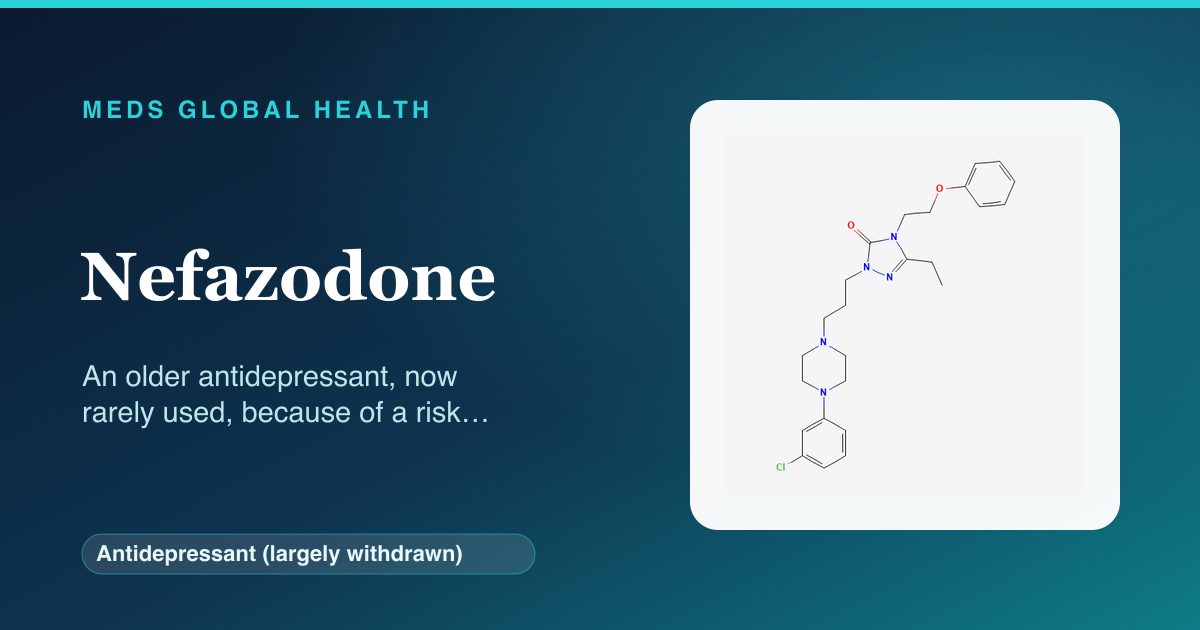
What it is
Nefazodone is an antidepressant that was used in the past to treat depression. It works on brain chemical messengers involved in mood, including serotonin. While it could help low mood, it became overshadowed by a serious safety concern: rare but severe liver injury, including liver failure. Because of this, it has been withdrawn from the market in many countries or is now used only very rarely. It is taken by mouth as tablets. Today it is largely regarded as an obsolete medicine, with safer antidepressants preferred.
How it works
Nefazodone works on the brain's chemical messengers, particularly serotonin, which are involved in mood. By adjusting how these messengers act, it was intended to lift low mood in depression. However, it is also broken down by, and strongly affects, a liver enzyme called CYP3A4 that handles many other medicines, which is why it has so many drug interactions. Its tendency to cause drowsiness comes from its effects on other brain receptors. The serious liver risk is the overriding reason its use has fallen away.
Company & origin
An older antidepressant that has been withdrawn or is rarely used in many countries because of a risk of serious liver problems.
What it treats
Conditions Nefazodone is used for
Practical use
How to take Nefazodone
General, dose-free guidance — always follow your prescriber's and the leaflet's specific instructions.
- Take it by mouth exactly as prescribed; it is often taken in divided doses.
- Report any signs of liver problems straight away, such as yellowing of the skin or eyes, dark urine, severe tiredness, nausea or tummy pain.
- Be aware it can make you drowsy, so take care with driving or using machinery until you know how it affects you.
- Give your prescriber a full list of all your medicines, as nefazodone interacts with many of them.
- Do not stop it suddenly; any change should be made gradually under medical advice.
Weighing it up
Advantages & disadvantages of Nefazodone
Advantages
- Could help low mood in depression and was less likely than some antidepressants to cause certain sexual side effects.
- Its calming effect sometimes helped people who also had trouble sleeping.
- Taken by mouth as tablets.
Disadvantages
- Can cause rare but serious liver problems, including liver failure, which is why it has largely been withdrawn.
- Often causes drowsiness and interacts with a very large number of other medicines.
- Now considered obsolete in many places, with safer antidepressants preferred.
Practical use
Good to know
The single most important thing to know about nefazodone is the risk, although rare, of severe liver problems including liver failure, which is why it has been withdrawn or is rarely used in many countries; anyone taking it should report signs such as yellowing of the skin or eyes, dark urine, severe tiredness, nausea or tummy pain straight away. It often causes drowsiness, so it can affect driving and is sometimes taken to help with sleep problems alongside low mood. It also interacts with a very large number of medicines because it affects a key liver enzyme, so a full medicines list is essential. As with all antidepressants, it should not be stopped suddenly, and mood and any thoughts of self-harm should be watched, especially early in treatment. Newer antidepressants are generally preferred.
Who should not take it / use with caution
- People who have had a serious allergic reaction to nefazodone should not take it.
- People with active liver disease or liver problems caused by it before should not take it.
- It should not be combined with certain other medicines that interact dangerously with it, such as some used for migraine, allergy or heart rhythm.
Monitoring
- Watching for any signs of liver problems and checking liver blood tests if concerns arise.
- Reviewing mood and any thoughts of self-harm, especially early in treatment.
- Reviewing all other medicines carefully because of the high risk of interactions.
Side effects
- Drowsiness, dizziness, dry mouth or blurred vision.
- Nausea, headache or feeling lightheaded, especially on standing.
- Rarely but seriously, severe liver injury or liver failure, needing urgent medical attention.
Key interactions
- It strongly affects a liver enzyme (CYP3A4), so it can dangerously raise the levels of many other medicines.
- It must not be combined with certain medicines that rely on this enzyme, including some for migraine, allergy and heart rhythm.
- It should not be used close to MAOI antidepressants, and care is needed with other medicines that raise serotonin.
Available as: Tablets taken by mouth.
Answers
Nefazodone: frequently asked questions
What is nefazodone used for?
It is an older antidepressant that was used to treat depression, though it is now rarely used because of safety concerns.
Why is it rarely used now?
Its main problem is a rare but serious risk of liver injury, including liver failure, which led to it being withdrawn or rarely used in many countries.
What warning signs should I look out for?
Report straight away any yellowing of the skin or eyes, dark urine, severe tiredness, nausea or tummy pain, as these can signal liver problems.
Why does it interact with so many medicines?
It strongly affects a liver enzyme that breaks down many drugs, so it can raise their levels and cause harmful interactions; give your prescriber a full medicines list.
Can I stop it suddenly?
No. Like other antidepressants it should be reduced gradually under medical advice rather than stopped abruptly.
Authoritative sources
- BNF
- NICE CKS
Building a medicines information resource?
We create evidence-led, dose-free drug and formulary references for teams.