An aminoglycoside antibiotic (topical/oral)
Neomycin
An aminoglycoside antibiotic used mostly on the skin, ear or eye, or by mouth to act inside the bowel.
What is Neomycin?
Neomycin is an aminoglycoside antibiotic used mainly on the skin, ears or eyes, or taken by mouth to act locally inside the bowel. It is not used for general infections because it can harm hearing and the kidneys if absorbed into the body. It can also cause an allergic skin reaction when used on the skin.
Education and reference only. This is a plain-language guide to Neomycin — it deliberately contains no doses. Doses depend on the person, the brand and the reason for treatment, and belong with your prescriber. Always check the BNF, the product labelling (SmPC) and follow medical advice.
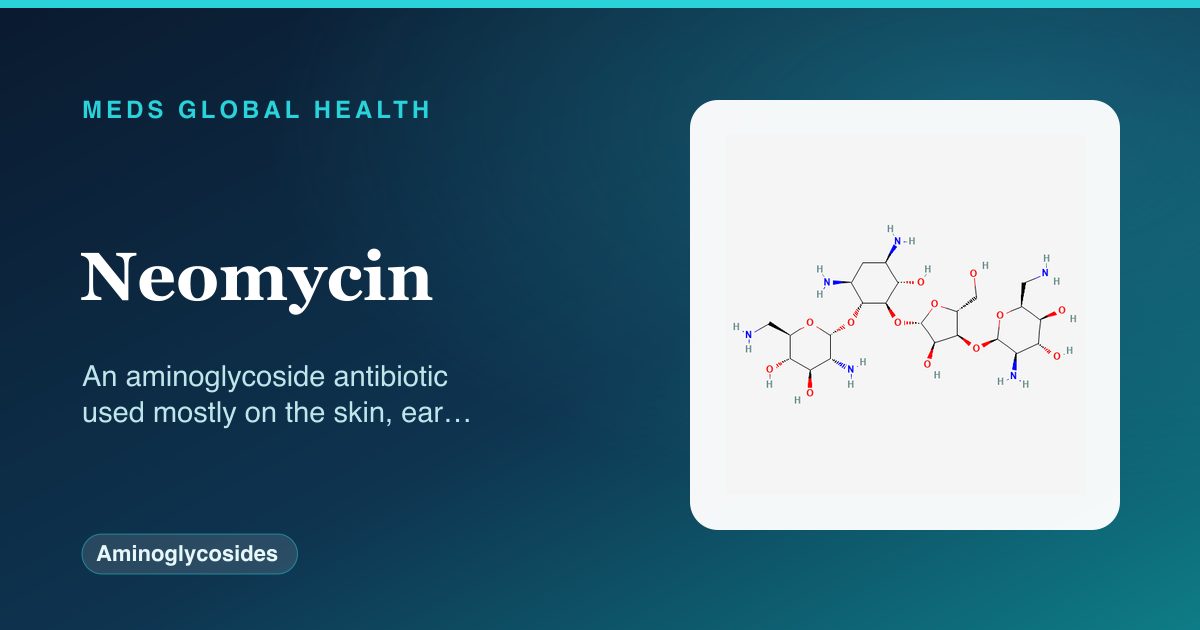
What it is
Neomycin is an aminoglycoside antibiotic. Because it can be toxic if it gets into the bloodstream, it is not given by injection for general infections. Instead it is used where it acts locally — in creams, ointments, ear drops and eye preparations (often combined with a steroid or other ingredients), or by mouth, where it stays largely in the bowel to reduce bacteria there before surgery or in certain liver conditions.
How it works
Neomycin enters bacteria and interferes with their ability to make the proteins they need to grow, which kills the bacteria. Used on the skin, in the ear or eye, or in the bowel, it acts where it is applied. The same effect on cells can harm the delicate structures of the inner ear and the kidneys if enough is absorbed into the body, which is why it is kept to local use.
Company & origin
Discovered in the 1940s and long used as a topical and oral antibiotic.
Practical use
How to take Neomycin
General, dose-free guidance — always follow your prescriber's and the leaflet's specific instructions.
- Use it exactly as directed for the affected area — skin, ear, eye or by mouth.
- Apply skin preparations thinly and only to the area advised, for the recommended time.
- Avoid using it for long periods or over large areas of broken skin, where more can be absorbed.
- Wash your hands after applying creams or drops, unless treating the hands.
- Stop and seek advice if a treated patch of skin becomes red, itchy or worse, which may signal an allergy.
- Tell your prescriber about any hearing or balance problems or kidney trouble.
Weighing it up
Advantages & disadvantages of Neomycin
Advantages
- Effective antibiotic action where it is applied, on the skin, ear, eye or in the bowel.
- Often combined with a steroid in ear and skin preparations to treat infection and inflammation together.
- Long-established and widely available.
Disadvantages
- Can cause an allergic, eczema-like skin reaction, particularly with prolonged use.
- If absorbed through broken skin or with long oral courses, it can harm hearing and the kidneys.
- Not suitable for general (whole-body) infections because of this toxicity.
Practical use
Good to know
Neomycin is generally used on the skin, in the ear or eye, or by mouth to act inside the bowel rather than for whole-body infections. Used on the skin it can cause an allergic, eczema-like reaction, especially with prolonged use or on broken skin. If it is absorbed — for example through broken skin or with long courses — it can harm hearing and the kidneys, so it is used carefully and for limited periods.
Who should not take it / use with caution
- People with a known allergy to neomycin or other aminoglycosides.
- Avoided in or around a perforated eardrum, where it can reach and harm the inner ear.
- Used with caution on large areas of broken skin, and in people with kidney problems.
Monitoring
- Watch for an allergic skin reaction with skin and ear preparations.
- Hearing and kidney function may be considered with prolonged oral use or where absorption is likely.
- Review the need to continue if there is no improvement.
Side effects
- Skin irritation, redness or an allergic, eczema-like rash where it is applied.
- Local stinging or discomfort with ear or eye preparations.
- If absorbed: harm to hearing or balance, and to the kidneys.
Key interactions
- Other medicines that can harm hearing or the kidneys — added risk if neomycin is absorbed.
- Oral neomycin can reduce the absorption of some medicines, including certain vitamins.
- Oral neomycin may increase the effect of blood thinners such as warfarin.
Available as: cream and ointment, ear drops, eye preparations, and tablets for use in the bowel
Answers
Neomycin: frequently asked questions
What is neomycin used for?
Mostly on the skin, in the ear or eye, or by mouth to reduce bacteria inside the bowel. It is not used for general infections because it can be toxic if absorbed.
Why is neomycin not given by injection?
Because aminoglycosides like neomycin can harm hearing and the kidneys, it is too toxic for routine whole-body use and is kept to local treatment.
Can neomycin cause a skin allergy?
Yes. Used on the skin it can cause an allergic, eczema-like reaction, especially with prolonged use, so report any worsening redness or itching.
Can it harm my hearing?
It can if enough is absorbed into the body, for example through broken skin or with long oral courses, which is why it is used carefully and for limited periods.
Can I use it with a perforated eardrum?
It is generally avoided in or around a perforated eardrum, because it can reach and damage the inner ear. Check with your prescriber.
The wider class
About Aminoglycosides
Neomycin belongs to the aminoglycosides class. For how the class as a whole works, its shared safety principles and monitoring, see the full guide.
Browse by body system
Authoritative sources
- BNF
- NICE CKS
Building a medicines information resource?
We create evidence-led, dose-free drug and formulary references for teams.