A medicine that boosts acetylcholine
Neostigmine
A medicine that boosts acetylcholine, used to reverse muscle relaxants after surgery and to treat myasthenia gravis and a sluggish bladder or bowel.
What is Neostigmine?
Neostigmine boosts the level of acetylcholine, a natural chemical messenger that helps nerves communicate with muscles. Anaesthetists use it to reverse the muscle relaxants given during an operation, helping the muscles work again afterwards; it is given together with another medicine (such as glycopyrronium or atropine) to limit side effects like a slow heartbeat, watery mouth and gut cramps. It is also used to treat myasthenia gravis and a sluggish bladder or bowel after surgery. Its effects come from raising acetylcholine, which can slow the heart and cause watery eyes and mouth, cramps and other cholinergic effects.
Education and reference only. This is a plain-language guide to Neostigmine — it deliberately contains no doses. Doses depend on the person, the brand and the reason for treatment, and belong with your prescriber. Always check the BNF, the product labelling (SmPC) and follow medical advice.
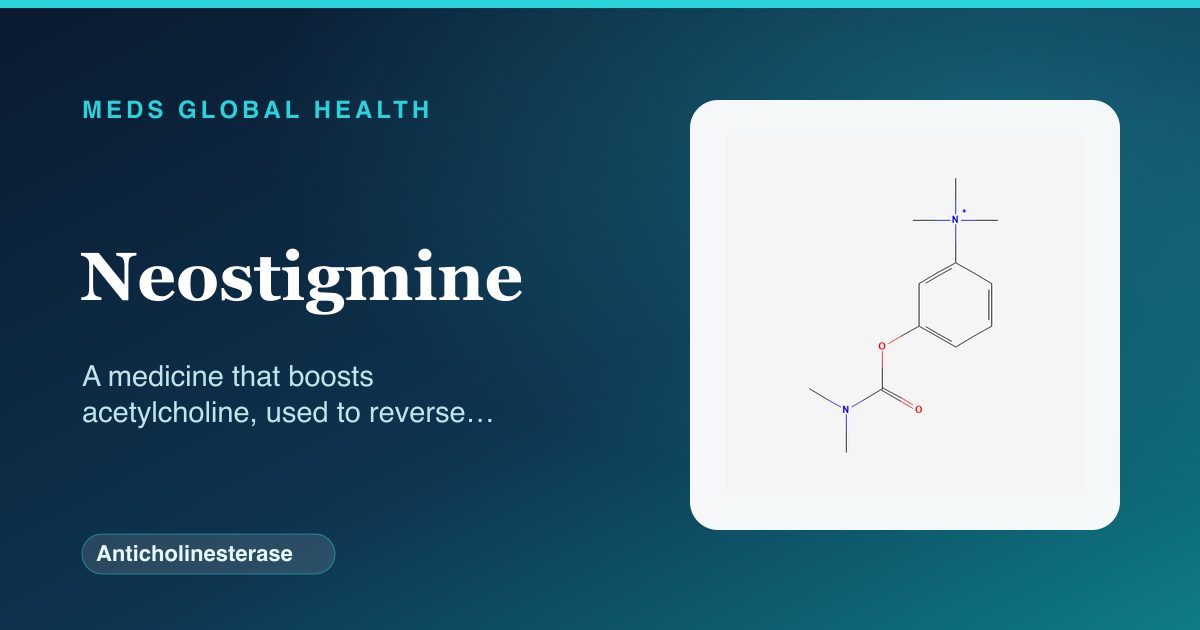
What it is
Neostigmine is a medicine that increases the amount of acetylcholine, a chemical messenger the body uses to pass signals from nerves to muscles. It is best known for being used by anaesthetists to reverse the effects of certain muscle relaxants at the end of an operation, so that breathing and movement return. It is also used to treat myasthenia gravis, a condition where muscles tire and weaken, and to help a bladder or bowel that has become sluggish, for example after surgery. It is given by injection or, in some situations, by mouth.
How it works
Acetylcholine is the messenger that nerves release to make muscles contract, but the body normally breaks it down quickly using an enzyme. Neostigmine blocks that enzyme, so acetylcholine builds up and acts for longer. This strengthens the signal to the muscles, which is why it can reverse muscle relaxants and improve strength in myasthenia gravis. The same rise in acetylcholine affects other parts of the body too, slowing the heart and increasing saliva, tears and gut activity, which is why a second medicine is often given alongside to balance these effects.
Company & origin
A long-established medicine used in the UK by anaesthetists to reverse muscle relaxants, and to treat myasthenia gravis and a sluggish bladder or bowel.
Practical use
How to take Neostigmine
General, dose-free guidance — always follow your prescriber's and the leaflet's specific instructions.
- For reversing muscle relaxants, it is given by injection by the anaesthetic team, usually with a medicine such as glycopyrronium or atropine.
- For myasthenia gravis it may be given by mouth or injection; take it exactly as prescribed and to the schedule you are given.
- Tell your team if you notice new or worsening muscle weakness, as the dose may need adjusting.
- Report a very slow heartbeat, faintness, heavy watering of the eyes or mouth, or marked tummy cramps.
- Do not change the timing or dose yourself if you take it for myasthenia gravis, as the balance is important.
Weighing it up
Advantages & disadvantages of Neostigmine
Advantages
- Reliably reverses the effects of certain muscle relaxants at the end of an operation.
- Improves muscle strength in myasthenia gravis and can help a sluggish bladder or bowel.
- Long-established and given under healthcare supervision, with a balancing medicine to limit side effects.
Disadvantages
- Raises acetylcholine throughout the body, causing a slow heart, watery eyes and mouth and gut cramps.
- In myasthenia gravis, too much can paradoxically worsen weakness.
- Usually needs to be given by injection, often alongside another medicine.
Practical use
Good to know
When neostigmine is used to reverse muscle relaxants after surgery, it is given together with a medicine such as glycopyrronium or atropine, which counteracts its tendency to slow the heart and increase saliva and secretions. The key effects to understand are the 'cholinergic' ones that come from raising acetylcholine: a slow heartbeat, watery eyes and mouth, increased saliva or secretions, tummy cramps, nausea and an urge to pass urine or open the bowels. In myasthenia gravis, too much can actually cause weakness as well (a 'cholinergic crisis'), so the dose is balanced carefully and any new or worsening weakness should be reported. It is given and supervised by healthcare professionals, with anaesthetic use happening entirely under their care.
Who should not take it / use with caution
- It is avoided in people with a blockage of the bowel or urinary tract.
- Used with caution in asthma, a very slow heart, or some heart-rhythm problems.
- People with certain other conditions need careful assessment before it is used.
Monitoring
- During anaesthesia, close monitoring of heart rate, breathing and the return of muscle strength.
- In myasthenia gravis, watching the balance between too little and too much, and any new weakness.
- Reviewing for cholinergic side effects such as a slow heart, secretions and cramps.
Side effects
- A slow heartbeat, watery eyes and mouth, increased saliva and secretions.
- Tummy cramps, nausea, diarrhoea and an urge to pass urine or open the bowels.
- Muscle twitching, and in myasthenia gravis, weakness if too much is given.
Key interactions
- It is given with glycopyrronium or atropine during anaesthesia to balance its slowing effect on the heart.
- Some medicines, including certain antibiotics and heart medicines, can affect muscle signalling and interact with it.
- Other muscle relaxants and some eye drops for glaucoma can interact, so your team reviews your medicines.
Available as: Injection, given by healthcare professionals, and tablets by mouth in some situations.
Answers
Neostigmine: frequently asked questions
What is neostigmine used for?
It is used by anaesthetists to reverse muscle relaxants after an operation, and to treat myasthenia gravis and a sluggish bladder or bowel.
How does it work?
It boosts acetylcholine, a chemical messenger that helps nerves signal to muscles, by blocking the enzyme that normally breaks it down.
Why is another medicine given with it?
During anaesthesia it is given with glycopyrronium or atropine to limit its tendency to slow the heart and increase saliva, tears and gut activity.
What side effects might it cause?
Raising acetylcholine can cause a slow heartbeat, watery eyes and mouth, increased secretions and tummy cramps; tell your team if these are troublesome.
Can too much cause weakness in myasthenia gravis?
Yes, too much can paradoxically cause weakness, so the dose is balanced carefully and any new or worsening weakness should be reported.
The wider class
About Anticholinesterase
Neostigmine belongs to the anticholinesterase class. For how the class as a whole works, its shared safety principles and monitoring, see the full guide.
Browse by body system
Authoritative sources
- BNF
- NICE CKS
Building a medicines information resource?
We create evidence-led, dose-free drug and formulary references for teams.