Vitamin B3 (niacinamide)
Nicotinamide
A form of vitamin B3 used to treat deficiency (pellagra) and some skin conditions; unlike nicotinic acid, it does not cause flushing.
What is Nicotinamide?
Nicotinamide, also called niacinamide, is a form of vitamin B3 that the body uses to release energy from food and to keep skin and the nervous system healthy. It is used to prevent and treat vitamin B3 deficiency, known as pellagra, and is also used for certain skin conditions. A useful difference from the other form of vitamin B3, nicotinic acid, is that nicotinamide does not cause the hot, flushing reaction that nicotinic acid often does. It is generally very safe and well tolerated, and most people get enough vitamin B3 from a balanced diet.
Education and reference only. This is a plain-language guide to Nicotinamide — it deliberately contains no doses. Doses depend on the person, the brand and the reason for treatment, and belong with your prescriber. Always check the BNF, the product labelling (SmPC) and follow medical advice.
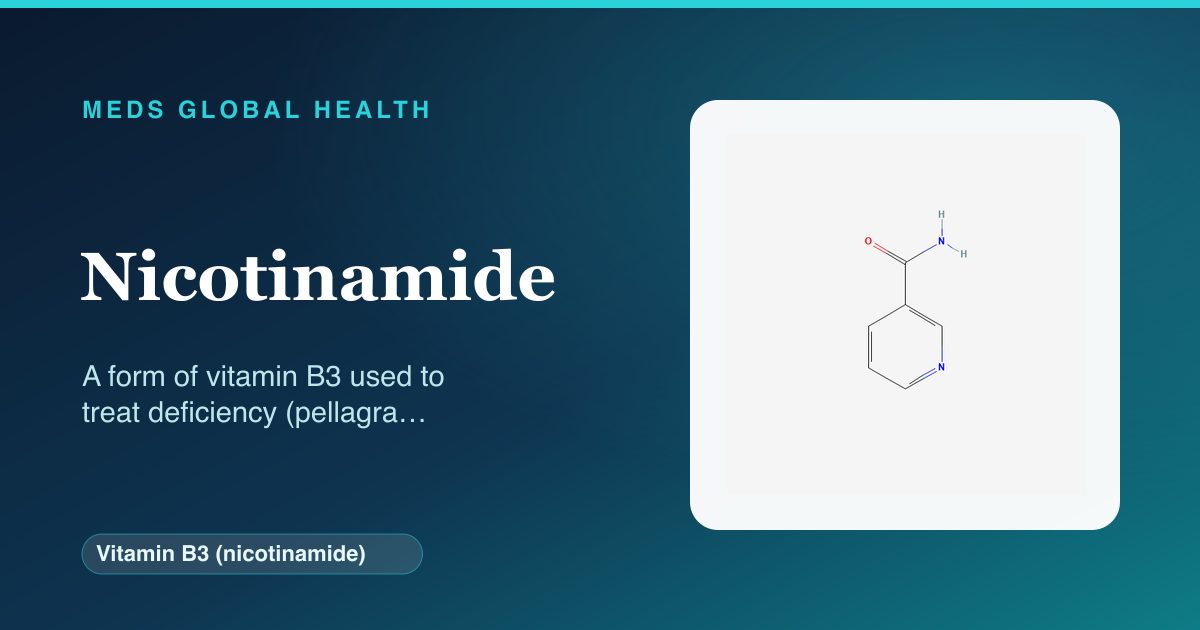
What it is
Nicotinamide is one of the two main forms of vitamin B3 (the other being nicotinic acid, or niacin). It is found in foods such as meat, fish, eggs, milk and fortified cereals, and the body can also make some from the amino acid tryptophan. Vitamin B3 is needed to release energy from food and to keep the skin, digestive system and nervous system healthy. As a medicine, nicotinamide is used to prevent and treat vitamin B3 deficiency (pellagra) and is also used in some skin conditions. It is taken by mouth.
How it works
Nicotinamide is used by the body to make helper molecules that countless enzymes rely on to release energy from food and to carry out cell repair and many other processes. When vitamin B3 is lacking, these processes fail and the symptoms of pellagra appear; supplementing corrects this. Unlike nicotinic acid, nicotinamide does not widen blood vessels in the skin, which is why it does not cause the characteristic flushing. In skin conditions, it is thought to support the skin barrier and calm inflammation.
Company & origin
Vitamin B3 was identified in the 1930s as the factor whose lack causes pellagra, a disease once common where diets relied heavily on maize.
Practical use
How to take Nicotinamide
General, dose-free guidance — always follow your prescriber's and the leaflet's specific instructions.
- Take it as advised, usually once a day, with or without food.
- Unlike nicotinic acid, nicotinamide does not usually cause hot flushing of the skin.
- If it is prescribed for a skin condition, follow the schedule your prescriber gives you.
- Do not assume more is better; high amounts should only be taken on advice.
- Most people get enough vitamin B3 from a balanced diet, so supplements are mainly for deficiency or specific reasons.
Weighing it up
Advantages & disadvantages of Nicotinamide
Advantages
- Effectively prevents and treats vitamin B3 deficiency (pellagra).
- Does not cause the hot flushing that nicotinic acid often does, so it is easier to tolerate.
- Useful in some inflammatory skin conditions.
Disadvantages
- Rarely needed by people who eat a balanced diet.
- Very high doses are not automatically beneficial and should be on advice.
- It treats vitamin B3 deficiency but is not a general tonic for everyone.
Practical use
Good to know
A helpful thing to know is that nicotinamide and nicotinic acid are both vitamin B3, but they behave differently: nicotinic acid often causes a harmless but uncomfortable hot flushing of the skin, whereas nicotinamide does not, which makes nicotinamide easier to tolerate for many people. It is used to treat vitamin B3 deficiency (pellagra), which causes skin changes, digestive upset and confusion, and is also used for certain inflammatory skin conditions. Most people get plenty of vitamin B3 from a balanced diet or make some from protein in food, so supplements are mainly for deficiency or a specific reason. As with other vitamins, very high doses are not automatically better and should be on advice.
Who should not take it / use with caution
- People with significant liver problems should use higher doses only under medical supervision.
- Routine high-dose use is unnecessary for those with a normal diet and no deficiency.
- Use for skin conditions should be guided by a healthcare professional.
Monitoring
- Reviewing whether a supplement is genuinely needed or whether diet provides enough.
- Checking that deficiency symptoms improve when it is given for pellagra.
- Considering liver checks with high-dose long-term use.
Side effects
- Usually well tolerated; occasionally mild stomach upset.
- Unlike nicotinic acid, it does not typically cause flushing.
- Rarely, very high doses may affect the liver, so high-dose use should be supervised.
Key interactions
- No major routine interactions with other medicines are well established at sensible amounts.
- Very high doses may add to the effects of some medicines on the liver, so caution is needed.
- Tell your prescriber what supplements you take so they have the full picture.
Available as: Tablets taken by mouth.
Answers
Nicotinamide: frequently asked questions
What is nicotinamide used for?
It is a form of vitamin B3 used to prevent and treat deficiency (pellagra) and is also used for certain skin conditions.
Will it cause flushing like niacin?
No. Unlike nicotinic acid, nicotinamide does not usually cause the hot flushing of the skin, which makes it easier to tolerate.
Is nicotinamide the same as niacin?
They are both forms of vitamin B3, but nicotinamide does not cause the flushing that nicotinic acid (niacin) often does.
Do I need a vitamin B3 supplement?
Most people get plenty from a balanced diet or make some from protein in food, so supplements are mainly for deficiency or a specific reason.
Can I take large amounts safely?
Very high doses are not automatically better and may affect the liver, so high-dose use should only be on medical advice.
Authoritative sources
- BNF
- NICE CKS
Building a medicines information resource?
We create evidence-led, dose-free drug and formulary references for teams.