Nicotine replacement therapy (NRT)
Nicotine
Nicotine replacement therapy (patches, gum, lozenges and sprays) that eases cravings and withdrawal to help people stop smoking.
What is Nicotine?
Nicotine replacement therapy (NRT) provides clean, measured nicotine to ease the cravings and withdrawal symptoms that make stopping smoking difficult. It comes as patches, gum, lozenges, inhalators and sprays, and is one of the most effective aids to quitting.
Education and reference only. This is a plain-language guide to Nicotine — it deliberately contains no doses. Doses depend on the person, the brand and the reason for treatment, and belong with your prescriber. Always check the BNF, the product labelling (SmPC) and follow medical advice.
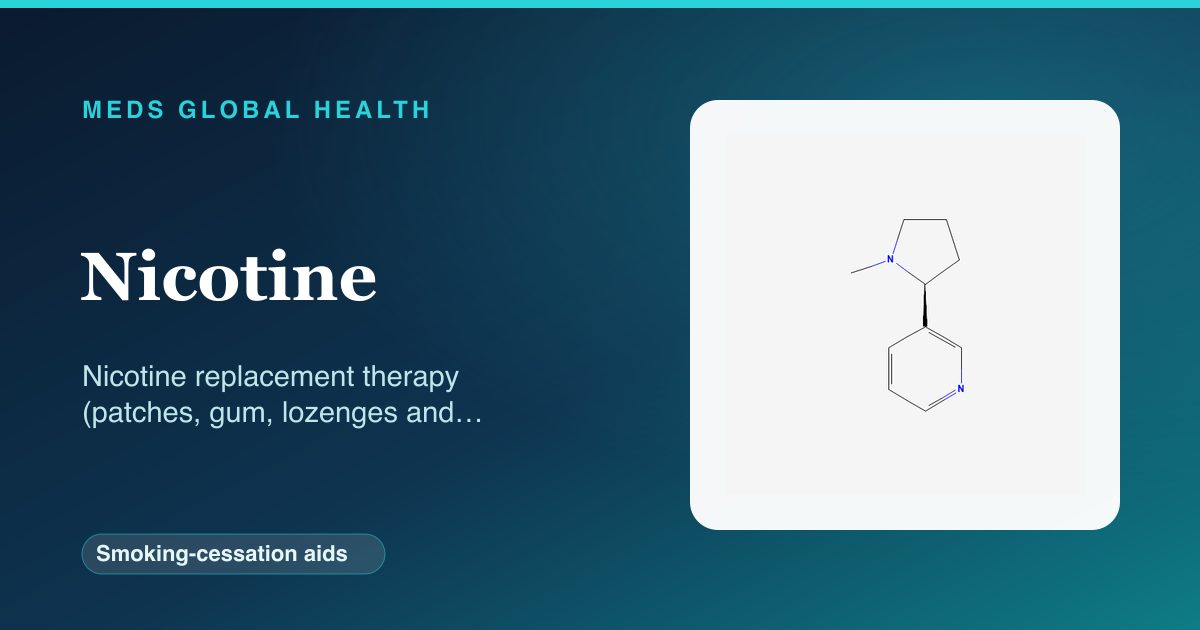
What it is
Nicotine replacement therapy (NRT) provides clean, measured nicotine to ease the cravings and withdrawal symptoms that make stopping smoking so hard. It comes as skin patches, chewing gum, lozenges, inhalators, mouth and nasal sprays. In the UK common brands include Nicorette and Nicotinell; in the US a familiar patch brand is NicoDerm. The key point is that it is the tar, carbon monoxide and thousands of other chemicals in tobacco smoke — not the nicotine itself — that cause most of the harm from smoking, so replacing smoked nicotine with NRT is far safer than continuing to smoke. NRT is widely available from pharmacies and supermarkets and through NHS stop-smoking services.
How it works
Nicotine is the substance in cigarettes that the body becomes dependent on. NRT supplies nicotine through the skin or the lining of the mouth or nose, without the smoke, so the brain receives enough to take the edge off cravings and withdrawal while the habit of smoking is broken. Patches release nicotine slowly and steadily for background control, while gum, lozenges and sprays act faster to handle sudden cravings — which is why combining a patch with a quick-acting form often works best.
Company & origin
Originated / developed by: AB Leo / Pharmacia (Sweden; Nicorette now owned by Kenvue).
Nicotine is a natural alkaloid of the tobacco plant; as a smoking-cessation aid it was first formulated as the nicotine gum Nicorette, developed in Sweden by AB Leo (researcher Ove Ferno) in the late 1960s-1970s and first marketed in 1978.
Practical use
How to take Nicotine
General, dose-free guidance — always follow your prescriber's and the leaflet's specific instructions.
- Patches are stuck to clean, dry, hairless skin and release nicotine steadily through the day; rotate the site and choose a 16-hour or 24-hour patch to suit you.
- Gum and lozenges are used when a craving hits — chew the gum slowly until the taste is strong then rest it against the cheek, and let lozenges dissolve rather than chewing them.
- The inhalator and mouth or nasal sprays give faster relief for sudden, strong cravings.
- Combining a patch with a faster-acting form, such as gum or spray, often works better than one product alone.
- Use NRT for long enough to get through withdrawal — usually a course of several weeks to a few months — then taper off.
- Ask a pharmacist or stop-smoking service for support, which greatly improves your chances of quitting.
Weighing it up
Advantages & disadvantages of Nicotine
Advantages
- Substantially improves the chance of stopping smoking successfully.
- Far safer than continuing to smoke, with none of the tobacco smoke toxins.
- Several formats let you match steady and on-demand craving relief.
- Widely available, including without prescription and through UK stop-smoking services.
Disadvantages
- Can cause skin irritation from patches, mouth or throat irritation, hiccups, nausea or vivid dreams.
- Does not address the habit and social side of smoking on its own.
- Some people remain dependent on the NRT product for a time.
- Wrong technique, such as chewing gum too fast, can cause hiccups and an upset stomach.
Practical use
Good to know
Using a steady patch together with a faster form (gum, lozenge or spray) for breakthrough cravings is more effective than either alone, and is recommended for most people. Quick-acting forms work best when used at the first sign of a craving, and the gum is "parked" against the cheek rather than chewed continuously. NRT is used for a planned period and then tapered down. Success is much higher with behavioural support, such as an NHS stop-smoking service. In pregnancy, stopping without medicine is preferred, but if NRT helps you quit it is far safer than smoking and is used after discussion with a midwife or clinician.
Who should not take it / use with caution
- People who have had a serious allergic reaction to a component of a particular product (a different form can often be used).
- Used with advice in pregnancy and breastfeeding, after recent heart attack, unstable angina or certain heart-rhythm problems — but always weighed against the much greater harm of continued smoking.
- Some forms are not suitable for children, and products are kept away from children and pets as swallowed nicotine is harmful.
Monitoring
- How well cravings and withdrawal are controlled
- Any signs of using too much (nausea, palpitations) so the form or amount can be adjusted
- Progress with quitting, ideally alongside behavioural support
Side effects
- Skin irritation under patches; mouth or throat irritation, hiccups or jaw ache with gum, lozenges or sprays.
- Headache, dizziness, nausea or palpitations — often a sign of using slightly more than needed, which can be eased by adjusting the form or amount.
- Vivid dreams or disturbed sleep with overnight patches, which can be helped by removing the patch at night.
Key interactions
- Stopping smoking itself (not the NRT) can change how the body handles some medicines, occasionally needing them to be reviewed — for example certain medicines for mental health and theophylline.
- No major direct drug interactions with NRT, but tell your prescriber you are quitting so other medicines can be checked if needed.
- Caffeine effects can feel stronger after quitting smoking, as smoking previously sped up its breakdown.
Available as: Skin patches, chewing gum, lozenges, an inhalator, and mouth and nasal sprays. Available without a prescription and through NHS stop-smoking services.
Answers
Nicotine: frequently asked questions
Is nicotine replacement as harmful as smoking?
No. Most of the harm from smoking comes from tar, carbon monoxide and other chemicals in the smoke, not from nicotine. NRT gives you nicotine without the smoke, so it is far safer than continuing to smoke and is a well-established way to help you quit.
Why use a patch and gum together?
A patch gives steady background nicotine to keep everyday cravings down, while gum, a lozenge or a spray acts quickly when a sudden strong craving hits. Using both together — sometimes called combination NRT — helps more people quit than a single product alone, and is recommended for most smokers.
How do I use nicotine gum properly?
Chew it slowly until you notice a peppery taste or tingle, then rest ("park") it against the inside of your cheek; chew again when the taste fades. Chewing it fast and continuously like ordinary gum releases nicotine too quickly and can cause hiccups, throat irritation or nausea.
Can I use NRT in pregnancy?
Stopping smoking without medicines is the preferred option in pregnancy, but smoking is very harmful to your baby, so if NRT helps you quit it is much safer than carrying on smoking. Discuss it with your midwife or a stop-smoking adviser, who can guide you on the best form to use.
What is the difference between Nicorette, Nicotinell and NicoDerm?
They are different brands of nicotine replacement — Nicorette and Nicotinell are common in the UK and NicoDerm is a US patch brand. They all deliver the same active ingredient, nicotine; the main difference is the form (patch, gum, lozenge, spray) and how quickly it acts.
The wider class
About Smoking-cessation aids
Nicotine belongs to the smoking-cessation aids class. For how the class as a whole works, its shared safety principles and monitoring, see the full guide.
Browse by body system
Authoritative sources
- BNF: Nicotine.
- NICE NG209: Tobacco — preventing uptake, promoting quitting and treating dependence.
- NICE CKS: Stop smoking treatments; Better Health — Quit Smoking.
Building a medicines information resource?
We create evidence-led, dose-free drug and formulary references for teams.