A B-vitamin used at higher strength to lower cholesterol
Nicotinic acid (niacin, vitamin B3)
A B-vitamin that, at higher medicinal strength, has been used to improve cholesterol and blood fats, though statins are now usually preferred.
What is Nicotinic acid (niacin, vitamin B3)?
Nicotinic acid, also called niacin or vitamin B3, is an essential vitamin that at much higher medicinal strength acts as a lipid-lowering medicine, improving cholesterol and other blood fats. Its most noticeable effect is flushing, a hot, red feeling in the skin that is very common when starting it. It can affect the liver and, when combined with statins, may increase the risk of muscle problems, so it needs medical supervision. In current UK practice it is used much less for cholesterol than statins.
Education and reference only. This is a plain-language guide to Nicotinic acid (niacin, vitamin B3) — it deliberately contains no doses. Doses depend on the person, the brand and the reason for treatment, and belong with your prescriber. Always check the BNF, the product labelling (SmPC) and follow medical advice.
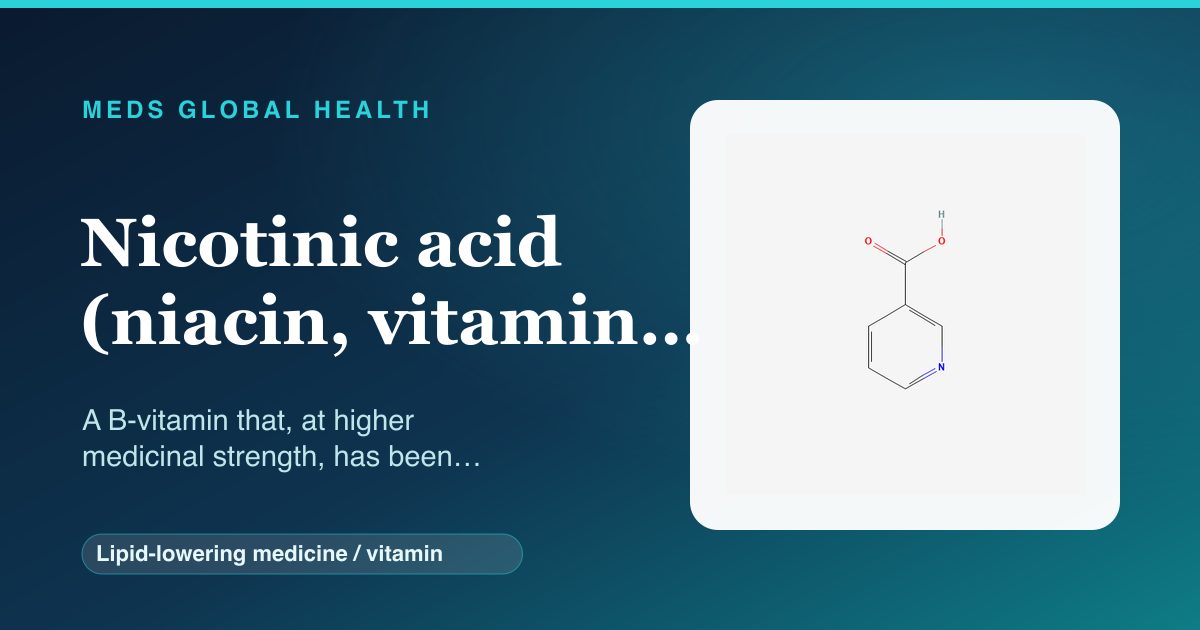
What it is
Nicotinic acid is vitamin B3, needed by the body in small amounts as part of a normal diet. As a medicine, given at far higher strength than the vitamin requirement, it was used to lower harmful cholesterol and raise the protective type, and to bring down certain other blood fats. Today it is used as a lipid medicine only in selected situations, because statins and other treatments are generally preferred and better tolerated. The vitamin itself remains important for health.
How it works
At medicinal strength, nicotinic acid acts on fat handling in the body, reducing the release of fatty material and lowering the production of certain cholesterol-carrying particles. This shifts the balance of blood fats in a more favourable direction. The same actions on small blood vessels in the skin cause the characteristic flushing. As a vitamin, in everyday amounts, it plays a role in energy production and healthy nerves, skin and digestion, which is a separate function from its cholesterol effect.
Company & origin
Also known as niacin or vitamin B3, this is an essential vitamin found in many foods. At ordinary amounts it is a nutrient, but at much higher medicinal strength it has been used as a lipid-lowering medicine to improve cholesterol and other blood fats. In modern UK practice statins and newer treatments are preferred for cholesterol, so high-strength nicotinic acid is now used far less often, while the vitamin role remains familiar.
What it treats
Conditions Nicotinic acid (niacin, vitamin B3) is used for
Practical use
How to take Nicotinic acid (niacin, vitamin B3)
General, dose-free guidance — always follow your prescriber's and the leaflet's specific instructions.
- Take it exactly as prescribed, as the medicinal strength is far higher than a vitamin supplement.
- Expect flushing, especially early on, and follow any advice given to reduce it, such as how and when to take it.
- Attend blood tests so your liver, blood fats and blood sugar can be monitored.
- Tell your doctor if you also take a statin, because the combination can raise the risk of muscle problems.
- Report unexplained muscle pain, weakness, or yellowing of the skin or eyes promptly.
Weighing it up
Advantages & disadvantages of Nicotinic acid (niacin, vitamin B3)
Advantages
- Can improve several blood fats at once, including raising the protective cholesterol.
- Is a long-established treatment with a well-understood profile.
- Doubles as an essential vitamin at ordinary dietary amounts.
Disadvantages
- Flushing is very common and can be uncomfortable.
- Can affect the liver and disturb blood sugar control.
- Increases the risk of muscle problems when combined with statins, and is now used much less.
Practical use
Good to know
Flushing, a sudden hot, red, tingling feeling usually in the face and upper body, is very common with high-strength nicotinic acid and can be uncomfortable, though it often eases with time. The medicine can affect the liver, so liver checks are part of treatment, and it can disturb blood sugar. An important interaction is with statins, where the combination may raise the risk of muscle damage. Because better-tolerated alternatives exist, its use for cholesterol is now limited and always supervised.
Who should not take it / use with caution
- People with active liver disease or unexplained raised liver blood tests.
- People with an active stomach ulcer, unless a specialist advises.
- People with gout or high uric acid levels, as higher-strength nicotinic acid can raise uric acid and trigger attacks.
- Anyone taking a statin without careful medical supervision, because of the muscle-injury risk.
Monitoring
- Periodic liver function blood tests during treatment.
- Checks of blood fats to confirm benefit, and of blood sugar.
- Prompt review of any muscle pain or weakness, especially with a statin.
Side effects
- Flushing, a hot, red, tingling feeling, especially in the face and upper body.
- Itching, stomach upset and, sometimes, raised blood sugar.
- Liver effects and, rarely, muscle problems, particularly alongside a statin.
Key interactions
- Combining it with statins can raise the risk of muscle damage (myopathy).
- It may affect blood sugar control in people taking diabetes medicines.
- Alcohol and hot drinks can worsen flushing, so tell your prescriber about your other medicines and habits.
Available as: Tablets taken by mouth at medicinal strength, separate from ordinary vitamin supplements.
Answers
Nicotinic acid (niacin, vitamin B3): frequently asked questions
Is nicotinic acid the same as niacin?
Yes. Nicotinic acid, niacin and vitamin B3 are names for the same vitamin. At ordinary dietary amounts it acts as a nutrient, while at much higher medicinal strength it has been used to improve cholesterol.
Why does it cause flushing?
At medicinal strength it widens small blood vessels in the skin, causing a sudden hot, red, tingling sensation, often in the face and upper body. It is very common, can be uncomfortable, and frequently eases as the body gets used to it.
Can I take it with my statin?
Only under medical supervision. Combining nicotinic acid with a statin can increase the risk of muscle damage, so your doctor will decide if it is appropriate and monitor you for muscle pain or weakness.
Is it still used for cholesterol in the UK?
Much less than before. Statins and newer cholesterol treatments are generally preferred because they are better tolerated and have stronger evidence, so high-strength nicotinic acid is now used only in selected, supervised situations.
Does a normal vitamin B3 supplement lower cholesterol?
No. The cholesterol effect needs a much higher strength than the small amounts in an ordinary vitamin supplement, and that strength must be supervised because of the side effects and monitoring involved.
Authoritative sources
- BNF
- NICE CKS
Building a medicines information resource?
We create evidence-led, dose-free drug and formulary references for teams.