An antiparasitic / antiprotozoal medicine
Nitazoxanide
An antiparasitic medicine used to treat diarrhoea caused by the parasites cryptosporidium and giardia.
What is Nitazoxanide?
Nitazoxanide is an antiparasitic (antiprotozoal) medicine used to treat diarrhoea caused by tiny gut parasites, particularly cryptosporidium and giardia. It is taken by mouth, usually with food, as a short course. It is generally well tolerated, and a harmless effect is that it can turn the urine bright yellow and sometimes give a yellow tint to the eyes; stomach upset can also occur. It is used more in some countries than it is routinely in the UK, where it tends to be a specialist option.
Education and reference only. This is a plain-language guide to Nitazoxanide — it deliberately contains no doses. Doses depend on the person, the brand and the reason for treatment, and belong with your prescriber. Always check the BNF, the product labelling (SmPC) and follow medical advice.
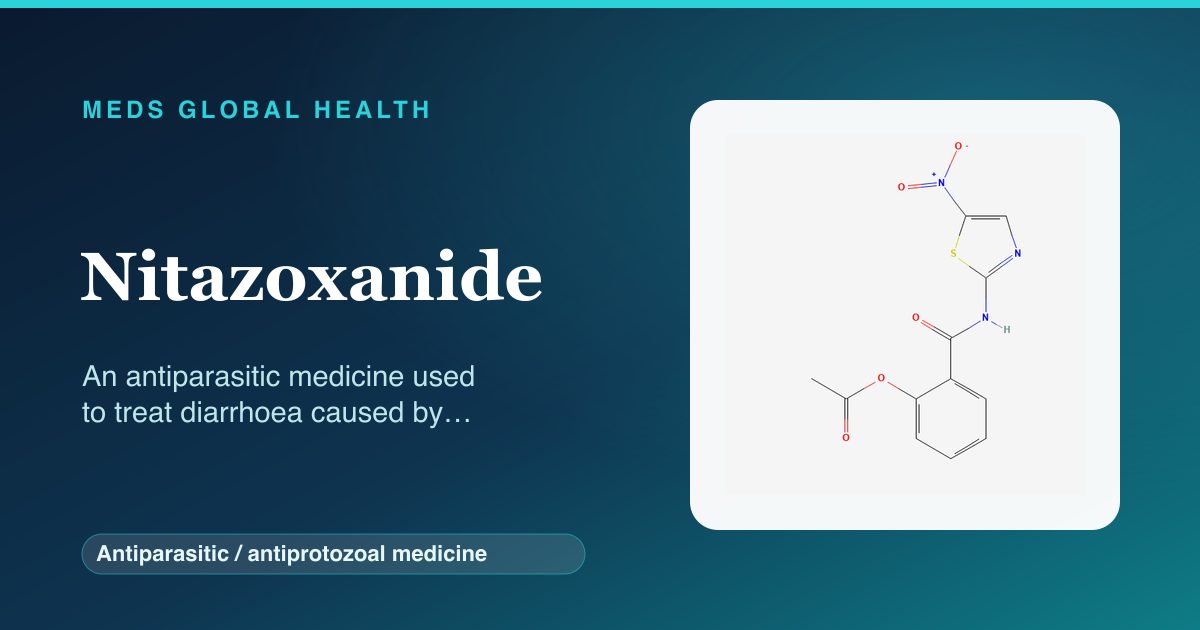
What it is
Nitazoxanide is a medicine used to treat infections caused by tiny gut parasites, known as protozoa. It is used particularly for diarrhoea caused by cryptosporidium and giardia, two parasites that infect the gut and cause watery diarrhoea and tummy upset. It is taken by mouth as tablets or a liquid, usually with food, as a short course. It is more commonly used in some other countries than it is routinely in the UK, where it tends to be used as a specialist option for these particular infections.
How it works
Nitazoxanide works by interfering with a process the parasites rely on to make energy, which stops them surviving and multiplying in the gut. By clearing or reducing the parasites, it helps settle the diarrhoea and other symptoms they cause. Because the infections it treats are confined to the gut, it acts mainly there. It is given as a short course, taken with food to help it work and to reduce stomach upset.
Company & origin
An antiparasitic medicine used to treat diarrhoea caused by the parasites cryptosporidium and giardia, used more in some countries than routinely in the UK.
Practical use
How to take Nitazoxanide
General, dose-free guidance — always follow your prescriber's and the leaflet's specific instructions.
- Take it by mouth with food, which helps it work and reduces stomach upset.
- Complete the full course as directed, even if your diarrhoea has settled.
- Do not be alarmed if your urine turns bright yellow or your eyes look slightly yellow; this is harmless and fades.
- Keep drinking fluids to replace what is lost with diarrhoea.
- Tell your doctor if your symptoms do not improve, especially if your immune system is weakened.
Weighing it up
Advantages & disadvantages of Nitazoxanide
Advantages
- Treats diarrhoea caused by the gut parasites cryptosporidium and giardia.
- Generally well tolerated, taken by mouth as a short course with food.
- Available as tablets or a liquid, which suits different people.
Disadvantages
- Can cause stomach upset such as nausea or tummy pain.
- Turns the urine bright yellow, which, although harmless, can be alarming.
- Cryptosporidium can be harder to clear in people with a weakened immune system.
Practical use
Good to know
Nitazoxanide is generally well tolerated, and one effect that often surprises people is that it can turn the urine a bright yellow colour and sometimes give a yellow tint to the whites of the eyes; this is harmless and fades after the course is finished. It is taken with food, which helps it work and eases any stomach upset such as nausea or tummy pain, the more common side effects. It is given as a short, defined course, so it is best to complete the whole course even if you feel better, to clear the infection fully. In people with a healthy immune system these infections often settle, but treatment can help; in people whose immune system is weakened, cryptosporidium in particular can be harder to clear and needs specialist input.
Who should not take it / use with caution
- People who have had a serious allergic reaction to nitazoxanide should not take it.
- It is used under medical guidance, with care in pregnancy where benefits and risks are weighed.
- It is used with care in people with significant liver or kidney problems, under medical advice.
Monitoring
- Reviewing whether the diarrhoea and other symptoms settle with treatment.
- Considering further input if symptoms persist, especially in people with a weakened immune system.
- Checking fluids are kept up to avoid dehydration from diarrhoea.
Side effects
- A harmless bright-yellow colour to the urine, and sometimes a yellow tint to the whites of the eyes, that fades after stopping.
- Nausea, tummy pain or other stomach upset, often eased by taking it with food.
- Headache in some people.
Key interactions
- Tell your prescriber about all your medicines, as a few can interact with it.
- It is taken with food, which is part of how it is best used.
- Your team will take your other medicines and any liver problems into account.
Available as: Tablets and an oral liquid taken by mouth.
Answers
Nitazoxanide: frequently asked questions
What is nitazoxanide used for?
It is an antiparasitic medicine used to treat diarrhoea caused by gut parasites, particularly cryptosporidium and giardia.
Why has my urine turned bright yellow?
A bright-yellow colour to the urine, and sometimes a yellow tint to the eyes, is a harmless effect of nitazoxanide that fades after you finish the course.
Should I take it with food?
Yes. Taking it with food helps it work and reduces stomach upset such as nausea or tummy pain.
Do I need to finish the whole course?
Yes. It is best to complete the full course as directed, even if your diarrhoea settles, to clear the infection fully.
Does it always cure cryptosporidium?
In people with a healthy immune system these infections often settle and treatment can help, but cryptosporidium can be harder to clear if the immune system is weakened, so specialist input may be needed.
Authoritative sources
- BNF
- NICE CKS
Building a medicines information resource?
We create evidence-led, dose-free drug and formulary references for teams.