Also called norepinephrine; an intensive-care drip for very low blood pressure
Noradrenaline
An intensive-care drip used to raise dangerously low blood pressure, for example in septic shock.
What is Noradrenaline?
Noradrenaline, also called norepinephrine, is a powerful hospital medicine given as a controlled drip into a vein to raise blood pressure that has fallen dangerously low, most often in septic shock and other forms of severe low blood pressure in intensive care. It works by tightening blood vessels so the pressure rises. It is given through a central line under close, continuous monitoring because it can severely damage skin and tissue if it leaks out of the vein, and it can cause a very fast or very slow heart rhythm.
Education and reference only. This is a plain-language guide to Noradrenaline — it deliberately contains no doses. Doses depend on the person, the brand and the reason for treatment, and belong with your prescriber. Always check the BNF, the product labelling (SmPC) and follow medical advice.
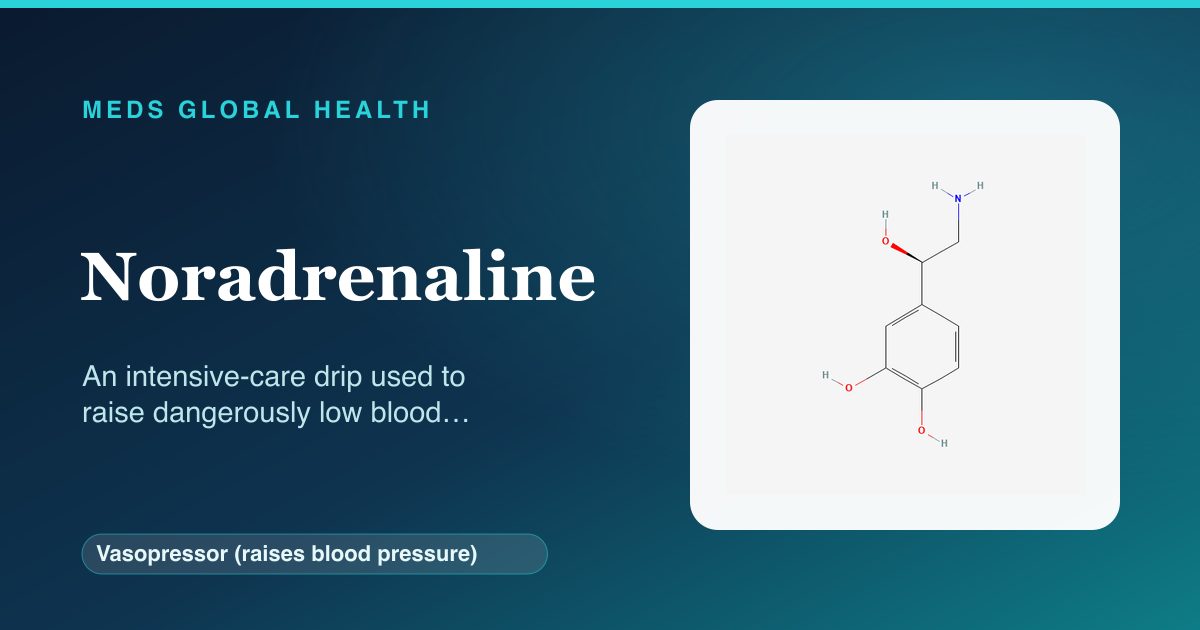
What it is
Noradrenaline, known in some countries as norepinephrine, is a vasopressor — a medicine that raises blood pressure. It is the same as a natural chemical the body makes, used as a medicine in intensive care and high-dependency units. It is the main treatment used to bring blood pressure back up in septic shock and other causes of severe, life-threatening low blood pressure. It is given as a carefully controlled drip into a vein, usually through a central line, with continuous monitoring of blood pressure and heart rhythm. It is a critical-care medicine, never used at home.
How it works
When blood pressure drops dangerously low, vital organs such as the brain, heart and kidneys do not get enough blood. Noradrenaline acts on blood vessels to make them tighten, which raises the pressure within them and helps restore blood flow to the organs. Because it is so powerful, it is given as a continuous drip whose rate is adjusted closely against the blood pressure readings. Its strong effect on blood vessels is also why it can damage tissue badly if it leaks from the vein, and why it can affect the heart's rhythm.
Company & origin
A hospital medicine used in the UK, mainly in intensive care, to raise dangerously low blood pressure in conditions such as septic shock.
Practical use
How to take Noradrenaline
General, dose-free guidance — always follow your prescriber's and the leaflet's specific instructions.
- It is given in critical care as a continuous drip into a vein, usually through a central line, by trained staff only.
- Your blood pressure and heart rhythm are monitored continuously while it is being given.
- The drip site is watched very closely, as the medicine can severely damage tissue if it leaks from the vein.
- The drip rate is adjusted closely against your blood pressure readings and usually reduced gradually, not stopped suddenly.
- The team monitors the heart, as the medicine can cause a very fast or very slow heart rhythm.
Weighing it up
Advantages & disadvantages of Noradrenaline
Advantages
- A powerful and effective way to raise dangerously low blood pressure in septic shock and severe low blood pressure.
- Helps restore blood flow to vital organs in critically ill people.
- Acts quickly, and the drip rate can be fine-tuned against the readings.
Disadvantages
- Can cause severe skin and tissue damage if it leaks out of the vein.
- Can cause a very fast or very slow heart rhythm.
- Used only in critical care through a central line, with continuous monitoring.
Practical use
Good to know
The dominant safety points with noradrenaline are that it is a powerful intensive-care medicine and that the way it is given matters. Because it tightens blood vessels so strongly, it can cause severe damage to the skin and surrounding tissue if it leaks out of the vein (called extravasation), which is the main reason it is usually given through a central line and the site is watched very closely. It can also cause a very fast or, sometimes, a very slow heart rhythm, so the heart is monitored continuously alongside blood pressure. The drip rate is adjusted minute by minute against the readings, and it is reduced gradually rather than stopped suddenly. It is used in critical care by teams who are very familiar with it, always with continuous monitoring.
Who should not take it / use with caution
- People who have had a serious allergic reaction to noradrenaline should not be given it.
- It is used with great care in people with certain heart-rhythm problems or very poor blood flow to the limbs.
- It is used cautiously alongside certain other medicines that affect blood pressure or heart rhythm.
Monitoring
- Continuous monitoring of blood pressure and heart rhythm throughout treatment.
- Very close watching of the drip site for any leak that could cause severe tissue damage.
- Adjusting the drip rate against the blood pressure readings and reducing it gradually.
Side effects
- A very fast or very slow heart rhythm.
- Severe tissue or skin damage if the medicine leaks out of the vein.
- Headache, anxiety, or reduced blood flow to the fingers, toes or other areas with strong or prolonged use.
Key interactions
- It can interact dangerously with certain antidepressants known as MAOIs, raising blood pressure too much.
- Care is needed with other medicines that affect blood pressure or the heart's rhythm.
- Tell the team about all your medicines, as several can change how noradrenaline behaves.
Available as: A solution for a continuous drip into a vein, given in critical care, usually through a central line.
Answers
Noradrenaline: frequently asked questions
What is noradrenaline used for?
It is a powerful intensive-care drip used to raise dangerously low blood pressure, most often in septic shock and other forms of severe low blood pressure.
Is noradrenaline the same as norepinephrine?
Yes. Noradrenaline and norepinephrine are two names for the same medicine, which raises blood pressure by tightening blood vessels.
Why is it given through a central line?
Because it tightens blood vessels so strongly, it can cause severe tissue damage if it leaks from a vein, so it is usually given through a central line with the site watched closely.
Why is my heart monitored while I have it?
Noradrenaline can cause a very fast or very slow heart rhythm, so the heart is monitored continuously alongside blood pressure throughout treatment.
Can it be stopped suddenly?
It is usually reduced gradually rather than stopped suddenly, with the drip rate adjusted closely against your blood pressure readings by the team.
Authoritative sources
- BNF
- NICE CKS
Building a medicines information resource?
We create evidence-led, dose-free drug and formulary references for teams.