An antifungal for oral thrush
Nystatin
An antifungal oral liquid used to treat oral thrush, held in the mouth and then swallowed so it acts where the infection is.
What is Nystatin?
Nystatin is an antifungal used mainly for oral thrush (a candida infection in the mouth). It comes as a liquid that you hold in the mouth, swish around and then swallow. It is barely absorbed from the gut, so it works on contact rather than throughout the body. Finish the full course.
Education and reference only. This is a plain-language guide to Nystatin — it deliberately contains no doses. Doses depend on the person, the brand and the reason for treatment, and belong with your prescriber. Always check the BNF, the product labelling (SmPC) and follow medical advice.
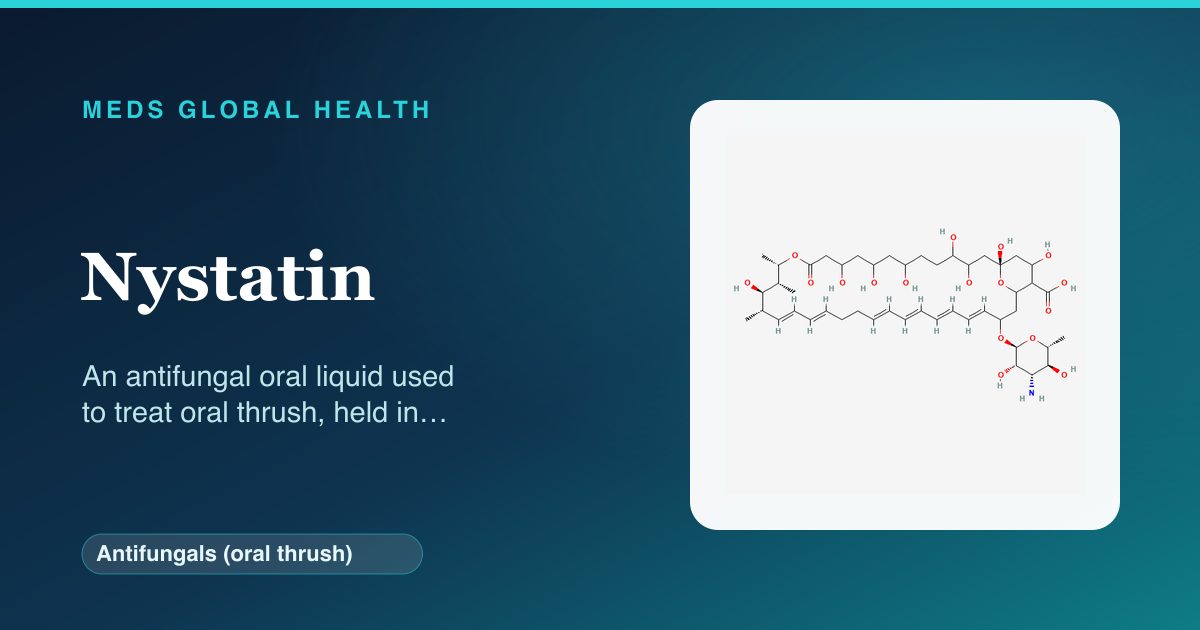
What it is
Nystatin is an antifungal medicine used chiefly to treat oral thrush — a candida yeast infection that causes white patches and soreness in the mouth and throat. It is given as an oral liquid that is held in the mouth and then swallowed, so it bathes the affected surfaces. It can also be used for candida infection further down the gut, and is sometimes used to help prevent thrush in people at higher risk.
How it works
Nystatin binds to a substance called ergosterol in the candida yeast's outer wall, punching tiny holes in it. The damaged wall leaks, and the yeast cell dies. Because nystatin is barely absorbed from the gut into the bloodstream, it stays in the mouth and digestive tract and acts on contact with the yeast there, which is why it is held in the mouth before swallowing.
Company & origin
Originated / developed by: E.R. Squibb.
Nystatin was discovered in the United States in the early 1950s and named after the New York State Health Department laboratory where it was found.
Practical use
How to take Nystatin
General, dose-free guidance — always follow your prescriber's and the leaflet's specific instructions.
- Hold the liquid in your mouth, swishing it over the affected areas, before swallowing it.
- Use it after food and after cleaning your teeth, then avoid eating or drinking for a short while so it stays in contact.
- Space the doses out evenly through the day as directed on the label.
- Finish the full course and keep going for a couple of days after symptoms clear.
- Clean dentures, dummies or feeding equipment to stop the infection returning.
Weighing it up
Advantages & disadvantages of Nystatin
Advantages
- Acts directly on contact in the mouth and gut where thrush lives.
- Barely absorbed into the body, so very few whole-body side effects or drug interactions.
- Suitable for babies, older people and others when treating oral thrush.
Disadvantages
- Needs to be held in the mouth and used several times a day, which takes some discipline.
- Has a taste some people dislike, which can affect use in young children.
- Only works where it touches, so it does not treat candida elsewhere in the body.
Practical use
Good to know
Nystatin works by contact, so it should be held in the mouth, swished around the affected areas and then swallowed rather than gulped straight down. Because it is barely absorbed from the gut, it has very few effects on the rest of the body and few drug interactions. It is important to finish the whole course and to keep going for a couple of days after the mouth looks and feels better, to stop the infection coming back. In babies and denture wearers, treating the source matters too — for example sterilising dummies and cleaning dentures.
Who should not take it / use with caution
- People who have had an allergic reaction to nystatin.
- It is not suitable for fungal infections deep inside the body, which need a medicine absorbed into the bloodstream.
- Use as advised in pregnancy and breastfeeding; because so little is absorbed it is generally considered suitable, but confirm with a clinician.
Monitoring
- No routine blood monitoring is needed.
- Review if oral thrush does not improve within the expected time or keeps returning.
- Recurrent thrush may prompt a look for an underlying cause, such as inhaler technique or diabetes.
Side effects
- Often well tolerated; sometimes mild stomach upset, nausea or a dislike of the taste.
- Occasional mouth irritation or, rarely, diarrhoea at higher use.
- Rarely, an allergic reaction with rash or swelling — stop and seek advice if this happens.
Key interactions
- Very few, because almost none of it is absorbed into the bloodstream.
- Eating or drinking too soon after a dose can wash it away before it has worked.
- Mention all your medicines to the pharmacist, but clinically important interactions are uncommon.
Available as: Oral suspension (liquid) held in the mouth and swallowed; sometimes pastilles in other settings.
Answers
Nystatin: frequently asked questions
Why do I hold nystatin in my mouth before swallowing?
Nystatin works by direct contact with the candida yeast and is barely absorbed into the bloodstream. Holding and swishing it around the mouth before swallowing lets it reach the infected surfaces, which is how it clears oral thrush.
Should I keep using it after my mouth feels better?
Yes. Finish the full course and continue for a couple of days after the soreness and white patches have cleared. Stopping as soon as it looks better can let the infection return.
Is nystatin absorbed into the body?
Hardly at all. It stays in the mouth and gut and acts where it touches, which is why it has very few whole-body side effects and few drug interactions. For fungal infections deeper in the body, a different, absorbed medicine is needed.
Can babies have nystatin for oral thrush?
Yes, nystatin is commonly used for oral thrush in babies. It is applied to the affected areas of the mouth as directed. Sterilising dummies and feeding equipment, and treating thrush on the mother if breastfeeding, helps stop it coming back.
My oral thrush keeps coming back — why?
Recurrent oral thrush can point to an underlying factor, such as poor inhaler technique with a steroid inhaler, ill-fitting dentures, diabetes or a weakened immune system. If thrush keeps returning, see a clinician to look for and address the cause.
The wider class
About Antifungals (oral thrush)
Nystatin belongs to the antifungals (oral thrush) class. For how the class as a whole works, its shared safety principles and monitoring, see the full guide.
Browse by body system
Authoritative sources
- BNF: Nystatin.
- NICE CKS: Oral thrush (mouth thrush).
Building a medicines information resource?
We create evidence-led, dose-free drug and formulary references for teams.