A cholinesterase reactivator antidote for organophosphate poisoning
Obidoxime
An antidote for organophosphate (nerve agent or pesticide) poisoning that helps restore a key enzyme, used in hospital alongside atropine.
What is Obidoxime?
Obidoxime is a specialist antidote used in hospital emergencies to treat poisoning by organophosphates, the chemicals found in nerve agents and some pesticides. These poisons block an important enzyme that nerves and muscles need to work properly, and obidoxime helps reactivate that enzyme. It is given alongside atropine, another antidote, as part of emergency treatment. It works best when given early, before the poison's effect on the enzyme becomes permanent. It can affect the liver and blood pressure, so the person is closely monitored. It is used only in emergency hospital settings.
Education and reference only. This is a plain-language guide to Obidoxime — it deliberately contains no doses. Doses depend on the person, the brand and the reason for treatment, and belong with your prescriber. Always check the BNF, the product labelling (SmPC) and follow medical advice.
What it is
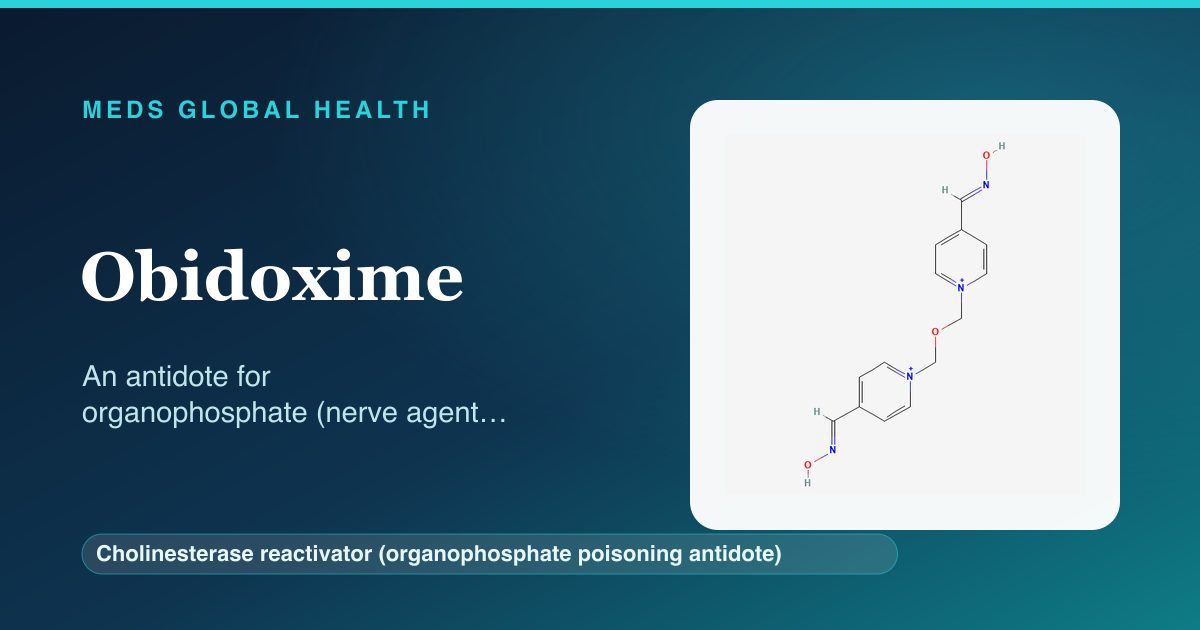
Obidoxime is a medicine used as an antidote for poisoning by organophosphates, a group of chemicals that includes nerve agents and some agricultural pesticides. These poisons attack an enzyme called cholinesterase, which the body needs to control the signals between nerves and muscles. When that enzyme is blocked, the result is a dangerous overload of nerve signals affecting breathing, the heart and the muscles. Obidoxime belongs to a group of antidotes that work by reactivating the blocked enzyme. It is given by injection in hospital emergencies, always together with atropine, and as part of full supportive care.
How it works
Organophosphates poison the body by locking onto cholinesterase, the enzyme that normally breaks down a key nerve-signalling chemical. With the enzyme blocked, that chemical builds up and overstimulates nerves and muscles. Obidoxime works by prising the poison off the enzyme, freeing it to work again. This is why timing is so important: if treatment is delayed, the bond between the poison and the enzyme can become permanent ('ageing'), after which the antidote can no longer reactivate it. Obidoxime is given with atropine, which blocks the effects of the excess signalling chemical, so the two antidotes tackle the poisoning in complementary ways.
Company & origin
A specialist hospital antidote used for poisoning by organophosphates, such as nerve agents and some pesticides, given alongside atropine.
Practical use
How to take Obidoxime
General, dose-free guidance — always follow your prescriber's and the leaflet's specific instructions.
- It is given by injection in hospital by emergency teams treating organophosphate poisoning.
- It is given as early as possible, as it works best before the poison's effect on the enzyme becomes permanent.
- It is always used together with atropine and full emergency support, not on its own.
- Liver tests and blood pressure are monitored during and after treatment.
- It is used only by teams trained to manage poisoning, who also protect against contamination.
Weighing it up
Advantages & disadvantages of Obidoxime
Advantages
- Can reactivate the key enzyme blocked by organophosphate poisons, tackling the cause of the poisoning.
- Works alongside atropine to manage a life-threatening emergency.
- Most effective when given early in the course of poisoning.
Disadvantages
- Loses its effect if given too late, once the poison has bonded permanently to the enzyme.
- Can affect the liver and change blood pressure, needing close monitoring.
- Used only in specialist emergency hospital settings, not a general treatment.
Practical use
Good to know
The most important point with obidoxime is that it works best when given early. Once the poison has bonded permanently to the enzyme, the antidote can no longer free it, so it is given as soon as organophosphate poisoning is recognised. It is always used alongside atropine, not instead of it, because the two antidotes work in different ways, and alongside full emergency support such as help with breathing. It can affect the liver and can change blood pressure, so the person is closely monitored throughout. Because organophosphate poisoning is a medical emergency, this antidote is used only in hospital by teams trained to manage poisoning, who also take care to protect themselves from contamination.
Who should not take it / use with caution
- It is used only for organophosphate poisoning, not for other types of poisoning.
- It is given with care in people with liver problems, with monitoring.
- It must be used in a hospital emergency setting alongside atropine and supportive care.
Monitoring
- Monitoring blood pressure and heart and breathing closely.
- Checking liver function during and after treatment.
- Watching the response to treatment and adjusting the overall care of the poisoning.
Side effects
- Changes in blood pressure during or after treatment.
- Effects on the liver, shown by changes in liver blood tests.
- Pain or a reaction where the injection is given, and feeling generally unwell.
Key interactions
- It is given together with atropine, the two antidotes working in complementary ways.
- Other medicines used in resuscitation are managed together by the emergency team.
- The poisoning itself, rather than other medicines, is the main thing driving treatment.
Available as: A solution given by injection in hospital.
Answers
Obidoxime: frequently asked questions
What is obidoxime used for?
It is an antidote for poisoning by organophosphates, the chemicals in nerve agents and some pesticides, helping to reactivate a key enzyme they block.
Why is it given quickly?
It works best early, because if treatment is delayed the poison can bond permanently to the enzyme, after which the antidote can no longer free it.
Is it used on its own?
No. It is always used alongside atropine and full emergency support, as the antidotes work in different, complementary ways.
Does it have risks?
It can affect the liver and change blood pressure, so the person is closely monitored throughout treatment in hospital.
Where is it given?
It is used only in hospital emergencies by teams trained to manage poisoning, who also protect themselves from contamination.
Authoritative sources
- BNF
- NICE CKS
Building a medicines information resource?
We create evidence-led, dose-free drug and formulary references for teams.