Vitamin K1
Phytomenadione
A form of vitamin K needed for normal blood clotting, given to newborns to prevent bleeding and used to reverse over-thinning of the blood from warfarin.
What is Phytomenadione?
Phytomenadione is a form of vitamin K, a vitamin the body needs to make the proteins that allow blood to clot normally. It is given routinely to newborn babies to prevent a rare but serious bleeding problem called vitamin K deficiency bleeding, and it is used in adults to reverse the blood being thinned too much by warfarin. Because vitamin K is what warfarin works against, the two have opposite effects, so phytomenadione is given carefully under medical guidance when warfarin needs to be counteracted. It can be given by mouth or by injection depending on the situation, always as directed by a healthcare professional.
Education and reference only. This is a plain-language guide to Phytomenadione — it deliberately contains no doses. Doses depend on the person, the brand and the reason for treatment, and belong with your prescriber. Always check the BNF, the product labelling (SmPC) and follow medical advice.
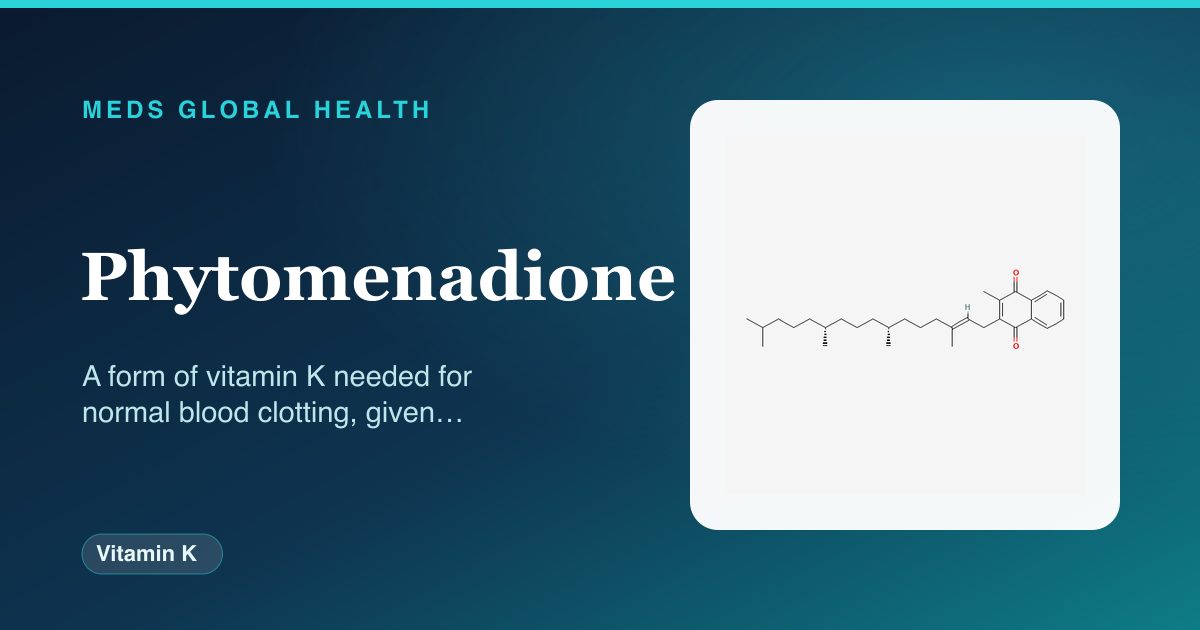
What it is
Phytomenadione is vitamin K1, the main dietary form of vitamin K, found naturally in green leafy vegetables and some oils. The body needs vitamin K to make several clotting factors, the proteins that allow blood to form clots and stop bleeding. As a medicine, phytomenadione is best known by the brand Konakion. It is given to newborn babies to prevent vitamin K deficiency bleeding, and to adults to treat or prevent bleeding caused by too little vitamin K, including when warfarin has thinned the blood too much. It is given by mouth or by injection.
How it works
Vitamin K is needed by the liver to make working clotting factors, so supplying phytomenadione restores the body's ability to form clots and stop bleeding. In newborns, whose vitamin K stores are naturally low, a routine dose prevents the rare but dangerous bleeding that can otherwise occur. In people taking warfarin, the warfarin works by blocking vitamin K, so giving phytomenadione directly opposes the warfarin and brings the over-thinned blood back towards normal. How quickly and by what route it is given depends on how urgent the situation is.
Company & origin
Vitamin K was discovered in the 1930s through its role in blood clotting; the K comes from the German word Koagulation.
Practical use
How to take Phytomenadione
General, dose-free guidance — always follow your prescriber's and the leaflet's specific instructions.
- It is given as advised by a healthcare professional, by mouth or by injection depending on the situation.
- For newborns, it is offered routinely soon after birth to prevent a rare but serious bleeding problem.
- If you take warfarin, it will only be given on medical advice to reverse blood that has become too thin.
- If you take warfarin, keep your intake of vitamin K-rich foods such as green vegetables steady rather than changing it suddenly.
- Always follow the route and schedule your healthcare team gives you, as the urgency guides how it is given.
Weighing it up
Advantages & disadvantages of Phytomenadione
Advantages
- Reliably prevents vitamin K deficiency bleeding in newborn babies.
- Effectively reverses blood that has been thinned too much by warfarin.
- Can be given by mouth or by injection to suit how urgent the situation is.
Disadvantages
- It directly opposes warfarin, so in people on warfarin it must be used carefully to avoid over-correcting.
- Injections, particularly into a vein, are given under supervision because of a rare risk of reaction.
- It is not a general-purpose vitamin supplement and is used for specific clotting-related reasons.
Practical use
Good to know
Phytomenadione is given routinely to newborn babies because their natural vitamin K stores are very low, and this simple measure prevents a rare but very serious bleeding problem; parents are usually offered it shortly after birth. In adults, the main use is to reverse warfarin when blood tests show the blood has become too thin, or when there is bleeding, so it is closely tied to careful monitoring of clotting. Importantly, because vitamin K opposes warfarin, people on warfarin are advised to keep their intake of vitamin K-rich foods steady rather than suddenly changing it, as big changes can upset their control. It is given by mouth or by injection depending on how quickly it is needed, always under medical guidance.
Who should not take it / use with caution
- It should only be used to counteract warfarin on medical advice, not by people adjusting their own treatment.
- Anyone who has had a serious reaction to a previous injection should tell their healthcare team.
- Its use in specific clotting disorders should be guided by a clinician.
Monitoring
- Blood clotting tests (such as the INR) when it is used to reverse warfarin.
- Checking that newborns have received their routine dose to prevent bleeding.
- Watching for any return of bleeding or, conversely, over-correction of clotting.
Side effects
- Usually well tolerated; injections can occasionally cause soreness at the injection site.
- Rarely, a reaction such as flushing or, very rarely, a more serious allergic reaction with injection into a vein.
- In people on warfarin, giving it can make the blood clot more readily again, which needs careful balancing.
Key interactions
- It directly opposes warfarin and similar blood thinners, reducing their effect.
- Large or sudden changes in vitamin K intake can upset warfarin control, so steadiness matters.
- Conditions or medicines that affect fat absorption can reduce how much vitamin K is absorbed.
Available as: Oral liquid and injection, given by a healthcare professional.
Answers
Phytomenadione: frequently asked questions
Why is vitamin K given to newborn babies?
Newborns have very low vitamin K stores, and a routine dose of phytomenadione prevents a rare but serious bleeding problem called vitamin K deficiency bleeding.
How does it affect warfarin?
Warfarin works by blocking vitamin K, so phytomenadione has the opposite effect and is used to reverse blood that has become too thin, under medical guidance.
Should I change my diet if I take warfarin?
It is best to keep your intake of vitamin K-rich foods such as green vegetables steady, as big sudden changes can upset your warfarin control.
How is it given?
It can be given by mouth or by injection, and the route depends on how urgently it is needed, always decided by your healthcare team.
Is it a vitamin supplement I can buy for general health?
It is mainly used for specific clotting-related reasons rather than as a general supplement, so it is given on medical advice.
Authoritative sources
- BNF
- NICE CKS
Building a medicines information resource?
We create evidence-led, dose-free drug and formulary references for teams.