An antidote for organophosphate (nerve agent or pesticide) poisoning
Pralidoxime
An emergency antidote used with atropine to treat organophosphate (pesticide or nerve agent) poisoning, working best when given early.
What is Pralidoxime?
Pralidoxime is an emergency antidote for poisoning by organophosphates, the chemicals found in some pesticides and in nerve agents. It works by helping to reactivate an enzyme (cholinesterase) that these poisons block, and it is always used together with atropine, which tackles the immediate dangerous symptoms. It works best when given early, before the poison's effect becomes fixed, so it is a time-critical hospital emergency treatment. It is given by injection or drip and can cause effects such as changes in blood pressure, blurred vision and dizziness, so it is given with monitoring.
Education and reference only. This is a plain-language guide to Pralidoxime — it deliberately contains no doses. Doses depend on the person, the brand and the reason for treatment, and belong with your prescriber. Always check the BNF, the product labelling (SmPC) and follow medical advice.
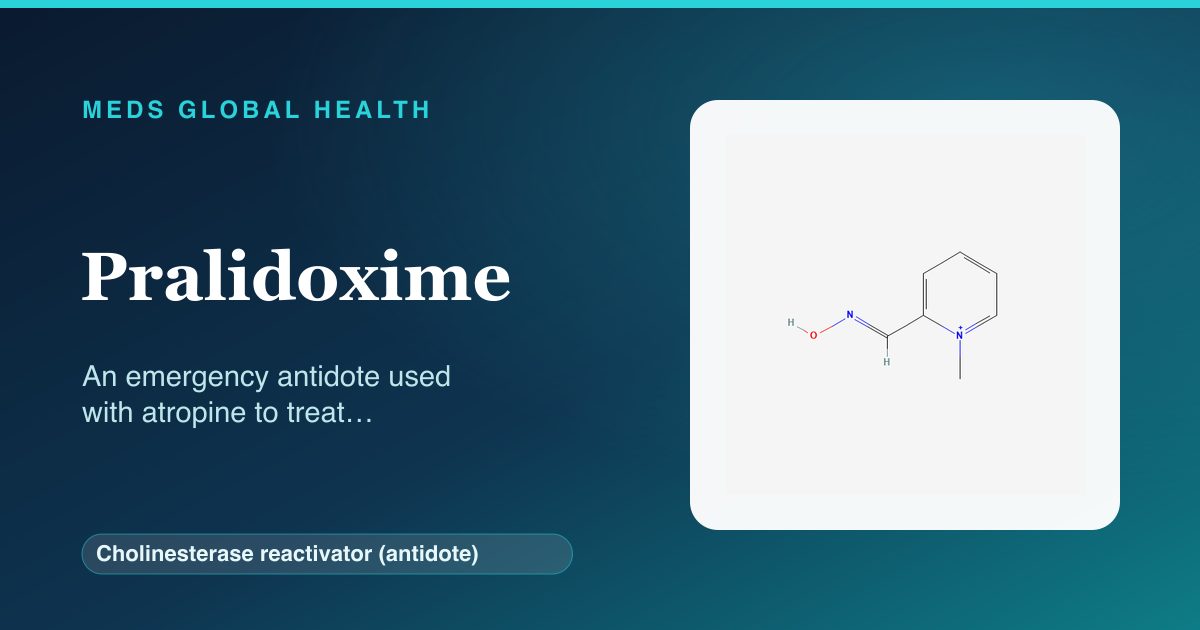
What it is
Pralidoxime is a medicine used as an antidote in poisoning by organophosphate compounds, which include certain pesticides and chemical nerve agents. These poisons block an enzyme the body needs to switch off nerve signals, leading to a flood of effects such as excessive secretions, muscle twitching and weakness, and breathing trouble. Pralidoxime is a cholinesterase reactivator, meaning it tries to free up the blocked enzyme, and it is always given alongside atropine, which controls the most dangerous immediate symptoms. It is a hospital emergency treatment given by injection or as a drip into a vein.
How it works
Organophosphate poisons attach to and block an enzyme called cholinesterase, which normally breaks down a nerve-signalling chemical; without it, the chemical builds up and overstimulates the body. Pralidoxime works by detaching the poison from the enzyme, reactivating it so it can do its job again, especially at the muscles where weakness and breathing problems arise. It does not deal with every effect on its own, which is why atropine is always given as well to calm secretions and slow the heart. Crucially, the poison can become permanently bonded to the enzyme over time (a process called ageing), so pralidoxime works far better the earlier it is given.
Company & origin
A specialist emergency antidote used in the UK, alongside atropine, to treat poisoning by organophosphate pesticides or nerve agents.
Practical use
How to take Pralidoxime
General, dose-free guidance — always follow your prescriber's and the leaflet's specific instructions.
- It is given as an emergency hospital treatment by injection or drip, as quickly as possible after poisoning.
- It is always used together with atropine, which treats the immediate dangerous symptoms.
- It is given with close monitoring of breathing, heart rate and blood pressure.
- Tell the team about kidney problems, as the dose may need adjusting.
- It is not a home medicine; suspected organophosphate poisoning needs emergency medical help straight away.
Weighing it up
Advantages & disadvantages of Pralidoxime
Advantages
- Can reactivate the blocked enzyme in organophosphate poisoning, easing muscle weakness and breathing problems.
- Works alongside atropine to treat poisoning more completely.
- A specific antidote for a life-threatening emergency when given early.
Disadvantages
- Works far less well if given late, once the poison has locked onto the enzyme.
- Can cause changes in blood pressure, blurred vision, dizziness and headache.
- A specialist emergency treatment that must be given in hospital with monitoring.
Practical use
Good to know
The most important point with pralidoxime is timing: it works best when given early, because organophosphate poisons gradually lock onto the enzyme permanently, after which the antidote can no longer free it. That is why it is a true emergency treatment, started as soon as poisoning is recognised. It is always used together with atropine, not instead of it, because the two tackle different parts of the poisoning. It is given by a hospital team into a vein, with close monitoring of breathing, heart and blood pressure, as it can cause changes in blood pressure, blurred or double vision, dizziness and headache. Caring for someone with organophosphate poisoning also involves protecting helpers from contamination and supporting breathing, which the emergency team manages.
Who should not take it / use with caution
- People who have had a serious allergic reaction to pralidoxime should not be given it.
- It is used with caution and dose adjustment in people with kidney problems.
- It is given only by emergency or specialist teams, with full monitoring.
Monitoring
- Close monitoring of breathing, heart rate and blood pressure during and after treatment.
- Watching the muscle and nerve symptoms to judge how well it is working.
- Checking kidney function, as this affects dosing.
Side effects
- Changes in blood pressure, dizziness or headache.
- Blurred or double vision and difficulty focusing.
- Nausea, fast heart rate or, if given too quickly, more pronounced reactions.
Key interactions
- It is given alongside atropine, and the two are used together as part of the same treatment.
- Care is needed with other medicines that affect the heart, breathing or blood pressure in a poisoned patient.
- The emergency team takes account of everything else being given during resuscitation.
Available as: A solution given by injection or as a drip into a vein in hospital.
Answers
Pralidoxime: frequently asked questions
What is pralidoxime used for?
It is an emergency antidote for poisoning by organophosphates, the chemicals in some pesticides and in nerve agents, used together with atropine.
Why is it given with atropine?
Atropine treats the immediate dangerous symptoms of the poisoning, while pralidoxime works to reactivate the blocked enzyme; the two are used together because they tackle different parts of the problem.
Why does it need to be given early?
Organophosphate poisons gradually lock permanently onto the enzyme, after which pralidoxime can no longer free it, so it works best when given as soon as possible.
How is it given?
It is given in hospital as an injection or a drip into a vein, with close monitoring of breathing, heart and blood pressure.
Can it be used at home?
No. Suspected organophosphate poisoning is a medical emergency; call for urgent help, and the treatment is given by an emergency hospital team.
Authoritative sources
- BNF
- NICE CKS
Building a medicines information resource?
We create evidence-led, dose-free drug and formulary references for teams.