Also called DHEA; a vaginal pessary for painful sex after the menopause
Prasterone
A vaginal pessary used to treat painful sex caused by thinning of the vaginal tissues after the menopause.
What is Prasterone?
Prasterone, also known as DHEA, is used as a vaginal pessary to treat painful sex caused by thinning and dryness of the vaginal tissues after the menopause. It is a hormone precursor, meaning the body uses it to make small amounts of hormones in the vaginal area itself, which helps restore the tissue locally. It is inserted into the vagina, usually at bedtime. The most common side effect is vaginal discharge. Because it acts mainly where it is placed, its effects are largely local.
Education and reference only. This is a plain-language guide to Prasterone — it deliberately contains no doses. Doses depend on the person, the brand and the reason for treatment, and belong with your prescriber. Always check the BNF, the product labelling (SmPC) and follow medical advice.
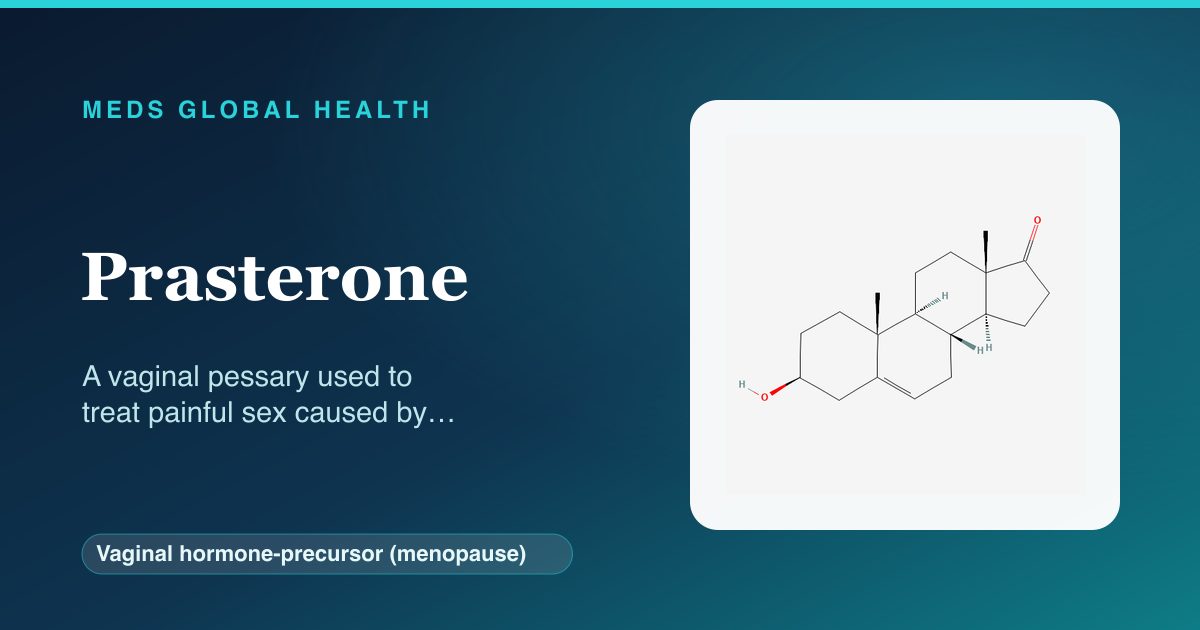
What it is
Prasterone, also called DHEA, is a medicine used as a vaginal pessary to treat moderate to severe painful sex (a symptom of vaginal atrophy) in women who have been through the menopause. After the menopause, falling hormone levels can make the tissues of the vagina thinner, drier and more fragile, which can make sex uncomfortable or painful. Prasterone is a hormone precursor, a substance the body converts into small amounts of hormones within the vaginal tissue itself. It is inserted into the vagina and works mainly in that area to help restore the tissue.
How it works
Prasterone is a building block that the body's own cells can turn into small amounts of oestrogen and other hormones. When placed in the vagina, it is taken up by the local tissue, which uses it to make these hormones right where they are needed. This helps the lining of the vagina become thicker, more supple and better lubricated, easing the dryness and discomfort that make sex painful after the menopause. Because it works mainly in the area where it is inserted, its effect is largely local rather than acting throughout the whole body.
Company & origin
A vaginal pessary used in the UK to treat painful sex caused by thinning of the vaginal tissues after the menopause.
Practical use
How to take Prasterone
General, dose-free guidance — always follow your prescriber's and the leaflet's specific instructions.
- Insert one pessary into the vagina each day, usually at bedtime, so it stays in place overnight.
- Use the applicator provided, or insert it with a clean finger, as advised in the instructions.
- Use it regularly as prescribed, as the benefit fades if treatment is stopped.
- Report any new or unexpected vaginal bleeding to your clinician.
- Tell your clinician about any history of hormone-sensitive cancer before starting.
Weighing it up
Advantages & disadvantages of Prasterone
Advantages
- Eases painful sex caused by thinning of the vaginal tissues after the menopause.
- Works mainly in the local area where it is inserted.
- Offers an option for women who prefer a vaginal treatment for this symptom.
Disadvantages
- Commonly causes vaginal discharge.
- Needs to be used regularly, as the benefit fades if it is stopped.
- Not suitable for everyone, including women with certain hormone-sensitive cancers or unexplained vaginal bleeding.
Practical use
Good to know
The main point to understand about prasterone is that it is a local vaginal treatment for one specific problem: painful sex due to the thinning of the vaginal tissues after the menopause. It is a hormone precursor, so the body makes its own small amounts of hormones in the vaginal tissue from it. It is usually inserted at bedtime so it stays in place. The most common side effect is vaginal discharge, which is generally harmless but can be a nuisance. As with other hormone-related treatments, it is important to tell your clinician about a history of hormone-sensitive cancers or unexplained vaginal bleeding, as these need to be assessed before starting. Any new vaginal bleeding while using it should be reported. It is used regularly to keep the benefit, as the symptoms return if treatment stops.
Who should not take it / use with caution
- Women with unexplained vaginal bleeding should not use it until this has been assessed.
- Women with a history of hormone-sensitive cancer, such as some breast cancers, should not use it unless their specialist advises.
- Women who have had a serious allergic reaction to it should not use it.
- It is for women who have been through the menopause and is not for use in pregnancy.
Monitoring
- Reviewing how well the painful sex and dryness have improved.
- Following up any new vaginal bleeding or abnormal smear result.
- Reviewing the need to continue and overall menopause care over time.
Side effects
- Vaginal discharge, which is the most common effect.
- An abnormal result on a cervical smear, which the team will explain and follow up.
- Occasionally, vaginal irritation or discomfort.
- Any new vaginal bleeding should be reported, as it needs to be checked.
Key interactions
- There are few well-established routine medicine interactions, but tell your clinician about all your medicines.
- Tell your clinician if you use other vaginal products or hormone treatments.
- It is generally not used together with other vaginal oestrogen products unless advised.
Available as: A pessary inserted into the vagina.
Answers
Prasterone: frequently asked questions
What is prasterone used for?
It is used as a vaginal pessary to treat painful sex caused by thinning and dryness of the vaginal tissues after the menopause.
Is prasterone the same as DHEA?
Yes. Prasterone is also known as DHEA; it is a hormone precursor that the body uses to make small amounts of hormones in the vaginal tissue.
How is it used?
It is inserted into the vagina, usually one pessary at bedtime, using the applicator provided or a clean finger.
What is the most common side effect?
The most common side effect is vaginal discharge, which is generally harmless but can be a nuisance.
Do I need to keep using it?
Yes. It is used regularly to keep the benefit, as the dryness and discomfort tend to return if treatment is stopped.
Authoritative sources
- BNF
- NICE CKS
Building a medicines information resource?
We create evidence-led, dose-free drug and formulary references for teams.