An older antiepileptic also used for essential tremor
Primidone
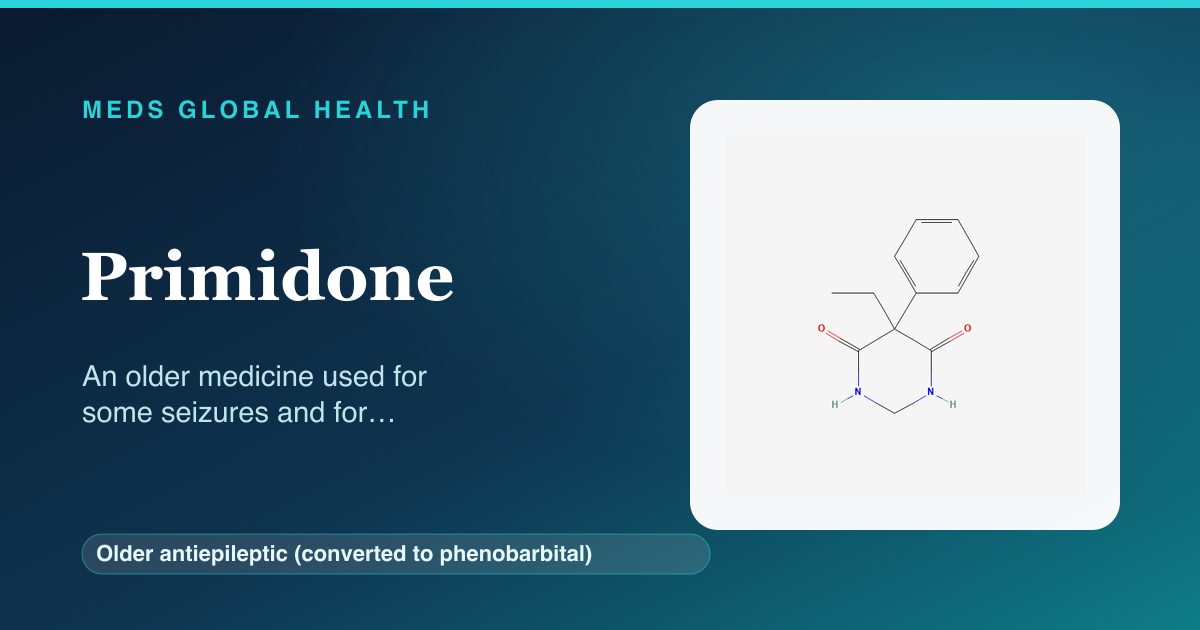
An older medicine used for some seizures and for essential tremor, which the body turns into phenobarbital.
What is Primidone?
Primidone is an older medicine used to treat some types of epilepsy and also to help essential tremor (a shaking, often of the hands). In the body it is converted into phenobarbital, an older antiepileptic, so it shares its effects. The main drawbacks are that it causes drowsiness and unsteadiness, especially at first, and that it can lead to dependence; for this reason it must never be stopped suddenly, as this can trigger withdrawal or seizures, and any change is made gradually. It is also an enzyme inducer, meaning it can make several other medicines, including some contraceptives, less effective. It is taken by mouth, usually started slowly.
Education and reference only. This is a plain-language guide to Primidone — it deliberately contains no doses. Doses depend on the person, the brand and the reason for treatment, and belong with your prescriber. Always check the BNF, the product labelling (SmPC) and follow medical advice.
What it is
Primidone is a long-established medicine used in two main ways: to treat certain types of epilepsy, and to help essential tremor, a common cause of shaking that often affects the hands. Once taken, the body converts it into phenobarbital, an older antiepileptic medicine, so much of its effect comes through that. It is taken by mouth as tablets and is usually started at a low level and built up slowly to reduce side effects. Because it is an older medicine with sedation and dependence concerns, it tends to be used when newer options are not suitable, under medical supervision.
How it works
Primidone calms overactive electrical activity in the brain, which is what causes seizures, and this same calming effect can reduce the shaking of essential tremor. Part of its action comes from the medicine itself and part from phenobarbital, which the body produces from it. Because it dampens down brain activity, it commonly causes drowsiness and unsteadiness, particularly when first started, which is why it is introduced slowly so the body can adjust. Over time the body adapts, but this also means it can lead to dependence, so it must not be stopped abruptly.
Company & origin
An older medicine used in the UK for some types of epilepsy and for essential tremor, taken by mouth.
What it treats
Conditions Primidone is used for
Practical use
How to take Primidone
General, dose-free guidance — always follow your prescriber's and the leaflet's specific instructions.
- Take it by mouth exactly as prescribed, usually starting at a low level and building up slowly to reduce side effects.
- Never stop it suddenly; any change must be gradual and guided by your doctor, as stopping abruptly can cause withdrawal or seizures.
- Do not drive or use machinery until you know how it affects you, as it commonly causes drowsiness and unsteadiness.
- Tell your prescriber about all your other medicines, as it can make several of them less effective.
- Discuss contraception and any plans for pregnancy, as it can reduce the effect of some contraceptives.
Weighing it up
Advantages & disadvantages of Primidone
Advantages
- An effective option for some types of epilepsy and for essential tremor.
- A long-established medicine with decades of experience behind its use.
- Taken by mouth as tablets.
Disadvantages
- Commonly causes drowsiness, dizziness and unsteadiness, especially when first started.
- Can lead to dependence and must never be stopped suddenly.
- An enzyme inducer that can make several other medicines, including some contraceptives, less effective.
Practical use
Good to know
Two points matter most with primidone. First, it must never be stopped suddenly: after taking it regularly, stopping abruptly can cause withdrawal and, in people with epilepsy, can trigger seizures, so any change is made gradually under medical guidance. Second, it commonly causes drowsiness, dizziness and unsteadiness, especially when first started, which is why it is built up slowly; you should not drive or operate machinery until you know how it affects you. It can lead to dependence with long-term use. It is also an enzyme inducer, meaning it speeds up the breakdown of several other medicines and can make them less effective, including some hormonal contraceptives, so a reliable contraception plan and a review of other medicines are important. As with other antiepileptics, tell your doctor if you are planning a pregnancy, as the medicine and the seizure plan need careful consideration.
Who should not take it / use with caution
- People who have had a serious allergic reaction to primidone or phenobarbital should not take it.
- It is used with caution in people with significant breathing, liver or kidney problems, under medical guidance.
- It is used with particular care in older or frail people, who are more sensitive to its sedating effects.
Monitoring
- Reviewing how well seizures or tremor are controlled and how side effects are tolerated.
- Watching for excessive drowsiness, mood changes and signs of dependence.
- Reviewing other medicines for reduced effectiveness, and checking blood or bone health with long-term use.
Side effects
- Drowsiness, dizziness and unsteadiness, especially when first started.
- Nausea, headache or, in some people, low mood.
- Skin rash, which should be reported as some rashes can be serious.
- With long-term use, dependence, and rarely effects on blood cells or bone health.
Key interactions
- As an enzyme inducer, it can make medicines such as some contraceptives, blood thinners and other antiepileptics less effective.
- Combining it with other sedating medicines or alcohol increases drowsiness and the risk to breathing.
- Tell your prescriber about all your medicines, as many interactions are possible.
Available as: Tablets taken by mouth.
Answers
Primidone: frequently asked questions
What is primidone used for?
It is an older medicine used to treat some types of epilepsy and to help essential tremor, a shaking that often affects the hands; in the body it is converted into phenobarbital.
Can I stop taking it if I feel fine?
No. It must never be stopped suddenly, as this can cause withdrawal and, in epilepsy, trigger seizures; any change is made gradually under medical guidance.
Why does it make me so drowsy at first?
It calms brain activity, which commonly causes drowsiness and unsteadiness early on, so it is built up slowly; do not drive until you know how it affects you.
Does it affect my other medicines?
Yes. It is an enzyme inducer, so it can make several other medicines, including some contraceptives, less effective, which is why your prescriber reviews everything you take.
Can it cause dependence?
With long-term use it can lead to dependence, which is one reason it must be reduced gradually rather than stopped suddenly.
Authoritative sources
- BNF
- NICE CKS
Building a medicines information resource?
We create evidence-led, dose-free drug and formulary references for teams.