A medicine that helps the body remove uric acid to prevent gout
Probenecid
A medicine that lowers uric acid by helping the body pass more of it out in the urine, used to prevent gout.
What is Probenecid?
Probenecid is a medicine used to prevent gout by helping the kidneys pass more uric acid out in the urine, which lowers the level in the blood. It was also used in the past to keep penicillin antibiotics in the body for longer. The most important points are that it can trigger gout flares when first started, and that drinking plenty of fluids is needed to reduce the risk of kidney stones. It should not be started during an acute gout attack and is avoided in people who get kidney stones.
Education and reference only. This is a plain-language guide to Probenecid — it deliberately contains no doses. Doses depend on the person, the brand and the reason for treatment, and belong with your prescriber. Always check the BNF, the product labelling (SmPC) and follow medical advice.
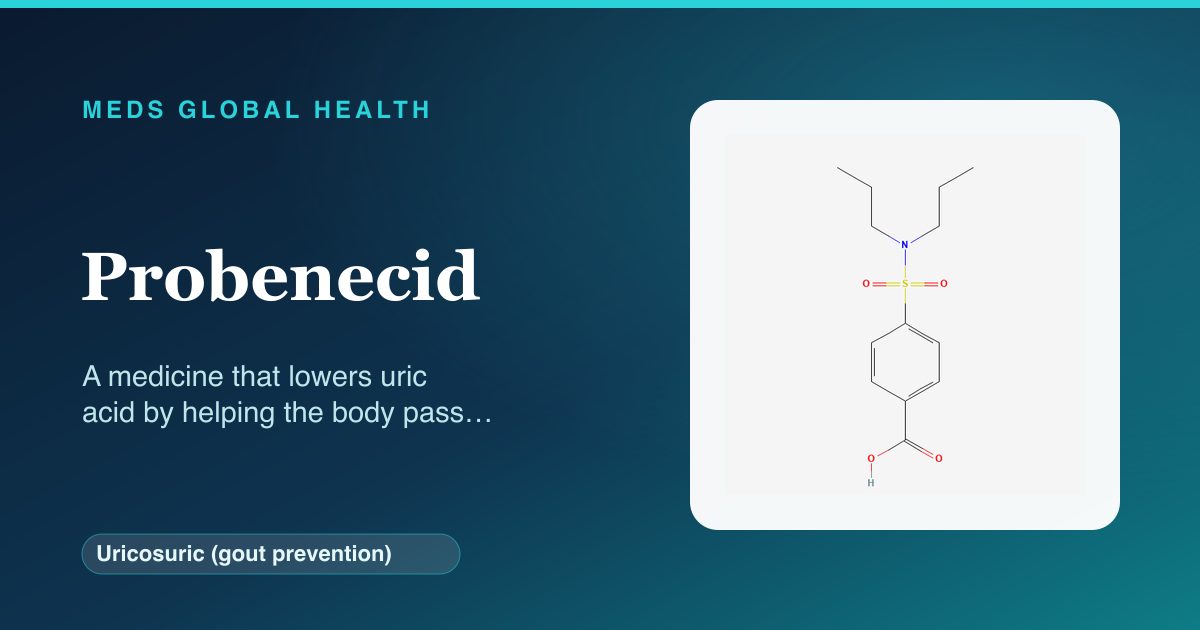
What it is
Probenecid is a long-established medicine used mainly to prevent attacks of gout, a painful condition caused by a build-up of uric acid that forms crystals in the joints. It works by helping the kidneys remove more uric acid, lowering the level in the blood over time. It is taken by mouth. Historically it has also been used alongside certain antibiotics, particularly penicillin, to keep their levels higher in the body for longer. It is used under medical supervision, with attention to fluid intake and to the timing around gout attacks.
How it works
Probenecid acts on the kidneys, where it reduces the amount of uric acid that is reabsorbed back into the body. This means more uric acid is passed out in the urine, and the level in the blood falls. Over time, lowering uric acid helps stop new crystals forming in the joints and allows existing ones to dissolve, which prevents gout attacks. The same action on the kidneys explains its older use with penicillin: it slows the removal of the antibiotic, keeping its levels higher for longer. Because it pushes more uric acid into the urine, drinking plenty of fluids helps prevent stones forming.
Company & origin
A long-established medicine used in the UK to help prevent gout by increasing the amount of uric acid passed out in the urine; it has also been used to boost levels of penicillin.
What it treats
Conditions Probenecid is used for
Practical use
How to take Probenecid
General, dose-free guidance — always follow your prescriber's and the leaflet's specific instructions.
- Take it by mouth as prescribed, usually with food to reduce stomach upset.
- Drink plenty of fluids through the day to lower the risk of kidney stones.
- Do not start it during an acute gout attack; it is for preventing attacks, not treating one that is happening.
- Keep taking it even if you get a flare early on, unless told otherwise, as flares can settle as treatment continues.
- Give your prescriber a full list of your medicines, as it can affect how others are handled by the body.
Weighing it up
Advantages & disadvantages of Probenecid
Advantages
- Lowers uric acid and helps prevent gout attacks over time.
- Taken by mouth and long established in use.
- Can also keep certain antibiotics, such as penicillin, in the body for longer when needed.
Disadvantages
- Can trigger gout flares in the early weeks of treatment.
- Can encourage kidney stones, so plenty of fluids are needed.
- Not suitable during an acute attack, in people who get kidney stones, or when kidney function is poor.
Practical use
Good to know
There are a few important things to know about probenecid. First, like other medicines that lower uric acid, it can actually trigger gout flares in the early weeks as the uric acid levels shift, so it is not started during an acute attack and is often used with another medicine to cover this period. Second, because it pushes more uric acid into the urine, it can encourage kidney stones, so it is important to drink plenty of fluids and it is avoided in people who already get uric-acid kidney stones. It is also not suitable when kidney function is poor, as it may not work well. It interacts with a number of other medicines by changing how the kidneys handle them, so a full medicines list is important.
Who should not take it / use with caution
- It should not be started during an acute gout attack, as it can make the attack worse.
- People who get uric-acid kidney stones should not use it, as it can encourage stones.
- People with poor kidney function or certain blood disorders should not use it, or should use it with caution.
- People who have had a serious allergic reaction to it should not take it.
Monitoring
- Blood tests to check uric acid levels and kidney function.
- Watching for gout flares early in treatment and adjusting the plan as needed.
- Checking fluid intake and any signs of kidney stones.
Side effects
- Gout flares, especially when treatment is first started.
- Nausea, loss of appetite or stomach upset.
- Kidney stones if fluid intake is low.
- Rarely but seriously, allergic reactions or blood problems, which need medical attention.
Key interactions
- It can raise the levels of some other medicines, including certain antibiotics such as penicillin, by slowing their removal.
- It affects how the kidneys handle several medicines, so tell your prescriber everything you take.
- It should not be used with aspirin or some other medicines that can work against its effect on uric acid.
Available as: Tablets taken by mouth.
Answers
Probenecid: frequently asked questions
What is probenecid used for?
It is used to prevent gout by helping the kidneys pass more uric acid out in the urine, which lowers the level in the blood. It has also been used to keep antibiotics such as penicillin in the body for longer.
Why might my gout get worse at first?
Like other uric-acid-lowering medicines, it can trigger flares in the early weeks as levels shift; it is not started during an attack and is often paired with another medicine to cover this period.
Why do I need to drink plenty of fluids?
It pushes more uric acid into the urine, which can encourage kidney stones, so drinking plenty of fluids helps reduce that risk.
Can I take it during a gout attack?
No. It is for preventing attacks, not treating one that is happening, and starting it during an attack can make it worse.
Why does my prescriber need my full medicines list?
It changes how the kidneys handle several other medicines, raising or affecting their levels, so a complete list helps keep treatment safe.
Authoritative sources
- BNF
- NICE CKS
Building a medicines information resource?
We create evidence-led, dose-free drug and formulary references for teams.