An older medicine for serious abnormal heart rhythms
Procainamide
An older medicine used to control serious abnormal heart rhythms, given with close heart monitoring.
What is Procainamide?
Procainamide is an older antiarrhythmic medicine used to control serious abnormal heart rhythms. It works by steadying the heart's electrical signals. Its main risks are that it can itself affect the heart's rhythm, in particular by prolonging the 'QT interval' and occasionally triggering new rhythm problems, so it is given with heart (ECG) monitoring. With longer use it can cause a lupus-like syndrome, and it can lower the blood counts, both of which need watching. Because of these effects it is used carefully, often started in hospital under specialist supervision.
Education and reference only. This is a plain-language guide to Procainamide — it deliberately contains no doses. Doses depend on the person, the brand and the reason for treatment, and belong with your prescriber. Always check the BNF, the product labelling (SmPC) and follow medical advice.
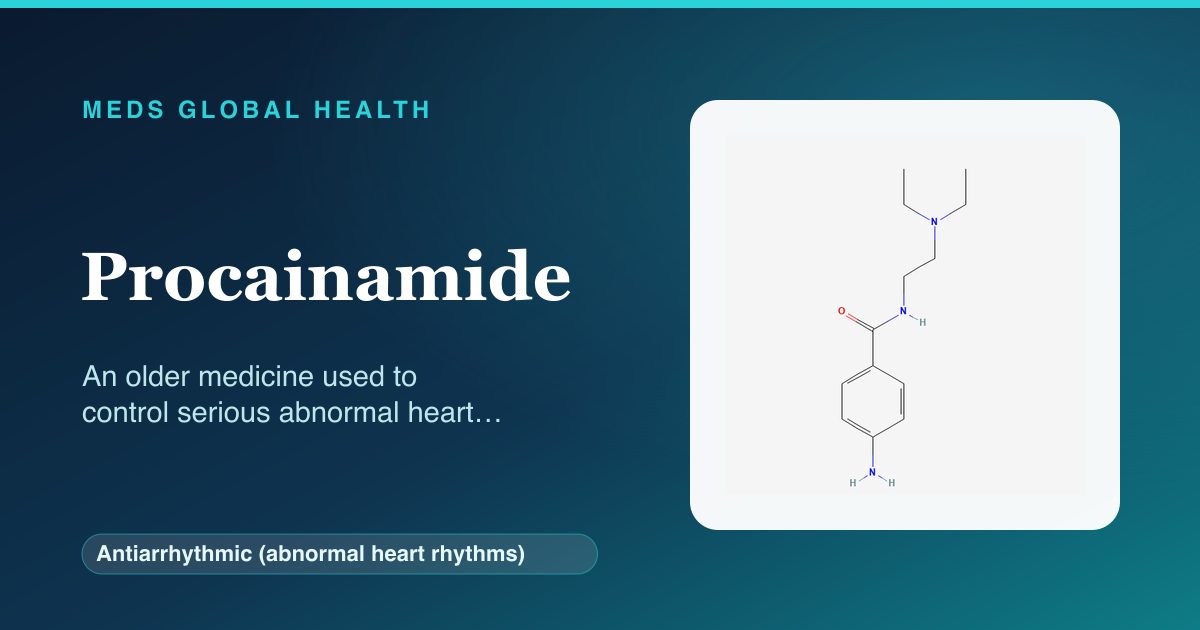
What it is
Procainamide is a long-established antiarrhythmic medicine, meaning it is used to treat abnormal heart rhythms — particular fast or irregular rhythms that can be serious. It steadies the electrical activity that controls the heartbeat. Because it can also cause rhythm problems of its own, and other effects with longer use, it is used carefully and usually under specialist supervision, often started in hospital with the heart trace (ECG) being watched. It can be given by injection in an urgent situation or taken by mouth for longer-term control.
How it works
The heartbeat is driven by electrical signals passing through the heart muscle. In some people these signals become disordered, causing the heart to beat too fast or irregularly. Procainamide slows and steadies the way these electrical signals spread, helping the heart return to and keep a more normal rhythm. The same action on the heart's electrical system is double-edged: it can lengthen the time the heart takes to reset between beats — the 'QT interval' — and occasionally provoke a new rhythm disturbance, which is why the heart is monitored while it is used.
Company & origin
An older antiarrhythmic medicine used in the UK to control serious abnormal heart rhythms, usually with close monitoring.
What it treats
Conditions Procainamide is used for
Practical use
How to take Procainamide
General, dose-free guidance — always follow your prescriber's and the leaflet's specific instructions.
- Take it by mouth at the regular intervals prescribed to keep a steady level, or receive it by injection in hospital when needed urgently.
- Attend the heart (ECG) and blood-test checks arranged for you, as these watch for rhythm and blood effects.
- Report any joint pains, fever, rashes or unusual tiredness, which can be signs of a lupus-like reaction.
- Report any signs of infection, such as a sore throat or fever, or any unusual bruising or bleeding.
- Tell your prescriber about all your medicines and any kidney problems, as these affect how it is used.
Weighing it up
Advantages & disadvantages of Procainamide
Advantages
- An effective option for controlling serious abnormal heart rhythms.
- Can be given by injection for quick control or taken by mouth for longer-term use.
- A long-established medicine with decades of experience behind its use.
Disadvantages
- Can itself affect the heart's rhythm, prolonging the QT interval and occasionally triggering new rhythm problems.
- With longer use can cause a lupus-like syndrome and can lower the blood counts.
- Needs heart (ECG) and blood monitoring and is usually started under specialist supervision.
Practical use
Good to know
The dominant safety point is that procainamide, while treating one rhythm problem, can cause another: it can prolong the heart's 'QT interval' and occasionally trigger a dangerous new rhythm, so it is given with heart (ECG) monitoring, especially when starting or with the injectable form. Two further effects matter with longer-term use. It can bring on a lupus-like syndrome, with symptoms such as joint pains, fever and rashes, which usually settle when the medicine is stopped; any such symptoms should be reported. It can also lower the blood counts, increasing the risk of infection or bleeding, so blood tests are done and signs of infection reported. It is used with extra care in people with kidney problems, as the medicine can build up. Because of all this, it is started and supervised by specialists and is not a first-choice rhythm medicine for most people today.
Who should not take it / use with caution
- People who have had a serious allergic reaction to procainamide should not take it.
- It is avoided in people with certain heart-rhythm or heart-conduction problems, unless a pacemaker is in place, on specialist advice.
- It is avoided in people with lupus, and used with caution where the QT interval is already prolonged.
- It is used with caution and at adjusted doses in people with kidney problems, as the medicine can build up.
Monitoring
- Heart (ECG) monitoring, especially when starting and with the injectable form, watching the QT interval.
- Regular blood tests to check the blood counts and for signs of a lupus-like reaction.
- Checking kidney function and blood pressure, and reviewing how well the rhythm is controlled.
Side effects
- Effects on the heart's rhythm, including prolonging the QT interval and occasionally new rhythm problems.
- Low blood pressure, dizziness or stomach upset, especially with the injection.
- With longer use, a lupus-like syndrome with joint pains, fever and rashes, which usually settles after stopping.
- Rarely but seriously, a severe drop in blood cells, which raises the risk of infection or bleeding and needs urgent attention.
Key interactions
- It is used with great caution alongside other medicines that prolong the QT interval, as the effect adds up.
- Other heart-rhythm medicines can add to its effects on the heart and need careful combining.
- Some medicines can raise its level in the body, so tell your prescriber everything you take.
Available as: Tablets taken by mouth and a solution for injection given in hospital.
Answers
Procainamide: frequently asked questions
What is procainamide used for?
It is an older medicine used to control serious abnormal heart rhythms, working by steadying the heart's electrical signals. It is usually used under specialist supervision.
Why does it need heart monitoring?
While treating one rhythm problem, procainamide can cause another, in particular by prolonging the heart's QT interval, so the heart trace (ECG) is monitored, especially when starting.
What is the lupus-like syndrome?
With longer use, procainamide can cause a reaction with joint pains, fever and rashes that resembles lupus. It usually settles when the medicine is stopped, so report any such symptoms.
Why do I need blood tests?
It can lower the blood counts, which raises the risk of infection or bleeding, so blood tests are done and any sore throat, fever or unusual bruising should be reported.
Why is the dose adjusted for kidney problems?
Procainamide is cleared by the kidneys, so in people with kidney problems it can build up. The dose is lowered and monitoring is closer to keep it safe.
Authoritative sources
- BNF
- NICE CKS
Building a medicines information resource?
We create evidence-led, dose-free drug and formulary references for teams.