An antiarrhythmic for abnormal heart rhythms
Propafenone
A rhythm-control medicine used to treat certain abnormal or fast heart rhythms, including atrial fibrillation.
What is Propafenone?
Propafenone is an antiarrhythmic medicine used to control certain abnormal or fast heart rhythms, including atrial fibrillation. It works by calming the electrical signals in the heart so it beats more normally. Its most important safety point is that, like other medicines of its type, it can sometimes make heart rhythms worse rather than better, so it is generally avoided in people with a weakened, scarred or poorly supplied heart and is usually started under specialist guidance. It can also slow the heart and, because of a mild beta-blocking effect, can worsen asthma.
Education and reference only. This is a plain-language guide to Propafenone — it deliberately contains no doses. Doses depend on the person, the brand and the reason for treatment, and belong with your prescriber. Always check the BNF, the product labelling (SmPC) and follow medical advice.
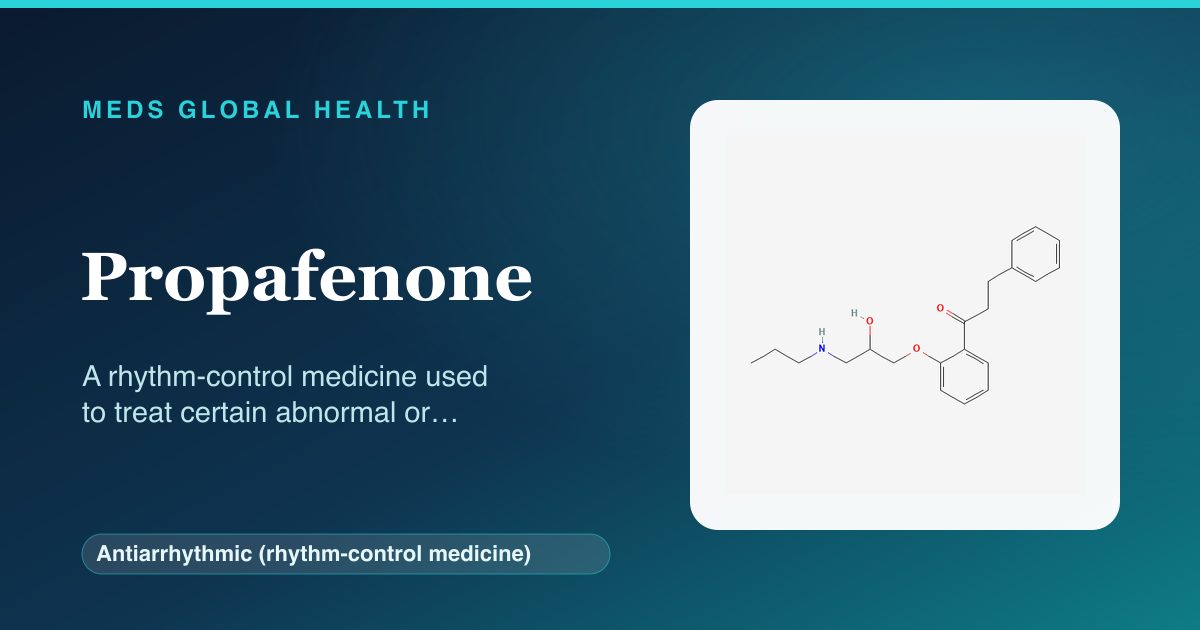
What it is
Propafenone is a rhythm-control (antiarrhythmic) medicine used to treat certain abnormal heart rhythms, such as atrial fibrillation and some fast rhythms coming from the upper or lower chambers of the heart. It is taken by mouth and is usually reserved for people whose heart is otherwise structurally normal, because in a damaged heart it can do more harm than good. Treatment is generally started or guided by a heart specialist, who checks that it is suitable before it is used.
How it works
The heartbeat is driven by electrical signals passing through the heart muscle. In some people these signals become disorganised or too fast, causing an abnormal rhythm. Propafenone slows the movement of sodium into heart cells, which steadies and slows these electrical signals so the heart can beat in a more regular pattern. It also has a mild beta-blocking action, which can slow the heart rate. Because it changes the heart's electrical behaviour, it can occasionally trigger a different, sometimes more dangerous, rhythm, which is why careful selection and monitoring matter.
Company & origin
A medicine used in the UK to control certain fast or abnormal heart rhythms, including atrial fibrillation, usually started under specialist advice.
What it treats
Conditions Propafenone is used for
Practical use
How to take Propafenone
General, dose-free guidance — always follow your prescriber's and the leaflet's specific instructions.
- Take it by mouth as prescribed, at evenly spaced times, with or after food if it upsets your stomach.
- Do not stop it suddenly or change the dose without medical advice, as this can affect your heart rhythm.
- Tell your prescriber if you feel faint, very dizzy, unusually breathless or notice your heartbeat becoming irregular.
- Let your team know if you have asthma or breathing problems, as propafenone can make these worse.
- Give your prescriber a full list of your other medicines, as propafenone interacts with several of them.
Weighing it up
Advantages & disadvantages of Propafenone
Advantages
- Can restore and help maintain a more normal heart rhythm in suitable people, including those with atrial fibrillation.
- Taken by mouth, which is convenient for long-term rhythm control.
- A well-established option for people whose heart is otherwise structurally normal.
Disadvantages
- Can sometimes worsen heart rhythms (pro-arrhythmia), so it is avoided in a weakened or scarred heart.
- Can slow the heart too much and, because of a beta-blocking effect, can worsen asthma.
- Interacts with several other medicines and usually needs specialist supervision to start.
Practical use
Good to know
The single most important thing to understand about propafenone is that medicines of this type can sometimes worsen heart rhythms rather than improve them, an effect called pro-arrhythmia. For this reason it is generally avoided in people who have a weakened, scarred or poorly supplied (ischaemic) heart, and it is usually started under specialist supervision with a heart tracing to check it is safe. It can slow the heart too much, causing dizziness or faint feelings, and because it has a mild beta-blocking effect it can tighten the airways and is generally avoided in people with asthma. Some people notice a metallic or bitter taste. It interacts with several other medicines, so your prescriber needs a full list of what you take.
Who should not take it / use with caution
- People with a weakened, scarred or poorly supplied (ischaemic) heart, including recent heart attack or heart failure, in whom it can be dangerous.
- People with very slow heart rates or certain heart-block problems unless they have a pacemaker.
- People with asthma or significant airway disease, because its beta-blocking effect can tighten the airways.
- People who have had a serious allergic reaction to propafenone.
Monitoring
- Heart tracings (ECGs) to check the rhythm and make sure the medicine is not causing harm.
- Watching for dizziness, faint feelings, breathlessness or a very slow heartbeat.
- Reviewing other medicines for interactions over time.
Side effects
- Dizziness, light-headedness or a feeling of the heart beating slowly.
- A metallic or bitter taste, nausea or stomach upset.
- Worsening of asthma or breathlessness in people prone to it.
- Rarely but seriously, a new or worse abnormal heart rhythm, which needs urgent medical attention.
Key interactions
- Other heart medicines, such as beta-blockers, digoxin and warfarin, can be affected, so doses may need adjusting.
- Medicines that affect the heart's rhythm should be reviewed before combining with propafenone.
- Some antidepressants and other medicines change propafenone levels, so tell your prescriber everything you take.
Available as: Tablets taken by mouth.
Answers
Propafenone: frequently asked questions
What is propafenone used for?
It is used to control certain abnormal or fast heart rhythms, including atrial fibrillation, by steadying the heart's electrical signals so it beats more regularly.
Why is it not suitable for everyone with a heart problem?
In a weakened, scarred or poorly supplied heart, medicines like propafenone can make rhythms worse rather than better, so it is mainly used when the heart is otherwise structurally normal.
Can it make my asthma worse?
Yes. Propafenone has a mild beta-blocking effect that can tighten the airways, so it is generally avoided in people with asthma; tell your prescriber about any breathing problems.
Can I stop taking it if I feel well?
No. Stopping suddenly or changing the dose without advice can disturb your heart rhythm, so only change it on medical advice.
Why do I need heart tracings?
Heart tracings (ECGs) check that propafenone is controlling your rhythm and not causing a new abnormal rhythm, which is an important safety check.
Authoritative sources
- BNF
- NICE CKS
Building a medicines information resource?
We create evidence-led, dose-free drug and formulary references for teams.