An intravenous general anaesthetic
Propofol
The common milky-white injection anaesthetists use to send people to sleep for surgery and for sedation in intensive care; fast-acting and quick to wear off.
What is Propofol?
Propofol is the common milky-white injection that anaesthetists use to send people to sleep quickly for surgery, and for sedation in intensive care and for some procedures. It works fast and wears off quickly, so people usually wake up soon after it is stopped. It is given only by professionals trained to manage the airway and breathing, because it can lower blood pressure and slow or stop breathing. It often stings as it goes into the vein, and is used with care in people with egg or soy allergy. A rare but serious risk, mainly with prolonged high-dose use in intensive care, is propofol infusion syndrome.
Education and reference only. This is a plain-language guide to Propofol — it deliberately contains no doses. Doses depend on the person, the brand and the reason for treatment, and belong with your prescriber. Always check the BNF, the product labelling (SmPC) and follow medical advice.
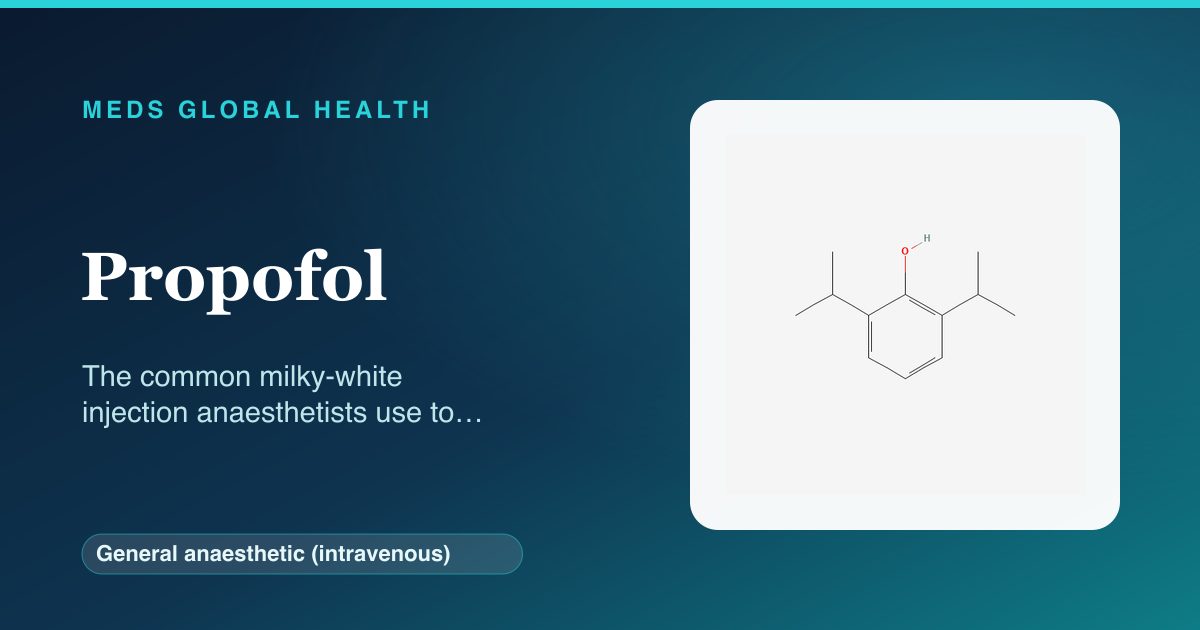
What it is
Propofol is an intravenous general anaesthetic, a medicine given into a vein to make someone unconscious for an operation, or deeply relaxed and sleepy (sedated) for a procedure or while on a breathing machine in intensive care. It is instantly recognisable as a milky-white liquid. It is one of the most widely used anaesthetics in the UK because it works very quickly and wears off quickly, giving a smooth start to anaesthesia and a fairly clear-headed recovery. It is given only by anaesthetists and other specially trained professionals.
How it works
Propofol calms the activity of the brain, quickly producing unconsciousness or deep sedation depending on how much is given. It acts fast because it reaches the brain rapidly through the bloodstream, and it wears off fast because the body quickly redistributes and breaks it down, which is why people usually wake soon after it is stopped. The same calming effect on the brain and body is why it can lower blood pressure and reduce or stop breathing, so the people giving it are trained and equipped to support the airway and circulation.
Company & origin
A widely used intravenous general anaesthetic in the UK, given by anaesthetists to send people to sleep for surgery and for sedation in intensive care.
Practical use
How to take Propofol
General, dose-free guidance — always follow your prescriber's and the leaflet's specific instructions.
- Propofol is given into a vein by an anaesthetist or trained specialist; you fall asleep within moments of it being injected.
- Your breathing, oxygen, heart rate and blood pressure are closely monitored throughout, with equipment ready to support your airway.
- For sedation during a procedure, smaller amounts are given so you are deeply relaxed but breathing is supported as needed.
- In intensive care it may be given continuously to keep someone comfortable on a breathing machine, with close monitoring.
- Tell the team beforehand about any egg or soy allergy, other medicines and previous anaesthetics.
- Afterwards, arrange for someone to take you home, and do not drive, operate machinery or make important decisions for the rest of the day.
Weighing it up
Advantages & disadvantages of Propofol
Advantages
- Works very quickly to send people to sleep, giving a smooth start to anaesthesia.
- Wears off quickly, so recovery is usually fast and fairly clear-headed.
- Useful both for full anaesthesia and for sedation during procedures and in intensive care, and tends to cause little nausea.
Disadvantages
- Can lower blood pressure and slow or stop breathing, so it must be given by trained professionals with monitoring.
- Often stings or causes a cold ache as it goes into the vein.
- Carries a rare but serious risk of propofol infusion syndrome with prolonged high-dose use in intensive care.
Practical use
Good to know
Propofol is given only by professionals trained to manage the airway and breathing, because it can drop blood pressure and slow or stop breathing — this is the key reason it is never a do-it-yourself medicine and is always given with full monitoring and resuscitation equipment to hand. It commonly stings or causes a cold ache as it goes into the vein, which the team can ease. Because the formulation contains components related to egg and soy, it is used with care, and the team should be told about egg or soy allergy. A rare but serious risk called propofol infusion syndrome can occur mainly with prolonged, high-dose use in intensive care, with heart, muscle and metabolic problems, so long sedation is carefully monitored. Recovery is usually quick and fairly clear-headed, though you should not drive or make important decisions for the rest of the day.
Who should not take it / use with caution
- People who have had a serious allergic reaction to propofol or its components should not receive it.
- It is used with extra caution, or the formulation chosen carefully, in people with egg or soy allergy.
- It is given only where the airway, breathing and circulation can be fully supported, so it is never self-administered or given outside such settings.
Monitoring
- Continuous monitoring of breathing, oxygen, heart rate and blood pressure during and after it is given.
- Readiness to support the airway and circulation throughout.
- Watching for signs of propofol infusion syndrome during prolonged high-dose sedation in intensive care.
Side effects
- Stinging or a cold ache in the vein as it is given, and a drop in blood pressure.
- Slowed or stopped breathing, which the team manages, and sometimes a slow heart rate.
- Rarely, propofol infusion syndrome with prolonged high-dose use, or allergic reactions.
Key interactions
- Other sedatives, strong painkillers and anaesthetics add to its effects on consciousness, breathing and blood pressure.
- Medicines that lower blood pressure can add to the fall in blood pressure it causes.
- Alcohol and recreational sedatives can increase its effects, so tell the team what you use.
Available as: A milky-white injection or infusion given into a vein by an anaesthetist or trained specialist.
Answers
Propofol: frequently asked questions
What is propofol used for?
It is an intravenous general anaesthetic used to send people to sleep for surgery and for sedation during procedures and in intensive care; it is the familiar milky-white injection.
Why does it sometimes sting going in?
Propofol commonly causes a sting or cold ache as it enters the vein; the team can take steps to ease this.
Is it safe if I am allergic to eggs or soy?
The formulation contains components related to egg and soy, so tell the team about any such allergy; they will take extra care or choose carefully.
How quickly will I wake up?
Propofol wears off quickly, so people usually wake soon after it is stopped, often feeling fairly clear-headed, though you should rest and not drive that day.
What is propofol infusion syndrome?
It is a rare but serious problem, mainly with prolonged high-dose use in intensive care, affecting the heart, muscles and metabolism, which is why long sedation is closely monitored.
Authoritative sources
- BNF
- NICE CKS
Building a medicines information resource?
We create evidence-led, dose-free drug and formulary references for teams.