A hormone used in tests of thyroid and pituitary function
Protirelin
A hormone (TRH) used in specialised diagnostic tests of thyroid and pituitary function, not as a treatment.
What is Protirelin?
Protirelin, also known as TRH, is a hormone used in specialised tests rather than as a treatment. It is given to check how the pituitary gland and thyroid respond, helping doctors investigate certain thyroid and pituitary problems. It is given as an injection into a vein, and blood is taken before and afterwards to see how the body responds. Common, short-lived effects right after the injection include flushing, a sudden urge to pass urine, a strange taste and brief changes in blood pressure. It is a diagnostic medicine used by specialists, not something you take regularly.
Education and reference only. This is a plain-language guide to Protirelin — it deliberately contains no doses. Doses depend on the person, the brand and the reason for treatment, and belong with your prescriber. Always check the BNF, the product labelling (SmPC) and follow medical advice.
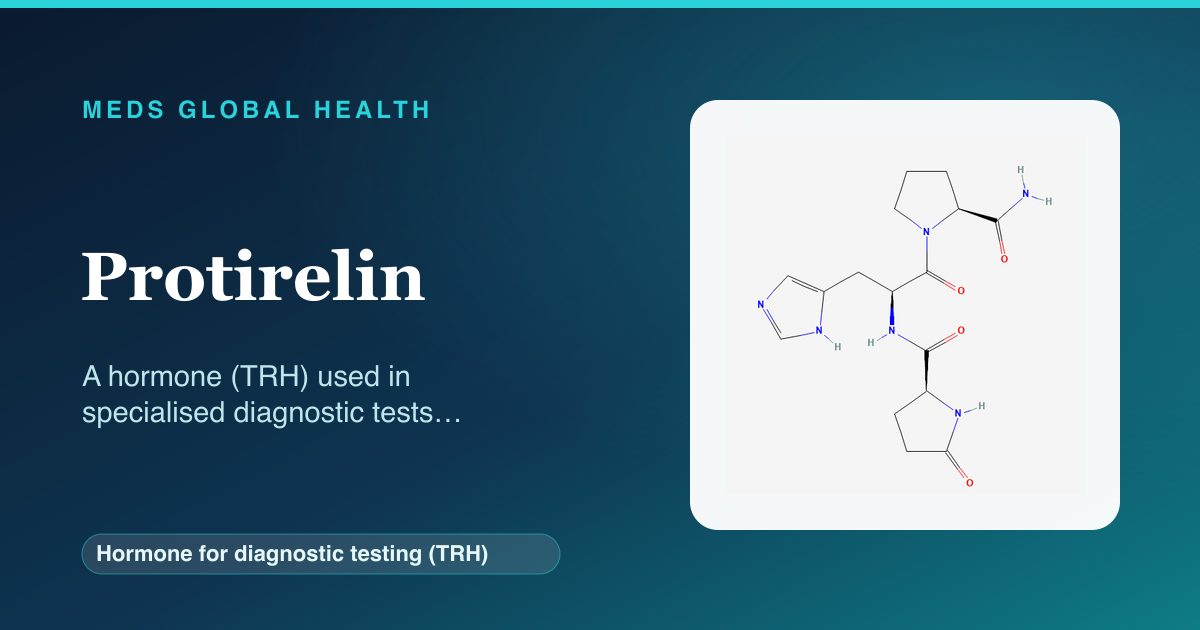
What it is
Protirelin is a man-made version of a natural hormone called thyrotropin-releasing hormone, or TRH. Rather than being a treatment, it is used as a tool in specialised tests of how the thyroid and pituitary glands are working. The pituitary is a small gland in the brain that controls the thyroid; protirelin prompts the pituitary to release its thyroid-stimulating hormone, and doctors measure the response in the blood to learn how these glands are functioning. It is given as an injection into a vein during the test, by a specialist team, and is not used as an ongoing medicine.
How it works
Normally the brain releases TRH, which tells the pituitary gland to release thyroid-stimulating hormone, which in turn tells the thyroid to make its hormones. In the test, protirelin acts as that signal: when it is injected, a healthy pituitary responds by releasing thyroid-stimulating hormone, and blood tests taken before and after show how big and how quick that response is. The pattern of the response helps doctors work out whether a problem lies in the pituitary or the thyroid. Because it is used just to trigger and measure this response, it is given as a single test dose rather than as a regular treatment.
Company & origin
A specialist hormone used in the UK in specialised tests of how the thyroid and pituitary glands are working.
Practical use
How to take Protirelin
General, dose-free guidance — always follow your prescriber's and the leaflet's specific instructions.
- It is given as an injection into a vein by a specialist team as part of a planned test, not taken at home.
- Expect to have blood taken before and at set times after the injection so the response can be measured.
- Be prepared for brief effects just after the injection, such as flushing, an urge to pass urine or a strange taste.
- Tell the team about heart, breathing or blood-pressure problems before the test.
- Mention all your medicines, as some can affect the test result and may need to be considered.
Weighing it up
Advantages & disadvantages of Protirelin
Advantages
- Provides useful information about how the thyroid and pituitary glands are working.
- Helps doctors tell whether a problem lies in the pituitary or the thyroid.
- Given as a single test dose rather than as an ongoing treatment.
Disadvantages
- Commonly causes brief effects such as flushing, an urge to pass urine and a strange taste.
- Can cause short-lived changes in blood pressure, so it is given under supervision.
- It is a diagnostic test, not a treatment, so it does not improve any condition itself.
Practical use
Good to know
The key thing to understand is that protirelin is a diagnostic medicine, not a treatment: it is given to see how your thyroid and pituitary glands respond, so the result is information for your doctors rather than therapy. The test usually involves an injection into a vein with blood taken before and at set times afterwards. Right after the injection it is common to have short-lived effects such as flushing, a sudden urge to pass urine, a strange or metallic taste, slight nausea and brief changes in blood pressure; these pass quickly. Tell the team about heart, breathing or blood-pressure problems and any medicines you take, as some can affect the result. It is a one-off test given under specialist supervision, so you are watched while it is done.
Who should not take it / use with caution
- People who have had a serious allergic reaction to protirelin should not be given it.
- It is used with care in people with certain heart, breathing or blood-pressure problems.
- It is used with care, and under specialist judgement, in pregnancy.
- It is given only as a supervised test by a specialist team.
Monitoring
- Taking blood before and at set times after the injection to measure the gland response.
- Watching blood pressure and how you feel during and just after the test.
- Interpreting the results to guide further investigation or treatment decisions.
Side effects
- Flushing, a warm feeling and a sudden urge to pass urine just after the injection.
- A strange or metallic taste, slight nausea or light-headedness, which pass quickly.
- Brief changes in blood pressure, which is why the test is supervised.
- Rarely, more troublesome reactions, which the team is ready to manage.
Key interactions
- Some medicines, including certain thyroid, hormone and other treatments, can affect the test result, so tell the team about them.
- Medicines affecting blood pressure may interact with the brief blood-pressure changes the test can cause.
- Always give the team a full list of your medicines before the test.
Available as: A solution for injection into a vein, used during a test.
Answers
Protirelin: frequently asked questions
What is protirelin used for?
It is a hormone (TRH) used in specialised tests of how the thyroid and pituitary glands are working; it is a diagnostic tool, not a treatment.
Is protirelin a treatment for my thyroid?
No. It is given to test how your glands respond, providing information for your doctors; it does not treat any condition itself.
What will I feel when it is given?
Just after the injection it is common to have brief flushing, a sudden urge to pass urine, a strange taste and slight nausea; these pass quickly.
Why is blood taken several times?
Blood is taken before and at set times after the injection so the team can see how big and how quick your pituitary's response is, which guides the diagnosis.
Is it the same as TRH?
Yes. Protirelin is a man-made version of the natural hormone TRH (thyrotropin-releasing hormone), so the two names refer to the same thing.
Authoritative sources
- BNF
- NICE CKS
Building a medicines information resource?
We create evidence-led, dose-free drug and formulary references for teams.