An older chemotherapy and radiosensitiser, related to dexrazoxane
Razoxane
An older, largely obsolete chemotherapy medicine, related to dexrazoxane, once used to treat some cancers.
What is Razoxane?
Razoxane is an older chemotherapy medicine that was used in the past to treat certain cancers and to make tumours more sensitive to radiotherapy. It is chemically related to dexrazoxane, a medicine still used to protect the heart during some chemotherapy. Razoxane is now considered largely obsolete and is rarely, if ever, used today, mainly because it lowers blood counts (bone-marrow suppression) and was linked to a risk of later blood cancer (leukaemia). It is included here for completeness rather than as a current treatment.
Education and reference only. This is a plain-language guide to Razoxane — it deliberately contains no doses. Doses depend on the person, the brand and the reason for treatment, and belong with your prescriber. Always check the BNF, the product labelling (SmPC) and follow medical advice.
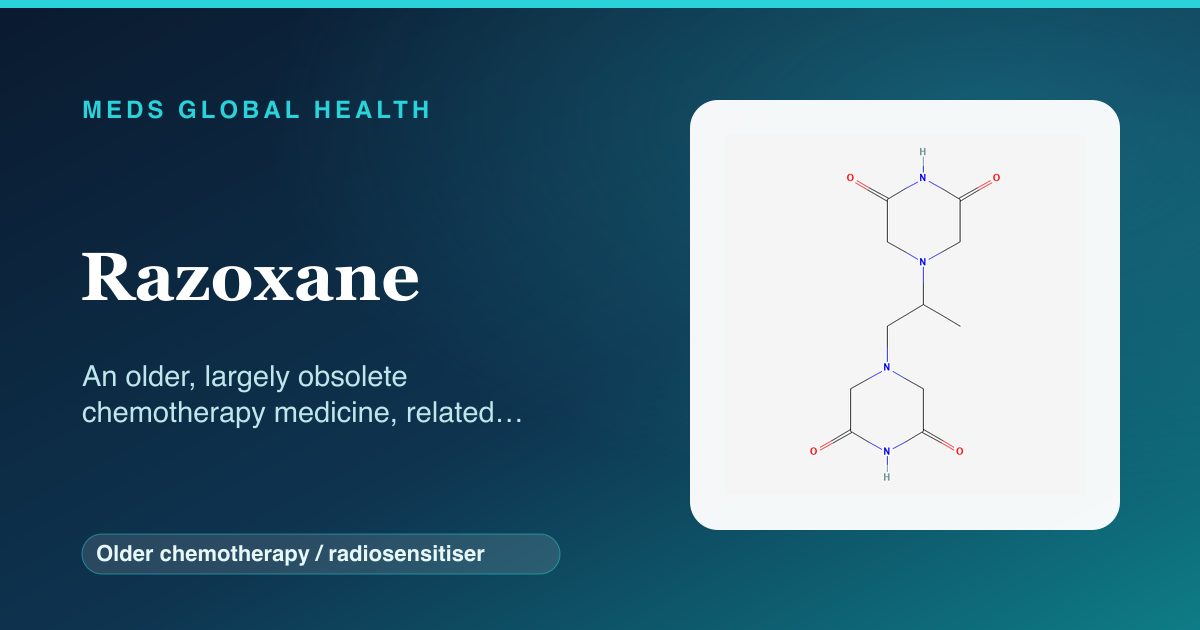
What it is
Razoxane is an older chemotherapy medicine that was used some decades ago to treat certain cancers and as a radiosensitiser, meaning it was used to make tumours respond better to radiotherapy. It is closely related to dexrazoxane, a medicine still used today to protect the heart from the side effects of some chemotherapy. Razoxane itself is now regarded as largely obsolete and is rarely if ever prescribed, having been replaced by newer and safer treatments. It is described here for background and completeness rather than as a treatment in current use.
How it works
Razoxane works as a chemotherapy by interfering with the way cancer cells divide, slowing or stopping their growth, and it was also used to make cancer cells more vulnerable to radiotherapy. Like other chemotherapy of its era, it affects fast-dividing healthy cells too, particularly the bone marrow, which is why it lowers blood counts. Its relative dexrazoxane works by binding metals such as iron, which is how it helps protect the heart in modern chemotherapy. Razoxane has fallen out of use because its benefits were limited and it carried serious long-term risks.
Company & origin
An older chemotherapy medicine used in the past in the UK, related to dexrazoxane, now largely obsolete and rarely if ever used.
Practical use
How to take Razoxane
General, dose-free guidance — always follow your prescriber's and the leaflet's specific instructions.
- Razoxane is an older, largely obsolete medicine and is not a treatment in current routine use.
- If it appears in your historical medical records, ask your specialist team to explain its past role.
- Do not confuse it with dexrazoxane, a related medicine still used today to protect the heart during some chemotherapy.
- Any chemotherapy of this kind would only ever be given by a specialist cancer team with close monitoring.
- Discuss any questions about old treatments and long-term follow-up with your specialist.
Weighing it up
Advantages & disadvantages of Razoxane
Advantages
- Had some activity against certain cancers and was used to make tumours more sensitive to radiotherapy.
- Is chemically related to dexrazoxane, which remains useful today for protecting the heart.
- Contributed historically to the development of related, safer medicines.
Disadvantages
- Is largely obsolete and no longer part of routine cancer treatment.
- Lowers blood counts (bone-marrow suppression), raising the risk of infection, bleeding and anaemia.
- Was linked to a risk of developing a blood cancer (leukaemia) later on, a major reason it was abandoned.
Practical use
Good to know
The most important thing to know about razoxane is that it is an old medicine that is now essentially historical and not part of routine cancer care, having been replaced by safer and more effective treatments. When it was used, its main problem was lowering blood counts (bone-marrow suppression), which raised the risk of infection, bleeding and anaemia, and it was also linked to a risk of developing a blood cancer (leukaemia) later on, which is one of the reasons it was abandoned. It should not be confused with dexrazoxane, a related but distinct medicine still used today to protect the heart during certain chemotherapy. If you have come across this medicine in older records, your specialist team can explain what it was used for and what follow-up, if any, is relevant.
Who should not take it / use with caution
- It is essentially not used today, so it would not be started in current practice.
- It would never be used in pregnancy, as chemotherapy of this kind can harm an unborn baby.
- Any historical or research use would only be under a specialist cancer team with very close monitoring.
Monitoring
- When it was used, regular blood tests checked blood counts.
- Long-term follow-up for blood problems, given the leukaemia risk, would have been important.
- Specialist review of any historical exposure and what follow-up may be relevant.
Side effects
- Low blood counts (bone-marrow suppression), raising the risk of infection, bleeding and anaemia.
- Nausea, tiredness and reduced appetite, as with other chemotherapy of its era.
- A long-term risk of developing a blood cancer (leukaemia), which contributed to it falling out of use.
Key interactions
- As an older chemotherapy, it would have been used carefully alongside other medicines that lower blood counts.
- It would interact with radiotherapy, which was part of how it was used as a radiosensitiser.
- Because it is essentially obsolete, modern interaction information is limited; any historical use needed specialist oversight.
Available as: Historically taken by mouth as tablets or capsules.
Answers
Razoxane: frequently asked questions
Is razoxane still used?
No. Razoxane is an older chemotherapy that is now largely obsolete and rarely if ever used, having been replaced by safer and more effective treatments.
Is it the same as dexrazoxane?
No. They are related but distinct medicines; dexrazoxane is still used today to protect the heart during some chemotherapy, while razoxane has fallen out of use.
Why did it stop being used?
Its benefits were limited, and it lowered blood counts and was linked to a later risk of a blood cancer (leukaemia), which is why it was abandoned in favour of safer options.
What was it used for?
It was used to treat certain cancers and as a radiosensitiser, meaning to make tumours respond better to radiotherapy.
I found it in old records — what should I do?
Ask your specialist team to explain its past role and whether any long-term follow-up is relevant for you.
Authoritative sources
- BNF
- NICE CKS
Building a medicines information resource?
We create evidence-led, dose-free drug and formulary references for teams.