A quick injection used to stress the heart for a scan
Regadenoson
A quick injection that briefly stresses the heart so blood flow can be assessed during a cardiac imaging (perfusion) scan.
What is Regadenoson?
Regadenoson is a specialist injection used during a heart imaging (myocardial perfusion) scan to mimic the effect of exercise in people who cannot exercise enough on a treadmill. It widens the heart's blood vessels so doctors can see how well blood reaches the heart muscle. It is given as a single quick injection by trained staff. It commonly causes a brief feeling of chest tightness, breathlessness, flushing or headache, and less commonly can cause serious slow heart rhythms, a drop in blood pressure or, rarely, a heart attack or seizure. Caffeine should be avoided beforehand, it is used with caution in asthma, and its effects can be reversed with aminophylline.
Education and reference only. This is a plain-language guide to Regadenoson — it deliberately contains no doses. Doses depend on the person, the brand and the reason for treatment, and belong with your prescriber. Always check the BNF, the product labelling (SmPC) and follow medical advice.
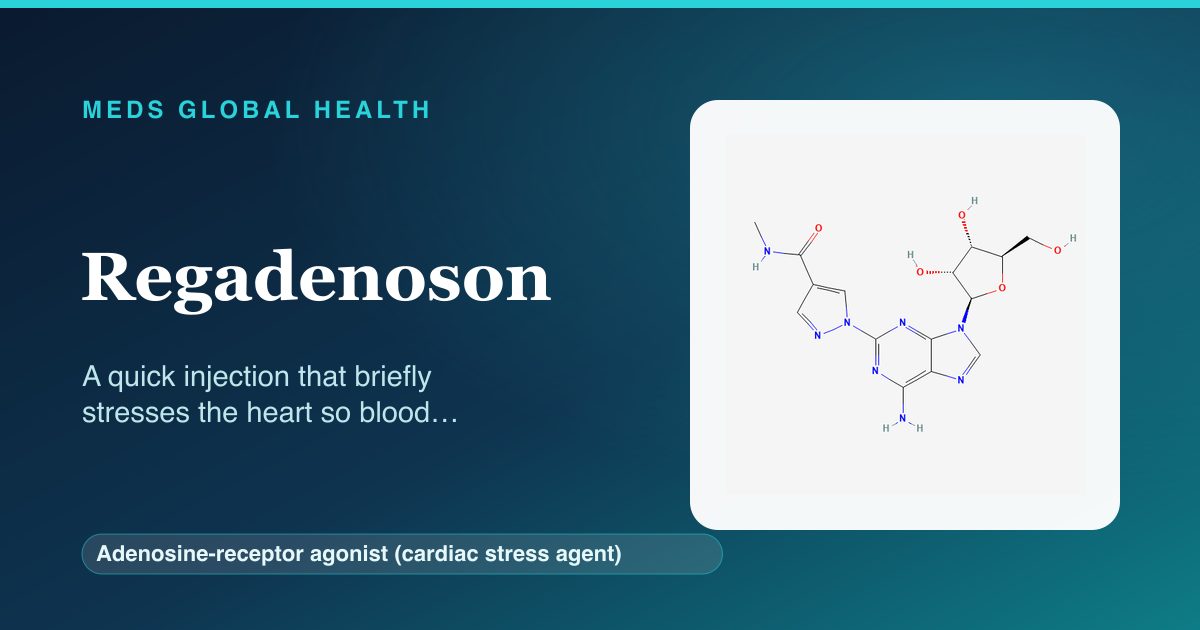
What it is
Regadenoson is an adenosine-receptor agonist used in hospital as part of a heart imaging test called a myocardial perfusion scan. The test looks at how well blood flows to the heart muscle, which usually needs the heart to be put under stress, normally by exercise. For people who cannot exercise enough, regadenoson is given instead as a quick injection to produce a similar effect, allowing the scan to show areas of the heart that may not be getting enough blood. It is a diagnostic agent given by trained staff in a controlled setting, not a treatment taken at home.
How it works
Regadenoson acts on a particular adenosine receptor on the blood vessels supplying the heart, causing healthy vessels to widen and blood flow to increase. In a perfusion scan, this difference between healthy areas and areas supplied by narrowed arteries shows up clearly, helping doctors find parts of the heart muscle that are short of blood. Because it works very quickly and wears off quickly, it is given as a single short injection during the scan. If its effects are unwanted or troublesome, they can be reversed with another medicine, aminophylline.
Company & origin
A specialist injection used in UK hospitals during heart imaging (myocardial perfusion) scans to mimic the effect of exercise on the heart.
Practical use
How to take Regadenoson
General, dose-free guidance — always follow your prescriber's and the leaflet's specific instructions.
- It is given to you as a single quick injection into a vein by trained staff during your heart scan, not something you take yourself.
- Avoid caffeine for the period your hospital tells you beforehand, as caffeine can stop the test working properly.
- Tell the staff before the scan if you have asthma, wheezy lungs, a slow heart rhythm or have recently had heart problems.
- Expect brief sensations such as chest tightness, breathlessness or flushing, and tell staff straight away if they are severe or do not pass.
- Stay as directed for monitoring after the injection until staff are happy you are well enough to leave.
Weighing it up
Advantages & disadvantages of Regadenoson
Advantages
- Allows a heart perfusion scan in people who cannot exercise enough on a treadmill.
- Given as a single, quick injection that works fast and wears off quickly.
- Its effects can be reversed with aminophylline if they become troublesome.
Disadvantages
- Commonly causes brief but unpleasant chest tightness, breathlessness, flushing or headache.
- Can occasionally cause serious slow heart rhythms, a drop in blood pressure or, rarely, a heart attack or seizure.
- Must be given in hospital where emergency treatment is immediately available, and caffeine must be avoided beforehand.
Practical use
Good to know
The most important thing to understand is that regadenoson is a one-off injection for a heart scan, not an ongoing medicine. It commonly causes a brief, expected set of sensations such as chest tightness, breathlessness, flushing, headache or a thumping heartbeat, which usually pass within minutes; staff expect these and watch you closely. A key safety point is that it can occasionally cause serious slow heart rhythms or a marked drop in blood pressure, and very rarely a heart attack or a seizure, which is exactly why it is only given where emergency care is immediately available. You will usually be asked to avoid caffeine for a period beforehand, because caffeine blocks the same receptor and can stop the test working. It is used with particular caution in people with asthma or other wheezy lung conditions, as it can trigger breathing problems, and its effects can be reversed with aminophylline if needed.
Who should not take it / use with caution
- People with certain serious slow heart rhythms or heart block, unless they have a working pacemaker, should not be given it.
- People who have had a serious allergic reaction to regadenoson should not be given it.
- It is used with great caution, or avoided, in people with asthma or other wheezy lung conditions because it can trigger breathing problems.
- It is used with caution in people who have recently had unstable heart problems or very low blood pressure.
Monitoring
- Close monitoring of heart rhythm, blood pressure and symptoms during and after the injection.
- Watching for serious slow heart rhythms, low blood pressure or breathing problems.
- Checking caffeine has been avoided beforehand so the test gives a reliable result.
Side effects
- Brief chest tightness, breathlessness, flushing, headache or a thumping heartbeat, usually passing within minutes.
- Dizziness, nausea or a feeling of warmth around the time of the injection.
- Less commonly, a serious slow heart rhythm or a marked drop in blood pressure.
- Rarely but seriously, a heart attack, a severe breathing problem or a seizure, which is why it is given under close supervision.
Key interactions
- Caffeine and similar substances (in coffee, tea, cola, chocolate and some medicines) block its effect, so they must be avoided beforehand.
- Aminophylline and theophylline interfere with how it works and are also used to reverse its effects.
- Medicines that slow the heart, such as some used for heart rhythm, may add to the risk of a very slow heartbeat, so tell staff what you take.
Available as: A solution for injection into a vein, given in hospital.
Answers
Regadenoson: frequently asked questions
What is regadenoson used for?
It is a quick injection used during a heart imaging (perfusion) scan to mimic the effect of exercise on the heart in people who cannot exercise enough, so doctors can see how well blood reaches the heart muscle.
Why must I avoid caffeine before the scan?
Caffeine blocks the same receptor that regadenoson acts on, so having caffeine beforehand can stop the test working and give an unreliable result.
Why do I feel chest tightness or breathless after it?
These brief sensations are common and expected as the medicine works on the heart's blood vessels; they usually pass within minutes, but tell staff straight away if they are severe or do not settle.
Is it safe if I have asthma?
It is used with particular caution, or avoided, in people with asthma or wheezy lungs because it can trigger breathing problems, so always tell the staff before the scan.
What happens if it makes me feel very unwell?
It is given in hospital with emergency care to hand, and its effects can be reversed with a medicine called aminophylline if needed.
Authoritative sources
- BNF
- NICE CKS
Building a medicines information resource?
We create evidence-led, dose-free drug and formulary references for teams.