An antiviral for COVID-19
Remdesivir
A drip used in hospital, and for some at-risk outpatients, to treat COVID-19, working best when started early.
What is Remdesivir?
Remdesivir is an antiviral given as a drip into a vein to treat COVID-19. It is used in hospital and, in some cases, for at-risk people who are not in hospital, and it works best when started early in the illness. While it is given, the liver may be monitored with blood tests, and the drip itself can occasionally cause a reaction. It is given and supervised by a healthcare team. The brand name is Veklury.
Education and reference only. This is a plain-language guide to Remdesivir — it deliberately contains no doses. Doses depend on the person, the brand and the reason for treatment, and belong with your prescriber. Always check the BNF, the product labelling (SmPC) and follow medical advice.
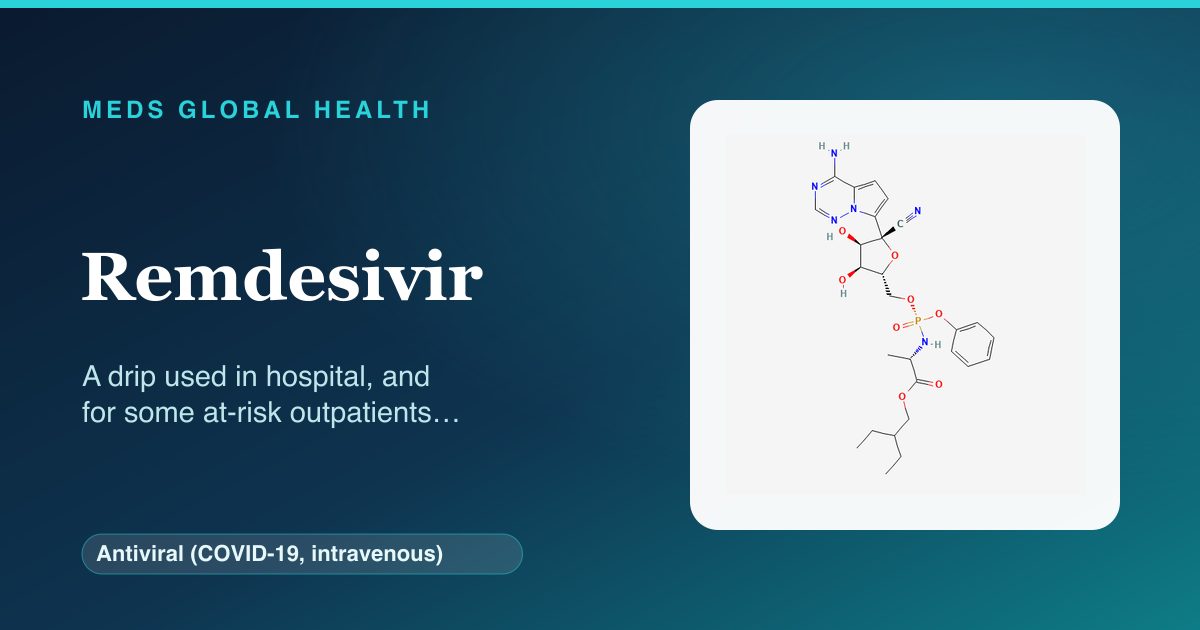
What it is
Remdesivir is an antiviral medicine used to treat COVID-19, the illness caused by the coronavirus. It is given as a drip into a vein, usually over a short course of days. It is used for people in hospital with COVID-19 and, in certain situations, for at-risk people in the community who are not in hospital, to reduce the chance of becoming seriously unwell. It works best when started early, soon after symptoms begin. The brand name is Veklury.
How it works
Remdesivir is taken up by cells and converted into an active form that interferes with the enzyme the coronavirus uses to copy its genetic material. By blocking this step, it slows the virus from multiplying, which can reduce how serious the illness becomes — particularly when it is given early, while the virus is still actively replicating. Later in the illness, when much of the harm comes from the body's own inflammatory response, antivirals like this are less likely to help.
Company & origin
Originated / developed by: Gilead Sciences.
An antiviral given by drip, used in the UK to treat COVID-19 in hospital and in some at-risk people, ideally started early.
Practical use
How to take Remdesivir
General, dose-free guidance — always follow your prescriber's and the leaflet's specific instructions.
- It is given as a drip into a vein by a healthcare team, usually over a short course of days.
- It works best when started early, so it is offered promptly to those who qualify.
- Blood tests may be done before and during treatment to check your liver.
- Tell the team straight away if you feel unwell during the drip, as the rate can be slowed if there is a reaction.
- Mention all your other medicines and conditions, so the team can confirm remdesivir is the right choice for you.
Weighing it up
Advantages & disadvantages of Remdesivir
Advantages
- An effective antiviral for COVID-19 that can reduce the risk of becoming seriously unwell, especially when started early.
- Can be used both in hospital and, in some cases, for at-risk people not in hospital.
- Given as a short course under supervision, so any reactions can be managed quickly.
Disadvantages
- Can only be given as a drip into a vein, not as a tablet at home.
- Can occasionally affect the liver, needing blood-test monitoring.
- Works best early in the illness and is less helpful once given later.
Practical use
Good to know
Remdesivir is most useful when started early in the course of COVID-19, so it is offered promptly to those who qualify. While you are receiving it, blood tests may be done to keep an eye on the liver, as it can occasionally affect liver readings. The drip itself can sometimes cause an infusion reaction, with symptoms such as a change in heart rate, low or high blood pressure, sweating, shivering or a rash, so it is given under supervision and the rate can be slowed if needed. It may be used in pregnancy when the benefit outweighs the risk, guided by a specialist. It is one of several COVID-19 treatments, and your team will choose based on your situation and the timing of your illness.
Who should not take it / use with caution
- People with significant liver problems are assessed carefully, as it can affect the liver.
- It is used with caution in those with reduced kidney function, under specialist guidance.
- Anyone who has had a serious reaction to remdesivir before should not receive it again.
Monitoring
- Liver blood tests before and during treatment.
- Watching for infusion reactions while the drip is running.
- Reviewing kidney function and overall response to treatment.
Side effects
- Nausea and changes in liver blood tests are among the more common effects.
- Infusion reactions, with a change in heart rate, blood pressure, sweating, shivering or a rash.
- Less commonly, rash or headache, and rarely a more serious allergic reaction.
Key interactions
- It can interact with some other medicines, including certain treatments used for the same conditions, so your team checks your list.
- It is generally not combined with some malaria-related medicines that may reduce its effect.
- Liver-affecting medicines may be taken into account when monitoring.
Available as: A drip into a vein, given under healthcare supervision.
Answers
Remdesivir: frequently asked questions
What is remdesivir used for?
It is an antiviral given as a drip to treat COVID-19, used in hospital and in some at-risk people not in hospital, working best when started early.
Why does it need to be started early?
Antivirals work while the virus is still actively multiplying, so remdesivir is most helpful when given soon after symptoms begin.
How is it given?
It is given as a drip into a vein by a healthcare team, usually over a short course of days.
What is an infusion reaction?
It is a reaction during or just after the drip, with symptoms such as a change in heart rate or blood pressure, sweating, shivering or a rash; the team can slow the drip if it happens.
Why are my liver tests checked?
Remdesivir can occasionally affect the liver, so blood tests are done before and during treatment to keep an eye on it.
Authoritative sources
- BNF
- NICE CKS
Building a medicines information resource?
We create evidence-led, dose-free drug and formulary references for teams.