A muscle relaxant for anaesthesia
Rocuronium
A fast-onset muscle relaxant given by an anaesthetist that can be rapidly reversed with sugammadex.
What is Rocuronium?
Rocuronium is a muscle relaxant given only by an anaesthetist during a general anaesthetic. It temporarily paralyses the muscles, including the breathing muscles, so a breathing tube can be placed and the muscles stay still during surgery. You are always asleep first and a machine breathes for you throughout. Rocuronium starts working quickly, and a key advantage is that its effect can be switched off rapidly with a reversal medicine called sugammadex. As with all these drugs, the anaesthetist watches carefully for rare reactions such as severe allergy.
Education and reference only. This is a plain-language guide to Rocuronium — it deliberately contains no doses. Doses depend on the person, the brand and the reason for treatment, and belong with your prescriber. Always check the BNF, the product labelling (SmPC) and follow medical advice.
What it is
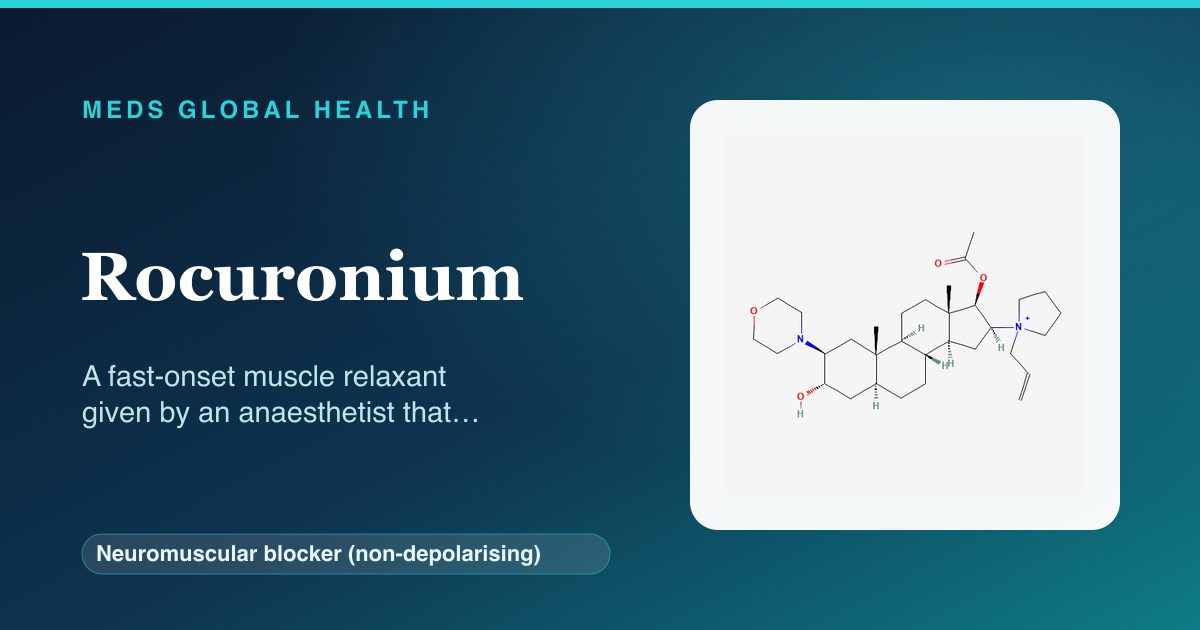
Rocuronium is a non-depolarising muscle relaxant used during general anaesthesia. It temporarily relaxes the muscles so the anaesthetist can place a breathing tube and keep the muscles still for surgery. It is known for starting to work quite quickly, and when a rapid effect is needed it can be used in a way that is followed, if necessary, by quick reversal with sugammadex. It is given as an injection into a vein by an anaesthetist, only once you are asleep and your breathing is supported by a machine.
How it works
Rocuronium works at the junction between nerves and muscles, where it blocks the signal that tells muscles to contract, so the muscles relax. Unlike suxamethonium it does not cause initial twitching. The block lasts for an intermediate length of time and is monitored with a nerve monitor; at the end of surgery it wears off naturally or can be reversed with a medicine. Throughout, a machine breathes for you while the muscles are relaxed.
Company & origin
A fast-onset muscle relaxant used in the UK by anaesthetists during general anaesthesia, with the advantage that its effect can be reversed quickly.
Practical use
How to take Rocuronium
General, dose-free guidance — always follow your prescriber's and the leaflet's specific instructions.
- This medicine is given only by an anaesthetist as an injection into a vein, never taken at home.
- You will always be fully asleep under general anaesthetic before it is given.
- A breathing tube is placed and a machine breathes for you while the muscles are relaxed.
- The anaesthetist monitors the block and, at the end, lets it wear off or reverses it, sometimes with sugammadex.
- Tell your anaesthetist beforehand about any previous reaction to anaesthetics or muscle relaxants.
Weighing it up
Advantages & disadvantages of Rocuronium
Advantages
- Starts working quickly, which helps when the airway needs to be secured promptly.
- Its effect can be reversed rapidly and reliably with sugammadex when needed.
- A widely used, well-understood option with a predictable, intermediate duration.
Disadvantages
- Like all muscle relaxants, it can rarely cause a severe allergic reaction.
- It must always be used with a breathing machine and close monitoring by an anaesthetist.
- Its duration is longer than suxamethonium, so it is less suited to when only a few minutes of relaxation are wanted.
Practical use
Good to know
You are always fully asleep before rocuronium is given, and a machine breathes for you the whole time, so you never experience being paralysed. A particular advantage of rocuronium is that, when a fast effect is needed, the block can be reversed quickly and reliably with sugammadex if the situation requires it. Like all muscle relaxants, the block is checked with a nerve monitor and reversed or allowed to wear off at the end. The main rare risk to be aware of is a severe allergic reaction (anaphylaxis), which the anaesthetic team is trained to recognise and treat immediately. As with all these medicines, malignant hyperthermia and severe allergy are the key emergencies the team watches for.
Who should not take it / use with caution
- People who have had a severe allergic reaction to rocuronium or similar muscle relaxants should not be given it.
- It is used with care in people with certain muscle or nerve conditions, guided by the anaesthetist.
- Any decision is made by the anaesthetist after reviewing your health and previous anaesthetics.
Monitoring
- Continuous monitoring of breathing, oxygen, heart rate and blood pressure throughout.
- A nerve monitor is used to check the depth and recovery of muscle relaxation.
- The team watches closely for any sign of a severe allergic reaction.
Side effects
- Most effects are part of the intended muscle relaxation, managed by the anaesthetist.
- A temporary rise or fall in heart rate or blood pressure in some people.
- Rarely, a severe allergic reaction, which the team is trained to treat immediately.
Key interactions
- Some antibiotics and other anaesthetic drugs can lengthen or change its effect.
- Sugammadex is used specifically to reverse it, switching off the block quickly.
- The anaesthetist manages all interactions directly in the operating theatre.
Available as: Injection into a vein, given only by an anaesthetist in hospital.
Answers
Rocuronium: frequently asked questions
Will I feel paralysed while it works?
No. You are always fully asleep under general anaesthetic before rocuronium is given, and a machine breathes for you, so you are not aware of being paralysed.
What is the advantage of rocuronium?
It starts working quickly and, importantly, its effect can be reversed rapidly and reliably with a medicine called sugammadex if needed.
How is the muscle relaxation reversed?
At the end of surgery the block wears off naturally or can be switched off with sugammadex, which wraps around rocuronium to end its effect quickly.
Is it safe?
It is widely used and well understood; the main rare risk is a severe allergic reaction, which the anaesthetic team is trained to recognise and treat at once.
Will I be able to breathe on my own afterwards?
Yes. The block is monitored and only allowed to wear off, or is reversed, once it is safe; your own breathing returns and is checked before the tube is removed.
Authoritative sources
- BNF
- NICE CKS
Building a medicines information resource?
We create evidence-led, dose-free drug and formulary references for teams.